
Close Menu
    Facebook X (Twitter) Instagram
    SciTechDaily
    • Biology
    • Chemistry
    • Earth
    • Health
    • Physics
    • Science
    • Space
    • Technology
    Facebook X (Twitter) Pinterest YouTube RSS
    SciTechDaily
    Home»Space»Reflections of Starlight Captured by Hubble Space Telescope
    Space

    Reflections of Starlight Captured by Hubble Space Telescope

    By NASADecember 22, 2021No Comments2 Mins Read
    Facebook Twitter Pinterest Telegram LinkedIn WhatsApp Email Reddit
    Share
    Facebook Twitter LinkedIn Pinterest Telegram Email Reddit
    Reflections of Starlight IC 2631
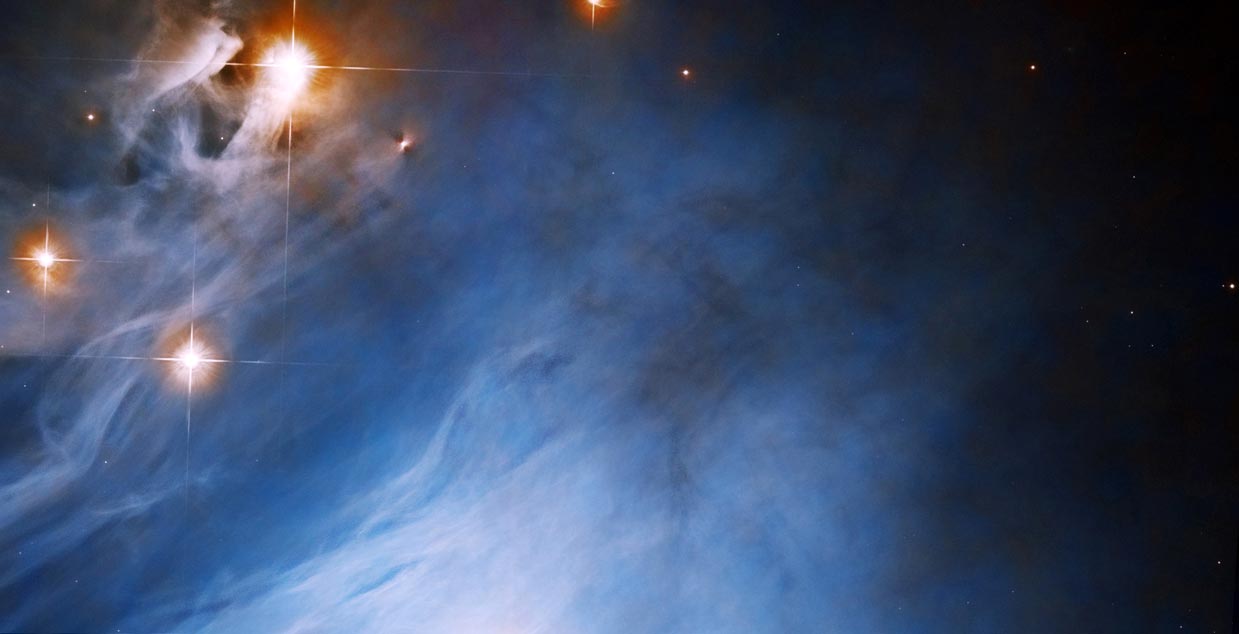
    This Hubble Space Telescope image captures a portion of the reflection nebula IC 2631, which contains a protostar, the hot, dense core of a forming star that is accumulating gas and dust. Credit: NASA, ESA, and K. Stapelfeldt (Jet Propulsion Laboratory); Processing; Gladys Kober (NASA/Catholic University of America)

    Hubble’s latest view of IC 2631 reveals a reflection nebula illuminated by a protostar, the dense, hot core of a star still gathering material.

    This Hubble Space Telescope image captures a portion of the reflection nebula IC 2631, which contains a protostar, the hot, dense core of a forming star that is accumulating gas and dust. Eventually, the protostar may gravitationally gather enough matter to begin nuclear fusion and emit its own energy and starlight.

    Reflection nebulae are clouds of gas and dust that reflect the light from nearby stars. The starlight scatters through the gas and dust like a flashlight beam shining on mist in the dark and illuminating it. Because of the way light scatters when it hits the fine dust of the interstellar medium, these nebulae are often bluish in color.

    Hubble observed this nebula while looking for disks of gas and dust around young stars. Such disks are left over from the formation of the star and may eventually form planets.

    Never miss a breakthrough: Join the SciTechDaily newsletter.
    Follow us on Google and Google News.

    Astronomy Hubble Space Telescope NASA
    Share. Facebook Twitter Pinterest LinkedIn Email Reddit

    Related Articles

    Hubble Reveals a Star Disk Three Times Hotter Than the Sun’s Surface

    A Star’s Unexpected Heatwave: FU Orionis Challenges Astrophysics Models

    NASA’s Hubble Reveals How the LMC Defied Galactic Destruction

    Legendary Star’s Smooth Disk Mystifies Astronomers, Challenges Planet Formation Theories

    Cosmic Horror Unveiled: NASA Reveals “Blood-Soaked Eyes” Staring From Deep Space [Video]

    Spanning 248 Billion Miles: Stunning Hubble Timelapse Captures a Star’s Violent Eruptions

    Jupiter’s Great Red Spot Enigma: Unexplained Oscillations Baffle Astronomers

    Unlocking Uranus: NASA’s Dual Observations Pave the Way to Discovering New Worlds

    Astronomers Baffled by Black Hole Jets Igniting Star Explosions

    Leave A Reply Cancel Reply

    • Facebook
    • Twitter
    • Pinterest
    • YouTube

    Don't Miss a Discovery

    Subscribe for the Latest in Science & Tech!

    Trending News

    Sitting Up Straight Could Actually Help You Make Better Decisions

    Never-Before-Seen Vortices Are Swirling Across the Sun

    This Common Amino Acid May Help the Body Fight Cancer and Viruses

    Low-Protein “Longevity Diet” Linked to Fat Loss, Muscle Preservation, and Healthy Aging

    How Prehistoric Poop Changed Earth’s Ecosystems Forever

    This Fossil Upends a Decades-Old Debate About Snake Evolution

    A Blood Test Years Before Cancer May Reveal a Hidden Warning Sign

    Starlink Satellites Reveal a Hidden Atmosphere 300 Miles Above Earth

    Follow SciTechDaily
    • Facebook
    • Twitter
    • YouTube
    • Pinterest
    • Newsletter
    • RSS
    SciTech News
    • Biology News
    • Chemistry News
    • Earth News
    • Health News
    • Physics News
    • Science News
    • Space News
    • Technology News
    Recent Posts
    • A Simple Feeding Change Makes Zoo Lions Behave More Like They Do in the Wild
    • Scientists Discover a Hidden World of Fungi 1,640 Feet Beneath Michigan
    • Where Were All the Tiny Dinosaurs? Scientists May Finally Have an Answer
    • Astronomers Caught a Star Exploding Almost the Instant It Began
    • Empty Space May Not Be Empty After All: Magnetar Reveals a Bizarre Quantum Effect
    Copyright © 1998 - 2026 SciTechDaily. All Rights Reserved.
    • Science News
    • About
    • Contact
    • Editorial Board
    • Privacy Policy
    • Terms of Use

    Type above and press Enter to search. Press Esc to cancel.