
Close Menu
    Facebook X (Twitter) Instagram
    SciTechDaily
    • Biology
    • Chemistry
    • Earth
    • Health
    • Physics
    • Science
    • Space
    • Technology
    Facebook X (Twitter) Pinterest YouTube RSS
    SciTechDaily
    Home»Science»Regenerative Electronic Biosensors
    Science

    Regenerative Electronic Biosensors

    By Yale UniversityJune 24, 20131 Comment2 Mins Read
    Facebook Twitter Pinterest Telegram LinkedIn WhatsApp Email Reddit
    Share
    Facebook Twitter LinkedIn Pinterest Telegram Email Reddit
    Scientists Develop Electronic Biosensors That Can Be Regenerated and Reused Repeatedly
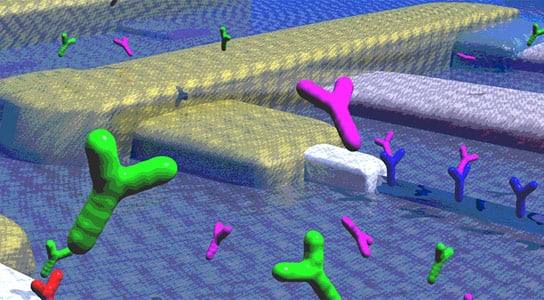
    Scientists develop reusable electronic biosensors. Credit: Yale University

    In a newly published study, scientists detail the development of electronic biosensors that can be regenerated and reused repeatedly.

    Imagine a swarm of tiny devices only a few hundred nanometers in size that can detect trace amounts of toxins in a water supply or the very earliest signs of cancer in the blood. Now imagine that these tiny sensors can reset themselves, allowing for repeated use over time inside a body of water – or a human body.

    Improving nanodevice biosensors is the goal of Mark Reed, Harold Hodgkinson Professor of Electrical Engineering at the Yale School of Engineering & Applied Science. Reed and his colleagues have reported a recent breakthrough in designing electronic biosensors that can be regenerated and reused repeatedly.

    Biosensors are used to detect and measure toxins in the environment; in the body they can identify chemical biomarkers that signal cancer and disease states by detecting changes at the molecular level. Reed’s lab has created biosensors using silicon nanowires configured as tiny transistors that are exponentially more sensitive than current sensing technology, in addition to being cheaper and easier to use.

    Reed’s latest research, published in the journal ACS Nano, outlines a method to add a layer of molecules to the surface of the biosensor that can be chemically regenerated, allowing for reuse. The ability to recharge nanodevice biosensors makes them more useful for applications like the remote monitoring of toxins or biothreats.

    Co-authors on the paper are Xuexin Duan, Nitin K. Rajan, David A. Routenberg, and Jurriaan Huskens.

    In addition to pollution and toxin detection, nanodevice biosensor technology has the potential to transform health care, enabling the diagnosis of diseases long before they can be detected by current methods and allowing for much earlier intervention and treatment.

    “The conventional wisdom was that these sensors could not be reused and it’s been one of the grand challenges of the field,” Reed said. “This discovery is exciting in that this technology has the potential to make real improvements in applications like cancer diagnosis, drug screening and pollution detection.”

    Reference: “Regenerative Electronic Biosensors Using Supramolecular Approaches” by Xuexin Duan, Nitin K. Rajan, David A. Routenberg, Jurriaan Huskens and Mark A. Reed, 8 April 2013, ACS Nano.
    DOI: 10.1021/nn306034f


    Never miss a breakthrough: Join the SciTechDaily newsletter.
    Follow us on Google and Google News.

    Biomedical Engineering Bionanotechnology Biosensor Nanotechnology Yale University
    Share. Facebook Twitter Pinterest LinkedIn Email Reddit

    Related Articles

    Yale Develops New Gene Editing Strategy to Correct Mutations

    Nanoscale Cage Allows Before-and-After Sequencing of DNA Strand

    Drug-Loaded Nanoparticles Offer New Approach to Treating Brain Cancer

    Nanogels Provide a New Way to Attack Lupus

    Magnetic Nanoparticles Control Thousands of Cells Simultaneously

    Designing Biomaterials Both High in Rigidity and Bioactivity

    Nanoparticle Delivers a Combination of Therapeutic Agents to Tumor Sites

    Nanoparticle-Based System Advances Stem Cell Culture Techniques

    Researchers Study the Use of Photosystem-I as Photovoltaic Panels

    1 Comment

    1. C. Peter O'Connor on June 24, 2013 12:29 pm

      This is great news! The developments in nano technology and other branches of science are now moving forward at a phenomenal rate. It’s just a great pity there is nobody around with the common decency or professionalism to give me the credit I deserve for my part in pointing the way..

      The fact is, without my restructuring of all the sub-atomic particles, as deposited with the academia two years ago, none of what is taking place now would be possible.

      Reply
    Leave A Reply Cancel Reply

    • Facebook
    • Twitter
    • Pinterest
    • YouTube

    Don't Miss a Discovery

    Subscribe for the Latest in Science & Tech!

    Trending News

    Largest-Ever Study Finds Medicinal Cannabis Ineffective for Anxiety, Depression, PTSD

    250-Million-Year-Old Egg Solves One of Evolution’s Biggest Mysteries

    Living With Roommates Might Be Changing Your Gut Microbiome Without You Knowing

    Century-Old Cleaning Chemical Linked to 500% Increased Risk of Parkinson’s Disease

    What if Your Memories Never Happened? Physicists Take a New Look at the Boltzmann Brain Paradox

    One of the Universe’s Largest Stars May Be Getting Ready To Explode

    Scientists Discover Enzyme That Could Supercharge Ozempic-Like Weight Loss Drugs

    Popular Sweetener Linked to DNA Damage – “It’s Something You Should Not Be Eating”

    Follow SciTechDaily
    • Facebook
    • Twitter
    • YouTube
    • Pinterest
    • Newsletter
    • RSS
    SciTech News
    • Biology News
    • Chemistry News
    • Earth News
    • Health News
    • Physics News
    • Science News
    • Space News
    • Technology News
    Recent Posts
    • The Surprising Diet Rule That Makes “Good” Parasites Work
    • This Simple Blood Test Could Outperform “Bad Cholesterol” in Preventing Heart Disease
    • Scientists Uncover Potential Brain Risks of Popular Fish Oil Supplements
    • Scientists Prove There Are Just Six Degrees of Separation in a Social Network
    • Bee Bacteria Could Fix a Major Flaw in Plant-Based Milk
    Copyright © 1998 - 2026 SciTechDaily. All Rights Reserved.
    • Science News
    • About
    • Contact
    • Editorial Board
    • Privacy Policy
    • Terms of Use

    Type above and press Enter to search. Press Esc to cancel.