
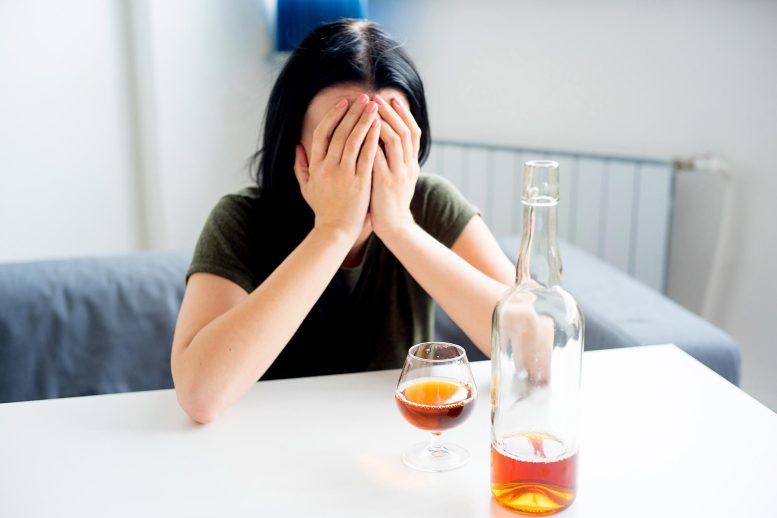
New research has found that drinking alone as an adolescent and young adult can increase the risk of alcohol use disorder later in life, especially for women.
A new study found that drinking alone during adolescence and young adulthood strongly increases the risk for alcohol use disorder (AUD) later in life. This risk is especially high for women. The results of the research from Carnegie Mellon University (CMU) are available in the July issue of the journal Drug and Alcohol Dependence.
“Most young people who drink do it with others in social settings, but a substantial minority of young people are drinking alone. Solitary drinking is a unique and robust risk factor for future alcohol use disorder,” said Kasey Creswell, associate professor of psychology at CMU and lead author. “Even after we account for well-known risk factors, like binge drinking, frequency of alcohol use, socioeconomic status, and gender, we see a strong signal that drinking alone as a young person predicts alcohol problems in adulthood.”
“With concurrent increases in pandemic-related depression and anxiety, we may very well see an increase in alcohol problems among the nation’s youth.” Kasey Creswell
Excessive alcohol use is a global burden, contributing to an estimated 3 million deaths worldwide each year. Although doctors often screen young people for risky alcohol use, their questions have typically focused on the frequency and quantity of alcohol consumed. Creswell believes the social context in which young people drink is a crucial but often overlooked indicator of future alcohol misuse.
Creswell joined Yvonne Terry-McElrath and Megan Patrick at the University of Michigan to analyze data from the Monitoring the Future study, an ongoing epidemiological study of drug and alcohol use among American youth followed into adulthood. Approximately 4,500 adolescents (age 18) responded to surveys asking about their patterns of alcohol use and whether they consumed alcohol while alone. These participants were then followed for 17 years, providing information about their alcohol use and drinking alone in young adulthood (ages 23/24) and reporting AUD symptoms in adulthood (age 35).
Increased Risk for Adolescents and Young Adults
According to the results, adolescents and young adults who reported drinking alone were at an increased risk for developing AUD symptoms in adulthood compared to their peers who only drank in social settings. The researchers controlled for a host of well-established early risk factors for alcohol problems, such as binge drinking and frequent drinking. They found the odds of having AUD symptoms at age 35 were 35% higher for adolescents who drank alone, and 60% higher for young adults who drank alone, compared to social-only drinkers. Adolescent females who drank alone appeared to be at particular risk for developing future alcohol problems in adulthood.
About 25% of adolescents and 40% of young adults reported drinking alone. These findings suggest that targeted interventions may be helpful to educate and inform these groups, especially young women, of the risks of solitary drinking to prevent the development of AUD in the future.
Previous work by Creswell and others has shown that young people drink alone as a way to cope with negative emotions, which is a pattern of alcohol use that has been consistently linked to the development of alcohol problems. Creswell noted that the pandemic has increased solitary drinking among young people.
“With concurrent increases in pandemic-related depression and anxiety, we may very well see an increase in alcohol problems among the nation’s youth,” Creswell said.
Reference: “Solitary alcohol use in adolescence predicts alcohol problems in adulthood: A 17-year longitudinal study in a large national sample of US high school students” by Kasey G. Creswell, Yvonne M. Terry-McElrath and Megan E. Patrick, 11 July 2022, Drug and Alcohol Dependence.
DOI: 10.1016/j.drugalcdep.2022.109552
Funding: National Institute on Drug Abuse, National Institute on Alcohol Abuse and Alcoholism
Never miss a breakthrough: Join the SciTechDaily newsletter.
Follow us on Google and Google News.