
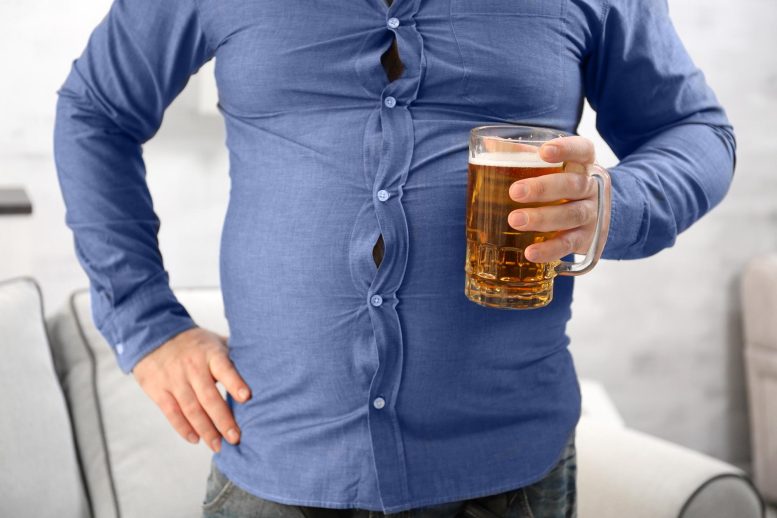
UK analysis of nearly 400,000 adults suggests overweight and obesity amplifies the harmful effects of alcohol on cancer risk, particularly in those with a high body fat percentage.
According to new research being presented at this year’s European Congress on Obesity (ECO) in Maastricht, Netherlands (May 4-7, 2022), being overweight or having obesity can exacerbate the harmful effects of alcohol on the risk of developing alcohol-related cancer, especially in people with a high body fat percentage.
Importantly, regardless of alcohol usage, the data revealed a dose-response association between increased obesity levels and the chance of getting obesity-related cancers.
The research, by Dr. Elif Inan-Eroglu from The University of Sydney, Australia, and colleagues, is the first study to look at obesity (body fat percentage, waist circumference and body mass index [BMI]) and alcohol consumption together, in relation to all the cancers that are known to be influenced by alcohol and obesity.
Dose-Response Relationship Between Obesity and Cancer Risk
The researchers say that current guidelines do not reflect the degree of cancer risk from the combined effects of alcohol and obesity and underscore the need to increase public awareness.
“Our results suggest that people with obesity, especially those with excess body fat, need to be more aware of the risks around alcohol consumption,” says Dr. Inan-Eroglu. “With around 650 million adults living with obesity worldwide, this is a hugely important issue. When it comes to the lifestyle factors and habits that people can change to reduce their risk of cancer, obesity and alcohol are top of the list.”
The Global Impact of Alcohol and Obesity on Cancer
Worldwide, 4% (741,300) of new cancer cases in 2020 were linked to alcohol consumption,[1] and overweight and obesity are linked with a higher risk of 13 types of cancer that account for over 40% of all these cancers diagnosed in the USA.[2] However, estimates suggest that more than half of cancers are potentially preventable—with alcohol the third leading preventable cause of cancer behind tobacco and obesity.
For this study, researchers combined data from 399,575 participants (aged 40-69 years; 55% female) from the UK Biobank prospective cohort, who were cancer free when the study began, and followed for an average of 12 years. Cancers were identified from hospital admissions and cancer registry data.
Participants were divided into three groups according to their body fat percentage, waist circumference, and BMI),[3] and classified according to their self-reported alcohol consumption based on UK guidelines (never, previous, within guidelines [14 units or less of alcohol/week] and above guideline drinkers [more than 14 units/week]) to examine the joint association of alcohol consumption and obesity with the risk of 21 different types of cancer (13 obesity-related and eight alcohol-related cancers.[4]
The results were adjusted for factors that might affect the findings including age, sex, diet, education level, physical activity, smoking status, sleep duration, socioeconomic status, and existing cardiovascular disease or type 2 diabetes.
Over an average follow-up of 12 years, 17,617 participants were diagnosed with alcohol-related cancer and 20,214 developed obesity-related cancer.
Increased Risk of Alcohol- and Obesity-Related Cancers
The researchers found that across all obesity markers, people with higher body fat percentage levels who drank more than the recommended guidelines, were at greater risk of cancer.
For example, people in the highest body fat percentage tertile who drank within the recommended alcohol guidelines were 53% more likely to develop alcohol-related cancers than those with the lowest body fat percentage who never drank; while those who drank above alcohol guidelines were at 61% greater risk.
Regardless of alcohol intake, the analysis identified a dose-response relationship between larger waist circumference and risk of developing obesity-related cancer. For example, people with bigger waistlines who drank more than the recommended alcohol guidelines had a 17% greater risk of developing obesity-related cancer compared to those with a healthy waistline who never drank; while in people with the largest waistlines who drank above alcohol guidelines the risk was 28% higher.
“Further research is needed to better understand the underlying mechanisms behind this joint effect of alcohol intake and obesity on cancer risk”, says Dr Inan-Eroglu. “Alcohol drinking guidelines need to acknowledge that two-thirds of the UK adult population are overweight or obese and consider specific recommendations to increase public awareness of the link between alcohol and cancer risk in this group. From a cancer-prevention standpoint, the safest level of alcohol consumption is total avoidance.”
Despite the important findings, the authors acknowledge that this is an observational study and is not based on a representative sample of the UK adult population. In addition, they note that the study relied on self-reported alcohol intake which may lead to underreporting and make affect the conclusions that can be drawn.
References:
- “Global burden of cancer in 2020 attributable to alcohol consumption: a population-based study” by Harriet Rumgay, BSc; Kevin Shield, PhD; Hadrien Charvat, PhD; Pietro Ferrari, PhD; Bundit Sornpaisarn, PhD; Prof Isidore Obot, PhD; Farhad Islami, PhD; Prof Valery E P P Lemmens, PhD; Prof Jürgen Rehm, PhD and Isabelle Soerjomataram, PhD, 13 July 2021, The Lancet Oncology.
DOI: 10.1016/S1470-2045(21)00279-5 - Obesity and Cancer | CDC
- Overweight is defined as a BMI of 25.0 to 29.9 and obesity as a BMI of 30 or more. For waist circumference: normal (<80 cm for women, <94 cm for men), overweight (>80 cm for women, >94 cm for men), and obese (>88 cm for women, >102 cm for men). For body fat percentage (BF%): tertile 1, 27.8% for women, >39.8% for men; tertile 2: 23.1- 27.8% for women, 33.9-39.8 for men; tertile 3: >27.8% for women, >39.8% for men.
- Eight alcohol-related cancers (oral cavity, throat, larynx, oesophagus, liver, colorectal, stomach, and female breast) and 13 obesity-related cancers (meningioma, multiple myeloma, adenocarcinoma of the oesophagus, and cancers of the thyroid, postmenopausal breast, gallbladder, stomach, liver, pancreas, kidney, ovaries, uterus, colorectal.
This work was supported by an Australian National Health and Medical Research Council Investigator Grant (APP1194510).
Never miss a breakthrough: Join the SciTechDaily newsletter.
Follow us on Google and Google News.