
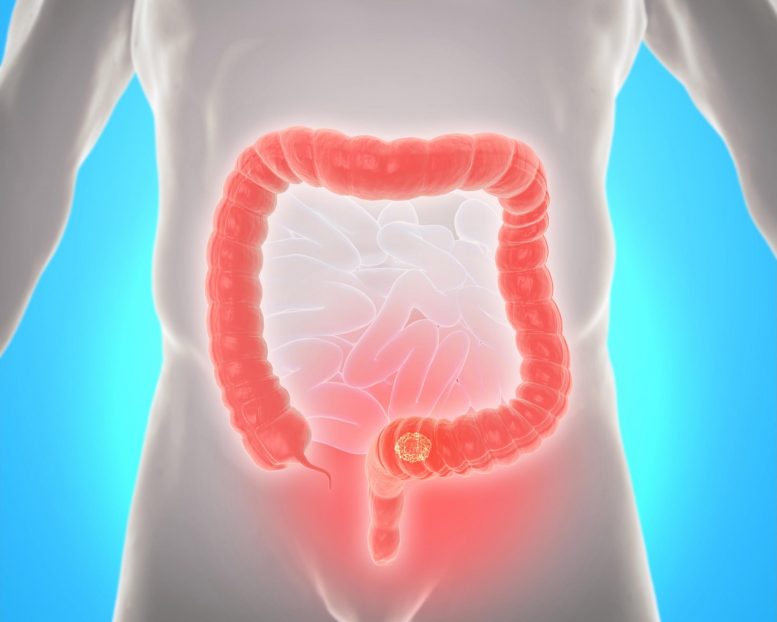
Alarming Rise in Young-Onset Colorectal Cancer
A new paper in JNCI Cancer Spectrum, published by Oxford University Press, indicates that several non-genetic factors — including greater red meat intake, lower educational attainment, and heavier alcohol use — are associated with an increase in colorectal cancer in people under 50.
In the United States, incidence rates of early-onset colorectal cancer have nearly doubled between 1992 and 2013 (from 8.6 to 13.1 per 100,000), with most of this increase due to early-onset cancers of the rectum. Approximately 1 in 10 diagnoses of colorectal cancer in this country occur in people under 50.
Researchers have observed the rise particularly among people born since the 1960s in studies from the United States, Canada, Australia, and Japan. During the same period there have been major changes in diets among younger generations across the developing world. Such changes include decreases in consumption of fruits, non-potato vegetables, and calcium-rich dairy sources. This is coupled with an increase in processed foods (e.g., meats, pizza, macaroni, and cheese, etc.) and soft drinks. Average nutrient intakes of fiber, folate, and calcium among the U.S. population are also lower than recommended.
The increase in early onset colorectal cancer is concerning to researchers because these cancers often have worse outcomes than those diagnosed in older people. It has led to recommendations that colorectal cancer screening begin at younger ages.
Known and Emerging Risk Factors
Previous research has outlined potential risk factors for early-onset colorectal cancer including greater consumption of processed meat, reduced consumption of vegetables and citrus fruit, greater body mass index, sedentary lifestyles, greater alcohol use, smoking, reduced aspirin use, and diabetes. However, researchers have yet to perform a comprehensive, large-scale evaluation that compares the magnitude of these risks with those for late-onset colorectal cancer and assesses whether the risks for early-onset colorectal cancer correlate with specific types of colorectal cancer.
Using data pooled from 13 population-based studies, researchers here studied 3,767 colorectal cancer cases and 4,049 controls in people under 50 and 23,437 colorectal cancer cases and 35,311 controls in people 50 or above years.
Early-onset colorectal cancer was associated with not regularly using aspirins, greater red meat intake, lower educational attainment, heavier alcohol use, and (interestingly enough) also alcohol abstinence. Researchers also found that lower total fiber intake was linked more strongly to rectal than colon cancer.
Several other colorectal cancer risk factors trended toward an association with early-onset colorectal cancer, including history of diabetes and lower folate, dietary fiber, and calcium intake. However, neither BMI nor smoking were risk factors in the early-onset group, in contrast to the late-onset group.
According to Richard Hayes, the senior investigator for this research: “this first large-scale study of non-genetic risk factors for early-onset colorectal cancer is providing the initial basis for targeted identification of those most at risk, which is imperative in mitigating the rising burden of this disease.”
Reference: “Nongenetic Determinants of Risk for Early-Onset Colorectal Cancer” by Alexi N Archambault, MPH; Yi Lin, MS; Jihyoun Jeon, PhD, MS; Tabitha A Harrison, MPH; D Timothy Bishop, PhD, MSc; Hermann Brenner, MD, MPH; Graham Casey, PhD; Andrew T Chan, MD, MPH; Jenny Chang-Claude, PhD; Jane C Figueiredo, PhD; Steven Gallinger, MD, MSc; Stephen B Gruber, MD, PhD; Marc J Gunter, PhD; Michael Hoffmeister, PhD; Mark A Jenkins, PhD; Temitope O Keku, PhD, MSPH, MSc; Loïc Le Marchand, MD, PhD; Li Li, MD, PhD; Victor Moreno, PhD; Polly A Newcomb, PhD, MPH; Rish Pai, MD, PhD; Patrick S Parfrey, MD; Gad Rennert, MD, PhD; Lori C Sakoda, PhD; Robert S Sandler, MD, MPH; Martha L Slattery, PhD; Mingyang Song, ScD, MS; Aung Ko Win, PhD, MPH; Michael O Woods, PhD; Neil Murphy, PhD; Peter T Campbell, PhD, MSc; Yu-Ru Su, PhD, MS; Anne Zeleniuch-Jacquotte, MD, MS; Peter S Liang, MD, MPH; Mengmeng Du, ScD; Li Hsu, PhD; Ulrike Peters, PhD, MPH and Richard B Hayes, PhD, MPH, DDS, 20 May 2021, JNCI Cancer Spectrum.
DOI: 10.1093/jncics/pkab029
This work was funded by the National Cancer Institute under R03-CA215775-02, awarded to Dr Richard Hayes, and through the Genetics and Epidemiology of Colorectal Cancer Consortium (GECCO) funded by the National Cancer Institute, National Institutes of Health, US Department of Health and Human Services (U01 CA164930, R01 CA201407), awarded to Dr Ulrike Peters. This research was funded in part through the NIH/NCI Cancer Center Support Grant P30 CA015704 and training grant T32HS026120, from the Agency for Healthcare Research and Quality. The Colon Cancer Family Registry (CCFR, www.coloncfr.org) is supported in part by funding from the National Cancer Institute (NCI), National Institutes of Health (NIH) (award U01 CA167551). The CCFR Set-1 (Illumina 1M/1M-Duo) and Set-2 (Illumina Omni1-Quad) scans were supported by NIH awards U01 CA122839 and R01 CA143247 (to GC). The CCFR Set-3 (Affymetrix Axiom CORECT Set array) was supported by NIH award U19 CA148107 and R01 CA81488 (to SBG). The CCFR Set-4 (Illumina OncoArray 600K SNP array) was supported by NIH award U19 CA148107 (to SBG) and by the Center for Table 3.
Never miss a breakthrough: Join the SciTechDaily newsletter.
Follow us on Google and Google News.
12 Comments
A comprehensive large scale analysis? What does that prove? I can assure you red meat isn’t to blame. Do they mention that most people eat meat with fries cooked in oxidized plant oils which are toxic to humans? Does it talk about soda consumption or processed foods that are also typically served at a burger joint? Demonizing red meat is only going to make more people sick. Fact is that it’s one of the most nutritious foods on the planet, far moreso than plants, and articles like this are why we have a chronic disease epidemic now.
I wholeheartedly agree
@ Troy J Mylius well put .
Great Troy! Articles like this are muddying the waters of science.
What do doctors learn on the first day of med school. “A patient cured is a customer lost.”
Well said Troy!
What does knowledge of world history have to do with butthole cancer?
red meat wasnot mint to be consumed killing and consuming
another life has rendered the punishment of cancer
for those who defy the laws of life
Red meat is not more nutritional than whole unprocessed vegetables and fruits!! That being said, I believe everything is in moderation. Eat fresh whole meats withe fresh whole vegetables. If the majority of the meat being consumed is “processed” such as deli meats,hot dogs, packaged sausage, etc., then it will have adverse effects on your health.
Thanks for sharing!
Can i comment here??
https://scitechdaily.com/ amazing website!
Reading this post and have knowledge about Colorectal Cancer. Your website is the perfect example of health posts. This will surely help people to understand what exactly is happening in Body. could you write more info about this so I can aware of this cancer problem? But before this, I want to get more info about the Swedish translation services. because I am thinking to create a translation website now