
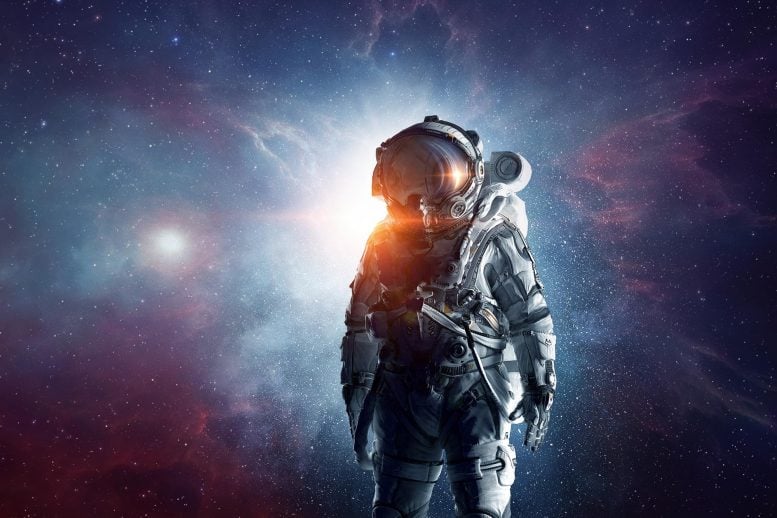
First study of timing of extreme space weather events reveals clear pattern.
Planned missions to return humans to the Moon need to hurry up to avoid hitting one of the busiest periods for extreme space weather, according to scientists conducting the most in-depth ever look at solar storm timing.
Scientists at the University of Reading studied 150 years of space weather data to investigate patterns in the timing of the most extreme events, which can be extremely dangerous to astronauts and satellites, and even disrupt power grids if they arrive at Earth.
The researchers found for the first time that extreme space weather events are more likely to occur early in even-numbered solar cycles, and late in odd-numbered cycles — such as the one just starting. They are also more likely during busy periods of solar activity and in bigger cycles, mirroring the pattern for moderate space weather.
The findings could have implications for the NASA-led Artemis mission, which plans to return humans to the moon in 2024, but which could be delayed to the late 2020s.
Professor Mathew Owens, a space physicist at the University of Reading, said: “Until now, the most extreme space-weather events were thought to be random in their timing and thus little could be done to plan around them.
“However, this research suggests they are more predictable, generally following the same ‘seasons’ of activity as smaller space-weather events. But they also show some important differences during the most active season, which could help us avoid damaging space-weather effects.
“These new findings should allow us to make better space weather forecasts for the solar cycle that is just beginning and will run for the decade or so. It suggests any significant space missions in the years ahead — including returning astronauts to the Moon and later, onto Mars — will be less likely to encounter extreme space-weather events over the first half of the solar cycle than the second.”
Solar Cycle Dynamics
Extreme space weather is driven by huge eruptions of plasma from the Sun, called coronal mass ejections, arriving at Earth, causing a global geomagnetic disturbance.
Previous research has generally focused on how big extreme space weather events can be, based on observations of previous events. Predicting their timing is far more difficult because extreme events are rare, so there is relatively little historical data in which to identify patterns.
In the new study, the scientists used a new method applying statistical modeling to storm timing for the first time. They looked at data from the past 150 years — the longest period of data available for this type of research — recorded by ground-based instruments that measure magnetic fields in the Earth’s atmosphere, located in the UK and Australia.
Solar Cycles and Magnetic Polarity Shifts
The Sun goes through regular 11-year cycles of its magnetic field, which is seen in the number of sunspots on its surface. During this cycle the Sun’s magnetic north and south poles switch places. Each cycle includes a solar maximum period, where solar activity is at its greatest, and a quiet solar minimum phase.
Previous research has shown moderate space weather is more likely during the solar maximum than the period around the solar minimum, and more likely during cycles with a larger peak sunspot number. However, this is the first study that shows the same pattern is also true of extreme events.
The major finding, though, was that extreme space weather events are more likely to occur early in even-numbered solar cycles, and late in odd-numbered cycles, such as cycle 25, which began in December 2019.
The scientists believe this could be because of the orientation of the Sun’s large-scale magnetic field, which flips at solar maximum so it is pointing opposite to Earth’s magnetic field early in even cycles and late in odd cycles. This theory will need more investigation.
Planning Missions with Space Weather in Mind
This new research on space weather timing allows predictions to be made for extreme space weather during solar cycle 25. It could therefore be used to plan the timing of activities that could be affected by extreme space weather, such as power grid maintenance on Earth, satellite operations, or major space missions.
The findings suggest that any major operations planned beyond the next five years will have to make allowances for the higher likelihood of severe space weather late in the current solar cycle between 2026 and 2030.
A major solar eruption in August 1972, between NASA’s Apollo 16 and 17 missions, was strong enough that it could have caused major technical or health problems to astronauts had it occurred while they were en route or around the Moon.
Reference: “Extreme Space-Weather Events and the Solar Cycle” by Mathew J. Owens, Mike Lockwood, Luke A. Barnard, Chris J. Scott, Carl Haines and Allan Macneil, 20 May 2021, Solar Physics.
DOI: 10.1007/s11207-021-01831-3
Funding: Science and Technology Facilities Council (STFC), Natural Environment Research Council (NERC)
Never miss a breakthrough: Join the SciTechDaily newsletter.
Follow us on Google and Google News.