
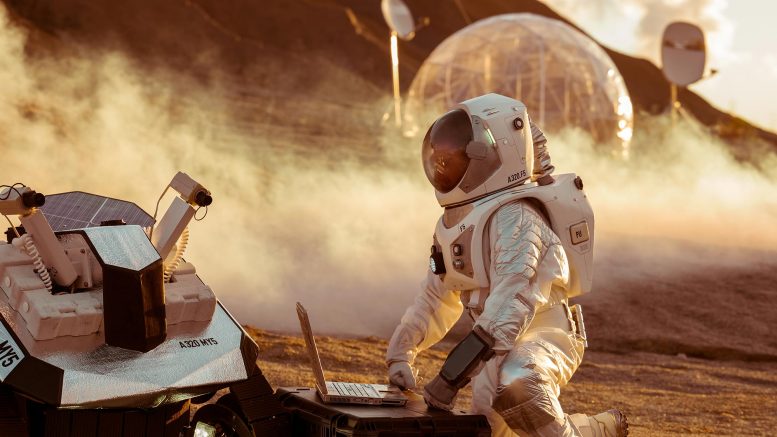
Any permanent human space settlement will require beneficial microbes.
With the recent celebration of the 50th anniversary of the Apollo program’s first landing of humans on the moon, the eyes and hopes of the world turn skyward again.
The romantic notions of exploring and even colonizing space have been rekindled, with the above and more recent movies such as The Martian and the fictional planting of potatoes. The ambitious spirit is further spurred by private space enterprises such as Elon Musk’s SpaceX, Jeff Bezos’ Blue Origins, and the idea that we may need a “Planet B”, as our own planet’s natural habitats become more stressed and the human population exponentially increases.
Jose Lopez, Ph.D., a professor at Nova Southeastern University’s (NSU) Halmos College of Natural Sciences and Oceanography, has now joined the movement with a peer-reviewed scientific opinion article calling for a rational and systematic approach to future space colonization of Mars or other planets. He and colleagues Raquel Peixoto and Alexandre Rosado from Federal University of Rio de Janeiro have just published the scientific opinion paper entitled “Space Colonization Beyond Earth with Microbes First” in the journal FEMS Microbiology Ecology.
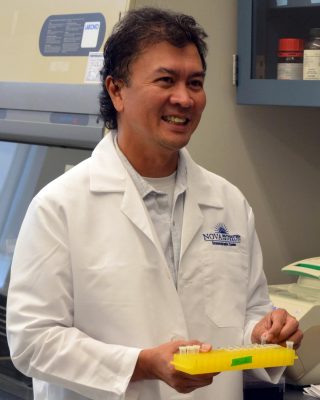
Lopez is a research scientist and claims microbes would be a better immediate investment to successfully colonize the red planet.
“Life as we know it cannot exist without beneficial microorganisms,” he said. “They are here on our planet and help define symbiotic associations — the living together of multiple organisms to create a greater whole. To survive on barren (and as far as all voyages to date tell us) sterile planets, we will have to take beneficial microbes with us. This will take time to prepare, discern and we are not advocating a rush to inoculate, but only after rigorous, systematic research on earth.”
Lopez and colleagues now assert that this rigorous microbial research agenda needs to be implemented for any future successful colonization of Mars. Moreover, microbes should probably supersede current ambitions to send people to Mars or other solar system locales, as they can condition or terraform places we may want to colonize eventually.
In the long run, the effort will save humanity money, can be life-sustaining, and boost microbiological understanding
However, to determine the most useful microbes for space requires a lot more research here on earth. In the publication, the researchers encapsulate this idea into a potential research regime called PIP or “Proactive Inoculation Plan”, which encompasses the screening of potential hardy microbial candidates, toxic or lethal genes, and describing mechanisms for the most productive symbiosis.
“Life on earth started with relatively simple microorganisms which have the capacity to adapt and evolve to extreme conditions, which defined earth’s habitats in the ancient past,” Lopez said. “Cyanobacteria for example provided most of the oxygen we now breathe more than two billion years ago. To find the best microbial candidates, we will have to confer with many microbiologists and carry out research here on our home planet to find the optimal microbial species.”
Reference: “Inevitable future: space colonization beyond Earth with microbes first” by Jose V Lopez, Raquel S Peixoto and Alexandre S Rosado, 22 August 2019, FEMS Microbiology Ecology.
DOI: 10.1093/femsec/fiz127
Never miss a breakthrough: Join the SciTechDaily newsletter.
Follow us on Google and Google News.