
Close Menu
    Facebook X (Twitter) Instagram
    SciTechDaily
    • Biology
    • Chemistry
    • Earth
    • Health
    • Physics
    • Science
    • Space
    • Technology
    Facebook X (Twitter) Pinterest YouTube RSS
    SciTechDaily
    Home»Science»Researchers Create 3D Structures Out of Liquid Metal
    Science

    Researchers Create 3D Structures Out of Liquid Metal

    By Matt Shipman, NC State UniversityJuly 10, 2013No Comments3 Mins Read
    Facebook Twitter Pinterest Telegram LinkedIn WhatsApp Email Reddit
    Share
    Facebook Twitter LinkedIn Pinterest Telegram Email Reddit
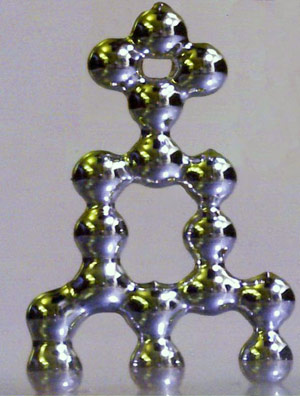
    Researchers Develop 3D Structures with Liquid Metal
    Researchers have developed three-dimensional structures out of liquid metal. Credit: Michael Dickey.

    In a newly published study, engineers from NC State University detail new techniques for creating 3D structures made of liquid metal.

    Researchers from North Carolina State University have developed three-dimensional (3-D) printing technology and techniques to create free-standing structures made of liquid metal at room temperature.

    “It’s difficult to create structures out of liquids, because liquids want to bead up. But we’ve found that a liquid metal alloy of gallium and indium reacts to the oxygen in the air at room temperature to form a ‘skin’ that allows the liquid metal structures to retain their shapes,” says Dr. Michael Dickey, an assistant professor of chemical and biomolecular engineering at NC State and co-author of a paper describing the work.

    The researchers developed multiple techniques for creating these structures, which can be used to connect electronic components in three dimensions. While it is relatively straightforward to pattern the metal “in plane” – meaning all on the same level – these liquid metal structures can also form shapes that reach up or down.

    One technique involves stacking droplets of liquid metal on top of each other, much like a stack of oranges at the supermarket. The droplets adhere to one another, but retain their shape – they do not merge into a single, larger droplet.

    Another technique injects liquid metal into a polymer template, so that the metal takes on a specific shape. The template is then dissolved, leaving the bare, liquid metal in the desired shape. The researchers also developed techniques for creating liquid metal wires, which retain their shape even when held perpendicular to the substrate.

    Dickey’s team is currently exploring how to further develop these techniques, as well as how to use them in various electronics applications and in conjunction with established 3-D printing technologies.

    “I’d also like to note that the work by an undergraduate, Collin Ladd, was indispensable to this project,” Dickey says. “He helped develop the concept, and literally created some of this technology out of spare parts he found himself.”

    The paper, “3-D Printing of Free Standing Liquid Metal Microstructures,” is published online in Advanced Materials. Ladd, a recent NC State graduate, is the lead author. Co-authors are Dickey; former NC State Ph.D. student Dr. Ju-Hee So; and Dr. John Muth, a professor of electrical and computer engineering at NC State.

    The work was supported by a National Science Foundation CAREER award and the National Science Foundation’s ASSIST Engineering Research Center at NC State.

    Reference: “3D Printing of Free Standing Liquid Metal Microstructures” by Collin Ladd, Ju-Hee So, John Muth and Michael D. Dickey, 4 July 2013, Advanced Materials.
    DOI: 10.1002/adma.201301400

    Never miss a breakthrough: Join the SciTechDaily newsletter.
    Follow us on Google and Google News.

    Engineering Materials Science North Carolina State University
    Share. Facebook Twitter Pinterest LinkedIn Email Reddit

    Related Articles

    Scientists Reveal New Insights into the Coupling between Wetting and Catalytic Activity

    Engineers Develop a New Slimmer Design for Invisibility Cloaks

    Controlling Surface Topography with Particle-Enhanced Soft Composites

    Crystal Boundaries Can Enhance, or Reduce, Hydrogen Embrittlement

    Scientists Create Dual-Purpose Film for Energy Storage

    Engineers Create Synthetic Materials That Can Change Colors and Textures

    Materials Scientists Reveal the Power of Hidden Patterns

    Engineers Demonstrate Active Electromagnetic Cloaking

    Researchers Control Water Movement by Varying Surface Stiffness

    Leave A Reply Cancel Reply

    • Facebook
    • Twitter
    • Pinterest
    • YouTube

    Don't Miss a Discovery

    Subscribe for the Latest in Science & Tech!

    Trending News

    Scientists Uncover Potential Brain Risks of Popular Fish Oil Supplements

    Scientists Discover a Surprising Way To Make Bread Healthier and More Nutritious

    After 60 Years, Scientists Uncover Unexpected Brain Effects of Popular Diabetes Drug Metformin

    New Research Uncovers Hidden Side Effects of Popular Weight-Loss Drugs

    Scientists Rethink Extreme Warming After Surprising Ocean Discovery

    Landmark Study Links Never Marrying to Significantly Higher Cancer Risk

    Researchers Discover Unknown Beetle Species Just Steps From Their Lab

    Largest-Ever Study Finds Medicinal Cannabis Ineffective for Anxiety, Depression, PTSD

    Follow SciTechDaily
    • Facebook
    • Twitter
    • YouTube
    • Pinterest
    • Newsletter
    • RSS
    SciTech News
    • Biology News
    • Chemistry News
    • Earth News
    • Health News
    • Physics News
    • Science News
    • Space News
    • Technology News
    Recent Posts
    • Scientists Discover Hidden Pathway Inside Catalysts That Defies Decades of Assumptions
    • Scientists Finally Crack Decades-Old Mystery of “Breathing” Lasers
    • “Like Liquid Metal”: Scientists Create Strange Shape-Shifting Material
    • Early Warning Signals of Esophageal Cancer May Be Hiding in Plain Sight
    • Researchers Have Discovered a THC-Free Cannabis Compound That May Replace Opioids
    Copyright © 1998 - 2026 SciTechDaily. All Rights Reserved.
    • Science News
    • About
    • Contact
    • Editorial Board
    • Privacy Policy
    • Terms of Use

    Type above and press Enter to search. Press Esc to cancel.