
The Use of Highly Dynamic Bistable Soft Actuators Enables Varied Locomotion
Many animals are capable of smoothly transitioning between walking, jumping, crawling, and swimming without requiring extensive adjustments or reconfiguring.
In contrast, most robots can’t. However, researchers at Carnegie Mellon University have developed soft robots that are capable of seamlessly switching between modes of movement, such as from walking to swimming or crawling to rolling.
Soft Robotics: Simple Yet Adaptive
“We were inspired by nature to develop a robot that can perform different tasks and adapt to its environment without adding actuators or complexity,” said Dinesh K. Patel, a post-doctoral fellow in the Morphing Matter Lab in the School of Computer Science’s Human-Computer Interaction Institute. “Our bistable actuator is simple, stable, and durable, and lays the foundation for future work on dynamic, reconfigurable soft robotics.”
The bistable actuator is made of 3D-printed soft rubber containing shape-memory alloy springs that react to electrical currents by contracting, which causes the actuator to bend. The team used this bistable motion to change the actuator or robot’s shape. Once the robot changes shape, it is stable until another electrical charge morphs it back to its previous configuration.
“Matching how animals transition from walking to swimming to crawling to jumping is a grand challenge for bio-inspired and soft robotics,” said Carmel Majidi, a professor in the Mechanical Engineering Department in CMU’s College of Engineering.
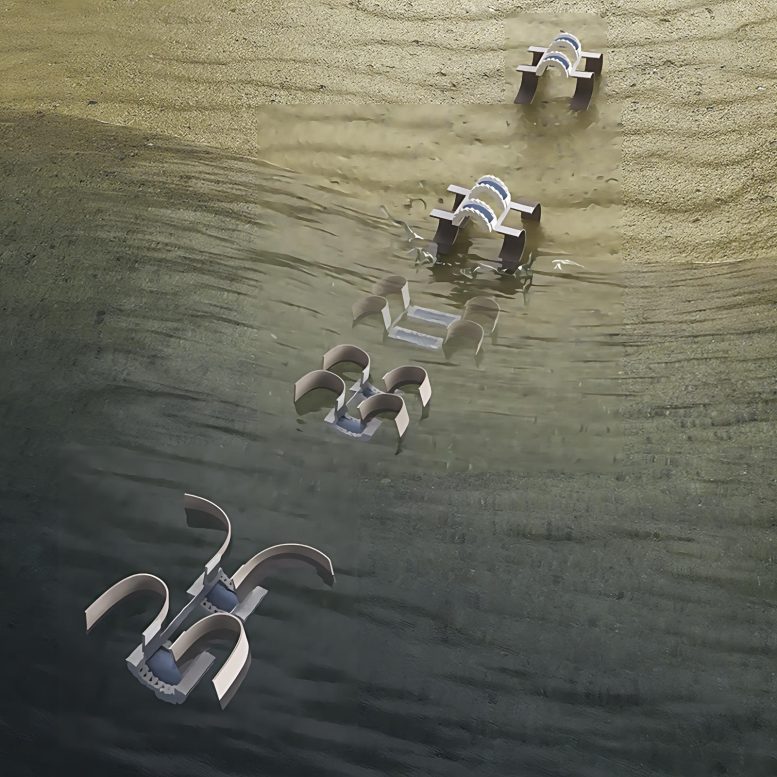
For example, one robot the team created has four curved actuators attached to the corners of a cellphone-sized body made of two bistable actuators. On land, the curved actuators act as legs, allowing the robot to walk. In the water, the bistable actuators change the robot’s shape, putting the curved actuators in an ideal position to act as propellers so it can swim.
“You need to have legs to walk on land, and you need to have a propeller to swim in the water. Building a robot with separate systems designed for each environment adds complexity and weight,” said Xiaonan Huang, an assistant professor of robotics at the University of Michigan and Majidi’s former Ph.D. student. “We use the same system for both environments to create an efficient robot.”
The team created two other robots: one that can crawl and jump, and one inspired by caterpillars and pill bugs that can crawl and roll.
Durable Robots Built for Real-World Challenges
The actuators require only a hundred milliseconds of electrical charge to change their shape, and they are durable. The team had a person ride a bicycle over one of the actuators a few times and changed their robots’ shapes hundreds of times to demonstrate durability.
In the future, the robots could be used in rescue situations or to interact with sea animals or coral. Using heat-activated springs in the actuators could open up applications in environmental monitoring, haptics, and reconfigurable electronics and communication.
“There are many interesting and exciting scenarios where energy-efficient and versatile robots like this could be useful,” said Lining Yao, the Cooper-Siegel Assistant Professor in HCII and head of the Morphing Matter Lab.
Reference: “Highly Dynamic Bistable Soft Actuator for Reconfigurable Multimodal Soft Robots” by Dinesh K. Patel, Xiaonan Huang, Yichi Luo, Mrunmayi Mungekar, M. Khalid Jawed, Lining Yao and Carmel Majidi, 18 November 2022, Advanced Materials Technologies.
DOI: 10.1002/admt.202201259
Never miss a breakthrough: Join the SciTechDaily newsletter.
Follow us on Google and Google News.