
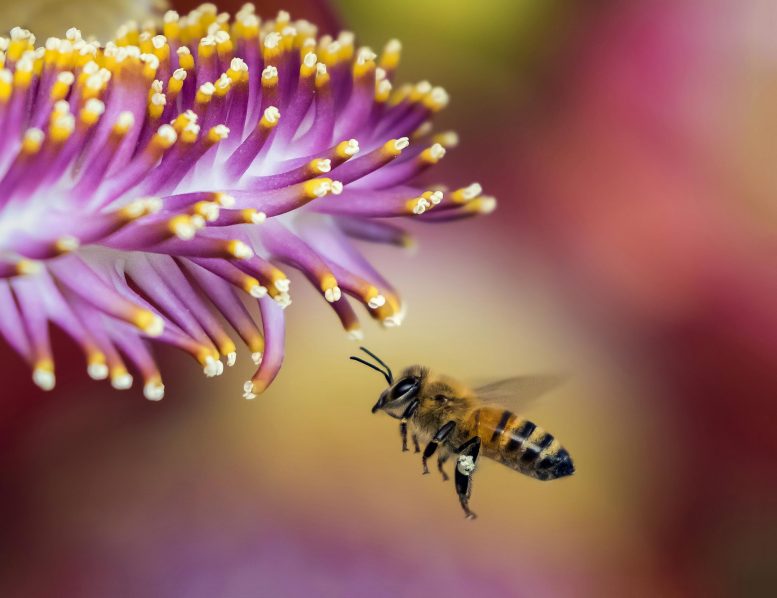
- Researchers at the University of Sheffield’s Institute for Sustainable Food are collaborating with industry to develop a natural, sustainable biocontrol which targets pests without harming honeybees and other beneficial pollinators
- Estimated global crop loss to pests – including insects, plant viruses and fungi – is around $100 billion every year, equating to a 40 percent loss in global agricultural production
- New pesticide alternative could help achieve food security whilst protecting vital pollinators
A natural, sustainable alternative to pesticides that targets specific pests, without harming beneficial pollinators such as honeybees, is being developed with the help of researchers from the Institute for Sustainable Food at the University of Sheffield.
Working in collaboration with industry partner and leading agricultural company, Syngenta, experts at the institute are helping to develop a pioneering biocontrol that uses dsRNA-based biocontrols to target plant pests.
RNA is a molecule essential for the coding, decoding, regulation, and expression of genes. RNA-based biocontrols exploit a naturally occurring process called RNA interference (RNAi) in which double-stranded RNA (dsRNA) essentially stops the production of a critical protein in the target pest.
There is a significant need for innovative approaches to crop protection, driven by the need for greater food production, pest expansion linked to climate breakdown and the push for more sustainable farming practices.
New research published by the scientists in Analyst, a Royal Society of Chemistry journal, suggests this new approach could be key to addressing the threat to food security posed by plant pests, which account for a 40 percent loss in global agricultural production and costs $100 billion every year.
Professor Mark Dickman, from the Institute for Sustainable Food and Director of Research at the University of Sheffield’s Department of Chemical and Biological Engineering, led the study. He said: “The RNA biocontrols we are working on with Syngenta can help to address the sustainability challenge for farming. The idea is that dsRNA is applied to the crops, then along comes the pest, which eats the crop. The dsRNA molecule then kills the pest by triggering the RNAi mechanism. The advantage of this is that we can be highly selective. We have the ability to target a specific pest while protecting beneficial species, such as honeybees.
“A key challenge will be making enough of these biocontrols which are natural, biodegradable and sustainable, and to deliver them to the crops. We’re currently working on production strategies to make the RNA biocontrols and methods to analyze this important product.”
Mike Bean, Head of RNAi Platforms at Syngenta, said: “Syngenta has been developing the science behind RNA-based biocontrols for several years, led by scientists at our Ghent Innovation Centre in Belgium. We partner with a number of leading academic institutions and industry organizations to help address the many challenges involved in moving from concept to product.
“We are delighted to work with the experts at the University of Sheffield’s Institute for Sustainable Food on some of the dsRNA production and analysis challenges as we continue to develop the high-quality science and data that will be needed to bring this innovative and exciting product to market for the benefit of farmers.”
The Institute for Sustainable Food at the University of Sheffield brings together multidisciplinary expertise and world-class research facilities to help achieve food security and protect the natural resources we all depend on.
Reference: “Analysis of long dsRNA produced in vitro and in vivo using atomic force microscopy in conjunction with ion-pair reverse-phase HPLC” by Alison O. Nwokeoji, Sandip Kumar, Peter M. Kilby, David E. Portwood, Jamie K. Hobbs and Mark J. Dickman, 22 July 2019, Analyst.
DOI:10.1039/C9AN00954J
Never miss a breakthrough: Join the SciTechDaily newsletter.
Follow us on Google and Google News.
1 Comment
Just regular humans then?…