
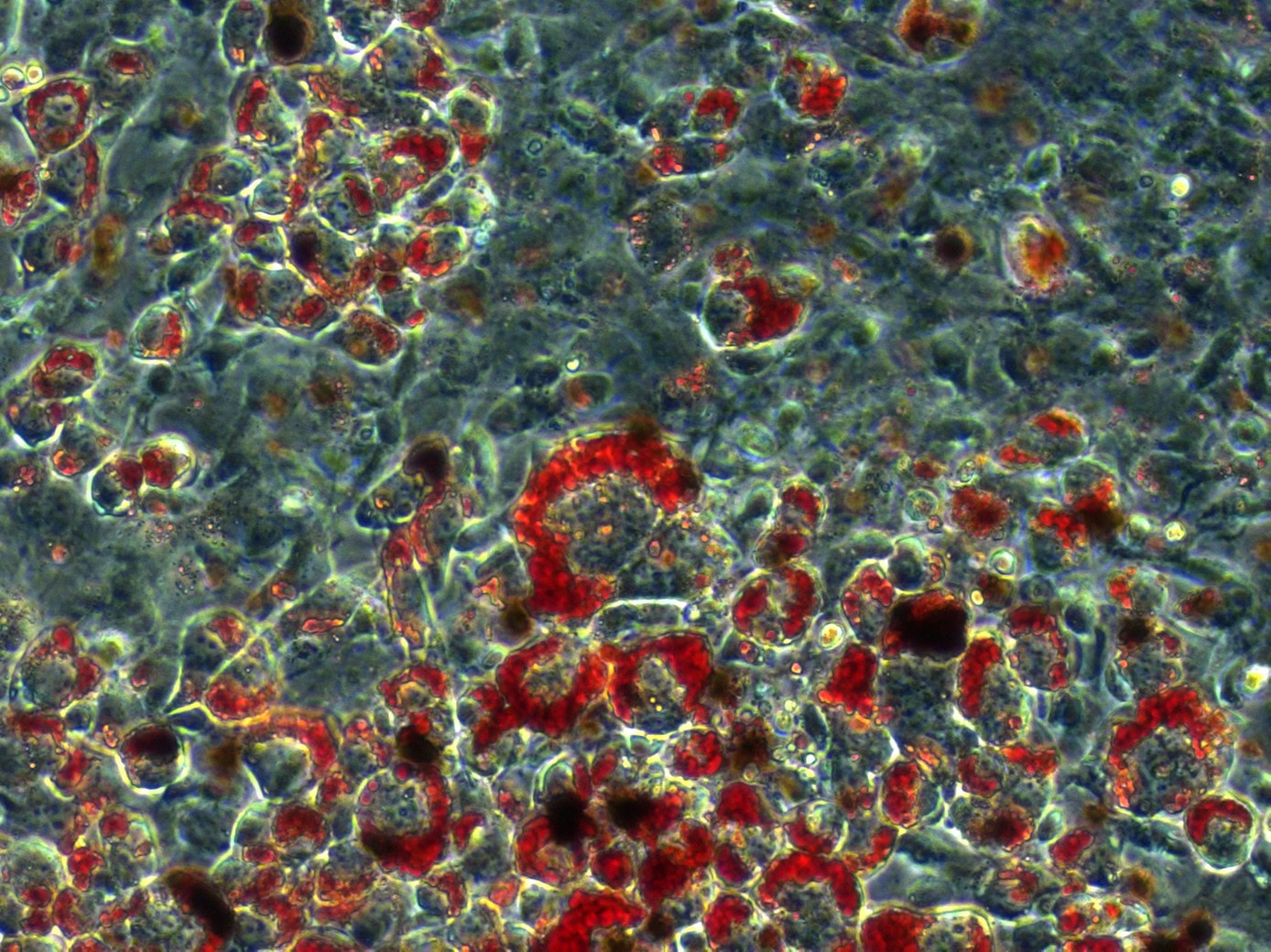
An international team of researchers has discovered a new signaling molecule capable of activating brown fat cells.
The number of overweight persons is greatly increasing worldwide – and as a result is the risk of suffering a heart attack, stroke, diabetes, or Alzheimer’s disease. For this reason, many people dream of an efficient method for losing weight. An international team of researchers led by Professor Alexander Pfeifer from the University Hospital Bonn, have now come one step closer to this goal. The scientists discovered a new way to stimulate brown fat and thus burn energy from food: The body’s own adenosine activates brown fat and “browns” white fat. The results are now being published in the journal Nature.
“Not all fat is equal,” says Professor Alexander Pfeifer from the Institute of Pharmacology and Toxicology of the University Hospital Bonn. Humans have two different types of fat: undesirable white fat cells which form bothersome “love handles”, for example, as well as brown fat cells, which act like a desirable heater to convert excess energy into heat. “If we are able to activate brown fat cells or to convert white fat cells into brown ones, it might be possible to simply melt excess fat away” reports the pharmacologist.
The group of Prof. Pfeifer together with an international team from Sweden, Denmark, and Finland, as well as from the Helmholtz-Center Dresden-Rossendorf and the University of Düsseldorf now discovered a new signaling molecule capable of activating brown fat cells: adenosine. Adenosine is typically released during stress. Crucial for transmitting the adenosine signal is the adenosine receptor A2A.
Adenosine activates brown adipose tissue
“If adenosine binds to this receptor in brown fat cells, fat burning is significantly stimulated,” reports Dr. Thorsten Gnad from Prof. Pfeifer’s team. It was previously thought not possible for adenosine to activate brown fat. Several studies with rats and hamsters demonstrated that adenosine blocks brown fat.
However, the researchers from the University of Bonn were not misled by these previous findings. In contrast, using brown fat cells removed from humans during surgery, the scientists investigated the signaling pathway for fat activation using adenosine. The results showed that rats and hamsters react differently than humans in this regard. “The brown fat in mice on the other hand behaves just as in humans,” summarizes Prof. Pfeifer.
“Browning” of white fat by adenosine
In addition, the research team investigated the possibility that adenosine transforms white fat cells into brown fat cells – a process termed “browning”. White fat cells normally cannot be induced to burn excess fat by adenosine, as they simply lack the A2A receptor. For this reason, the team of scientists transferred the A2A receptor gene from brown fat cells to white fat cells in mice. Consequently, the white fat cells also have A2A receptors and start browning and burning energy.
Clinical application is still far off
As a result, it was possible for the researchers from the University of Bonn to comprehend the significance of adenosine for brown cells in mice and humans for the first time. “Through the administration of adenosine-like substances, the mice actually lost weight,” reports Prof. Pfeifer. However, many questions in this regard still need to be investigated. For this reason, clinical application is still far off.
Reference: “Adenosine activates brown adipose tissue and recruits beige adipocytes via A2A receptors” by Thorsten Gnad, Saskia Scheibler, Ivar von Kügelgen, Camilla Scheele, Ana Kilić, Anja Glöde, Linda S. Hoffmann, Laia Reverte-Salisa, Philipp Horn, Samet Mutlu, Ali El-Tayeb, Mathias Kranz, Winnie Deuther-Conrad, Peter Brust, Martin E. Lidell, Matthias J. Betz, Sven Enerbäck, Jürgen Schrader, Gennady G. Yegutkin, Christa E. Müller and Alexander Pfeifer, 15 October 2014, Nature.
DOI: 10.1038/nature13816
Source: University of Bonn
Never miss a breakthrough: Join the SciTechDaily newsletter.
Follow us on Google and Google News.