

The Houston Methodist team employed a bacterial protein which effectively reduced cholesterol levels by more than 40% within a span of three hours.
Researchers at Houston Methodist have restored fertility in infertile mice by lowering their high cholesterol levels using a bacterial protein, reinforcing the connection between high cholesterol and female infertility. This breakthrough holds promise, as one in five women of reproductive age in the U.S. struggle to conceive after a year of trying.
“We are working with a protein, called serum opacity factor, with unique characteristics,” said Corina Rosales, Ph.D., assistant research professor of molecular biology in medicine with the Houston Methodist Research Institute and lead author on the study. “In our experiments, serum opacity factor lowered cholesterol levels by over 40% in three hours. So, this protein is quite potent.”
The findings were recently published in the American Society for Biochemistry and Molecular Biology’s Journal of Lipid Research.
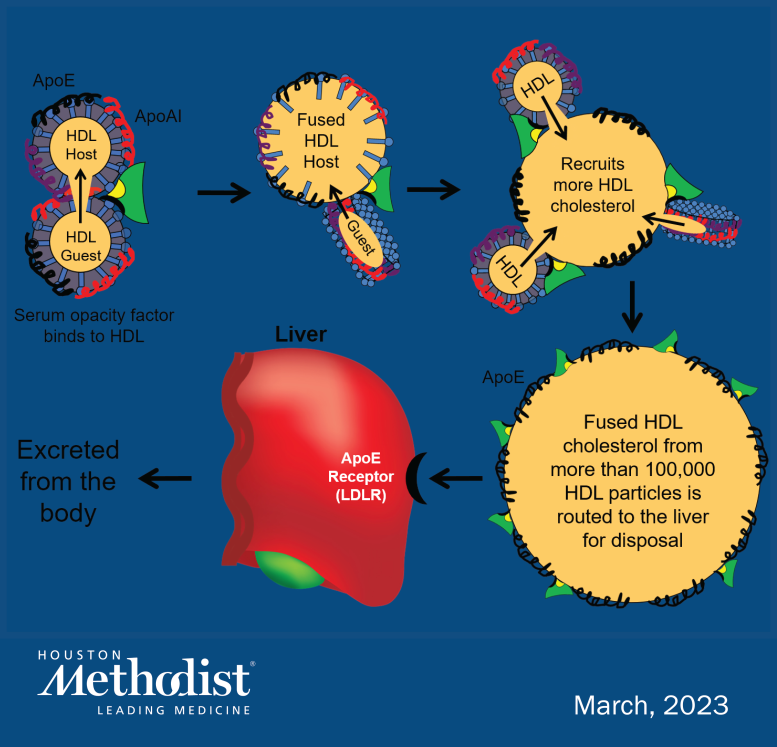
HDL Cholesterol’s Role in Fertility and Lipid Metabolism
While this protein’s primary function is to increase bacterial colonization, it also alters the structure of cholesterol-carrying high-density lipoproteins, or HDLs, making it easier for the liver to dispose of the excess cholesterol that’s preventing conception. The researchers also noted that serum opacity factor’s dramatic action on HDL could be leveraged as a potential alternative to statins, which are the current gold standard for lowering cholesterol in people with atherosclerosis.
HDL, known as the “good cholesterol,” carries excess cholesterol from different tissues to the liver for breakdown, thereby bringing down cholesterol levels. However, if there is HDL dysfunction, lipid metabolism gets altered, which could then be harmful, like its counterpart LDL, or low-density lipoprotein. Often called “bad cholesterol,” LDL carries cholesterol from the liver to other tissues, with high levels of it causing accumulation and diseases.
“Both HDLs and LDLs contain a mixture of free and esterified cholesterol, and free cholesterol is known to be toxic to many tissues,” said Henry J. Pownall, Ph.D., professor of biochemistry in medicine at the Houston Methodist Research Institute and corresponding author on the study. “So, any dysfunction in HDL could be a risk factor for several diseases, too.”
To study HDL dysfunction, the researchers worked with preclinical mouse models that had unnaturally high levels of HDL cholesterol circulating in their bloodstream. While this made them ideal for studying atherosclerosis, Rosales observed that these mice were also completely sterile.
“Cholesterol is the backbone of all steroidal hormones, and an orchestra of hormones is needed to have a fertile animal,” Rosales said. “We know that the ovaries are studded with receptors for HDL, so the metabolism of HDL had to play a very important role in fertility for that reason.”
Restoring Fertility with Serum Opacity Factor Delivery
As predicted, when the researchers fed the sterile mice with a lipid-lowering drug, both LDL and HDL cholesterol levels reduced, and the animals were temporarily rescued from infertility. Motivated by these results, they turned to the bacterial protein serum opacity factor, known to be highly selective for HDL.
“Serum opacity factor is known mainly in the context of bacterial strep infections where it serves as a virulence factor. But it was also discovered that this protein only reacts to HDL and not to LDL or other lipoproteins,” Rosales said. “We hypothesized that perhaps administering serum opacity factor to these mice might help restore their fertility, as well.”
For their next set of experiments, the team engineered an adeno-associated virus to deliver the gene for serum opacity factor to the mice lacking HDL receptors that had high blood cholesterol. When the gene was expressed and the bacterial protein was produced, the animals’ HDL cholesterol significantly lowered, and their fertility was restored.
Based on these promising preclinical results, the researchers’ next plan to conduct a clinical study to investigate lipid levels in women undergoing treatments for idiopathic infertility, where the underlying causes are not fully known. If these patients have high HDL levels, then the researchers say serum opacity factor may be a line of future treatment.
“Even if we were to help 1% of women who are struggling to conceive, it would be life-changing for them, and I think that’s where we can make the most impact with our research,” Rosales said.
Reference: “Serum opacity factor rescues fertility among female Scarb1−/− mice by reducing HDL-free cholesterol bioavailability” by Corina Rosales, Dedipya Yelamanchili, Baiba K. Gillard, Jing Liu, Antonio M. Gotto and Henry J. Pownall, 31 December 2022, Journal of Lipid Research.
DOI: 10.1016/j.jlr.2022.100327
Rosales and Pownall’s collaborators on this study were Dedipya Yelamanchili, Baiba K. Gillard and Jing Liu with the Center for Bioenergetics and Department of Medicine at the Houston Methodist Research Institute; and Antonio M. Gotto Jr. with Weill Cornell Medicine’s Department of Medicine.
The study was funded by the National Institutes of Health and the Bass Endowment.
Never miss a breakthrough: Join the SciTechDaily newsletter.
Follow us on Google and Google News.