
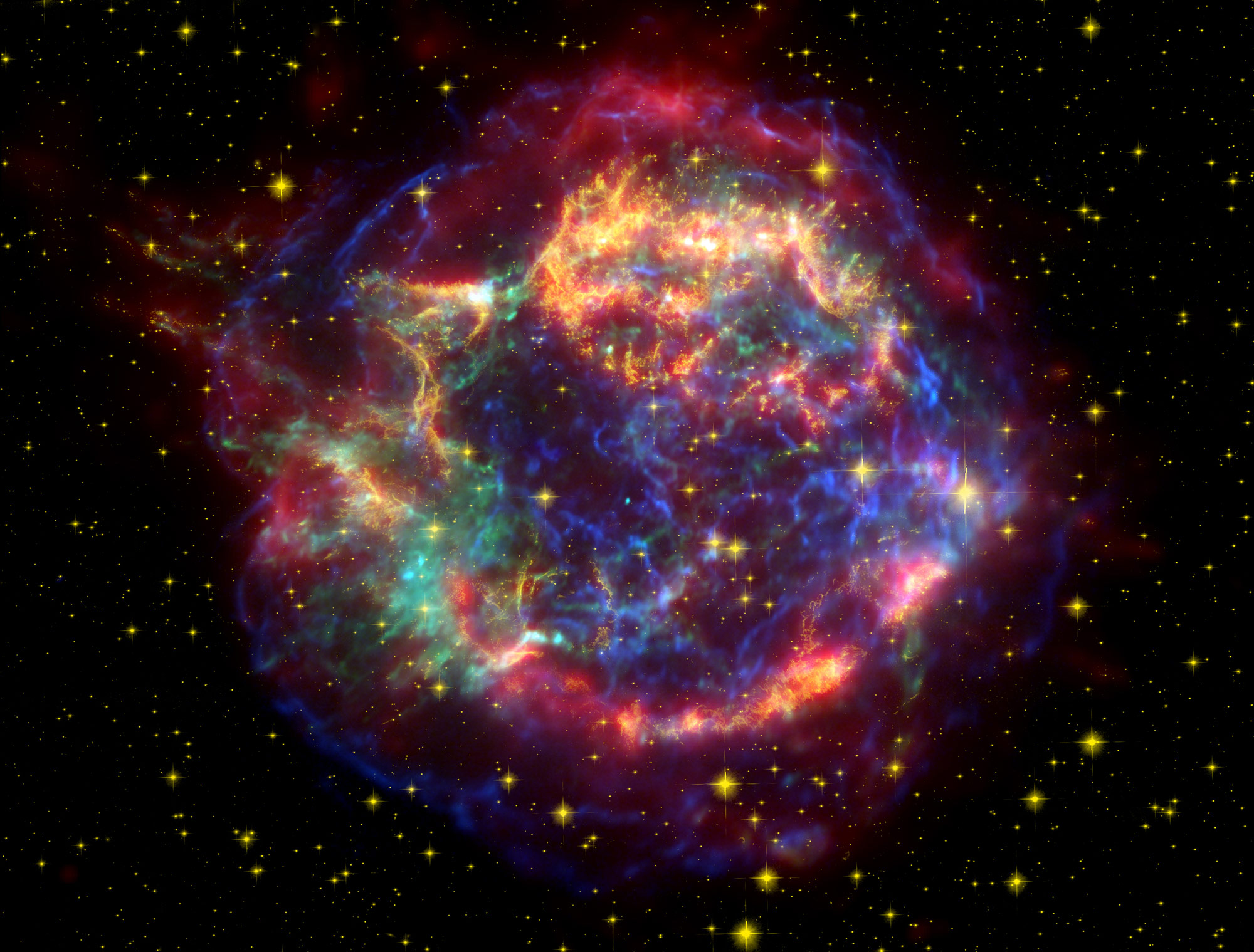
Scientists at the Technische Universitaet Muenchen have discovered the first proven biological evidence of a supernova on earth, finding hints of supernova iron in bacteria microfossils.
In fossil remnants of iron-loving bacteria, researchers of the Cluster of Excellence Origin and Structure of the Universe at the Technische Universitaet Muenchen (TUM), found a radioactive iron isotope that they trace back to a supernova in our cosmic neighborhood. This is the first proven biological signature of a starburst on our earth. The age determination of the deep-drill core from the Pacific Ocean showed that the supernova must have occurred about 2.2 million years ago, roughly around the time when the modern human developed.
Most of the chemical elements have their origin in core collapse supernovae. When a star ends its life in a gigantic starburst, it throws most of its mass into space. The radioactive iron isotope Fe-60 is produced almost exclusively in such supernovae. Because its half-life of 2.62 million years is short compared to the age of our solar system, no supernova iron should be present on Earth. Therefore, any discovery of Fe-60 on Earth would indicate a supernova in our cosmic neighborhood. In the year 2004 scientists at TU Muenchen discovered Fe-60 on Earth for the first time in a ferromanganese crust obtained from the floor of the equatorial Pacific Ocean. Its geological dating puts the event around 2.2 million years ago.
So-called magnetotactic bacteria live within the sediments of the Earth’s oceans, close to the water-sediment interface. They make within their cells hundreds of tiny crystals of magnetite (Fe3O4), each approximately 80 nanometers in diameter. The magnetotactic bacteria obtain the iron from atmospheric dust that enters the ocean. Nuclear astrophysicist Shawn Bishop from the Technische Universitaet Muenchen conjectured, therefore, that Fe-60 should also reside within those magnetite crystals produced by magnetotactic bacteria extant at the time of the supernova interaction with our planet. These bacterially produced crystals, when found in sediments long after their host bacteria have died, are called “magnetofossils.”
Shawn Bishop and his colleagues analyzed parts of a Pacific Ocean sediment core obtained from the Ocean Drilling Program, dating between about 1.7 million and 3.3 million years ago. They took sediment samples corresponding to intervals of about 100,000 years and treated them chemically to selectively dissolve the magnetofossils – thereby extracting any Fe-60 they might contain.
Finally, using the ultra sensitive accelerator mass spectrometry system at the Maier Leibnitz Laboratory in Garching, Munich, they found a tantalizing hint of Iron-60 atoms occurring around 2.2 million years ago, which matches the expected time from the ferromanganese study. “It seems reasonable to suppose that the apparent signal of Fe-60 could be remains of magnetite chains formed by bacteria on the sea floor as a starburst showered on them from the atmosphere”, Shawn Bishop says. He and his team are now preparing to analyze a second sediment drill core, containing upwards of 10 times the amount of material as the first drill core, to see if it also holds the Fe-60 signal and, if it does, to map out the shape of the signal as a function of time.
Publication: APS April Meeting 2013, Volume 58, Number 4; meetings.aps.org/link/BAPS.2013.APR.X8.2
Previous Research: “Discovery prospects for a supernova signature of biogenic origin” by Shawn Bishop and Ramon Egli, 15 February 2011, Icarus.
DOI: 10.1016/j.icarus.2011.02.003
Never miss a breakthrough: Join the SciTechDaily newsletter.
Follow us on Google and Google News.