
New Research Suggests Fathers May Play a Greater Genetic Role in Autism Spectrum Disorder
Researchers from Cold Spring Harbor Laboratory (CSHL) have recently revised the commonly held genetic assumptions about autism spectrum disorder (ASD).
For many years, scientists believed that siblings diagnosed with ASD tended to inherit more genetic traits from their mother than their father. However, Associate Professor Ivan Iossifov and Professor Michael Wigler from CSHL have demonstrated that it could often be the father who has a more significant genetic contribution in numerous instances.
Autism spectrum disorders cover a range of neurological and developmental conditions. They can affect how a person communicates, socializes, learns, and behaves. ASD may also manifest as repetitive behaviors or restricted interests. In the United States, it affects around one in 36 children.
“There are children diagnosed with autism who are high functioning,” Iossifov says. “They have a completely productive life, although they have some minor troubles in social interactions, as most of us do. But also, there are children diagnosed with autism who never learn to speak, and they have definitely a difficult life.”
Over the last two decades, CSHL scientists have led a multimillion-dollar effort to uncover the genetic origins of autism. They discovered thousands of genes that, when damaged, may cause a child to be born with ASD. But their work was not able to account for all cases of ASD. So Iossifov and Wigler set out to find the missing sources.
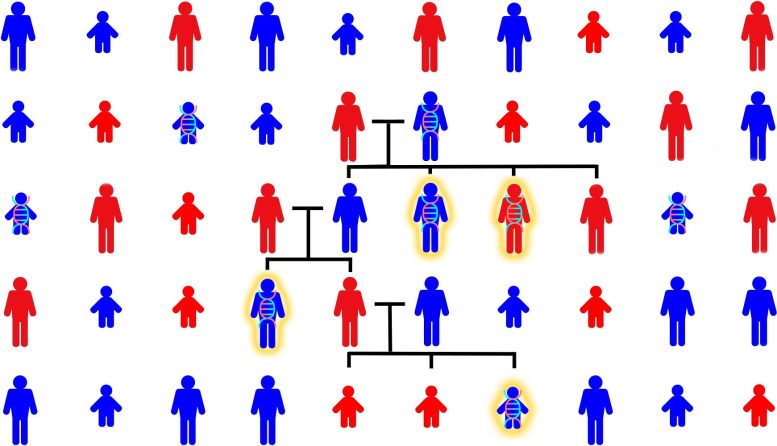
The duo analyzed the genomes of over 6,000 volunteer families. They found that in families that have two or more children with ASD, the siblings shared more of their father’s genome. Meanwhile, in families where only one sibling had ASD, the children shared less of their father’s genome. While the discovery reveals a new potential source of ASD, it also poses a provocative question. Could other disorders play by the same genetic rules?
Exploring Potential Mechanisms Behind Paternal Influence
No one is sure how dad’s genome makes its mark on children with ASD. But Iossifov has a couple of interesting ideas. He thinks some fathers may carry protective mutations that fail to get passed on. Or fathers may pass down mutations that trigger the mother’s immune system to attack the developing embryo. Both theories offer hope for parents of children with ASD and other neurological disorders like schizophrenia.
“Our future research is exciting,” Iossifov says. “If one of those theories or two of them prove to be true, then it opens different treatment strategies, which can, in the future, affect quite a lot of families.”
In addition, this research offers helpful tools for educators and therapists. It may allow for earlier diagnoses and a better overall understanding of autism.
Reference: “Sharing parental genomes by siblings concordant or discordant for autism” by Mathew Wroten, Seungtai Yoon, Peter Andrews, Boris Yamrom, Michael Ronemus, Andreas Buja, Abba M. Krieger, Dan Levy, Kenny Ye, Michael Wigler and Ivan Iossifov, 8 May 2023, Cell Genomics.
DOI: 10.1016/j.xgen.2023.100319
The study was funded by the Simons Center for Quantitative Biology, the Simons Foundation Autism Research Initiative, the Centers for Common Disease Genomics, the National Human Genome Research Institute, and the National Heart, Lung, and Blood Institute.
Never miss a breakthrough: Join the SciTechDaily newsletter.
Follow us on Google and Google News.
2 Comments
Good day,
I read your article about Researchers Have Flipped the Script on Autism Genetics. I was wondering if you might be right, my youngest son has Autism and we have a family with rear blood types and learning problems. I would like to know, if my mother and father may have a huge part to play in it (which will be his grand parents). As they are HR positive and HR negative. My sister is AB negative and I am O+, my youngest son is O+ as well. My eldest son is A+, but is not autistic. It would be nice if you could get back to me and advise if you believe it could be the case. However both the children are extremally smart and don’t really have issues learning, my youngest might be on the high functioning spectrum, but we stay in South Africa and he might not have been diagnosed correctly. Nevertheless very informative article.
Chantal
Just like Moore’s Law, knowledge of medicine is increasing at an exponential rate. We all want effective treatments and cures. Bring it on!