
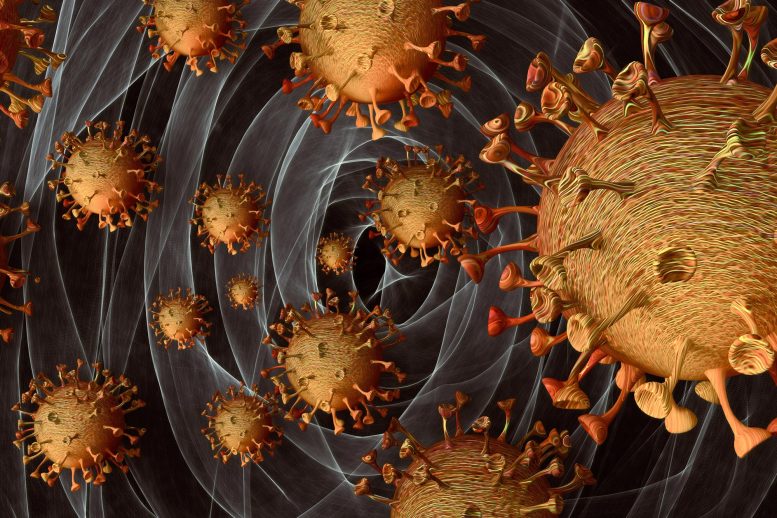
University of Ottawa-led team found a new viral entry for SARS-CoV-2 and suggests it may be able to use proteins to infect a wider range of cells.
One of the many pressing research undertakings by the scientific community amid the ongoing COVID-19 pandemic has focused on ways the coronavirus manages to enter host cells.
Now, in a study adding to the pool of knowledge about viral entry, Dr. Marceline Côté’s Faculty of Medicine lab and collaborators have published a highly compelling study showing a previously unrecognized entryway for SARS-CoV-2, the virus that causes COVID-19 and the driver of the global health crisis that’s transformed the world.

Previous studies have shown that SARS-CoV-2 as well as an earlier coronavirus, SARS-CoV-1, the virus behind the SARS outbreak in 2003, enter cells via two distinct pathways. The new research led by Dr. Côté’s lab shows a third entry route.
Metalloproteinases: A Key to Viral Entry
This viral entryway involves metalloproteinases, enzymes in the body with a catalytic mechanism that requires a metal, such as zinc atoms, to function.
Over a series of experiments starting in 2020, Dr. Côté’s research team discovered that SARS-COV-2 can enter cells in a metalloproteinase-dependent manner. The team describes a role for two matrix metalloproteinases—MMP-2 and MMP-9—in the activation of the spike glycoprotein.
What are the ramifications of this kind of viral entry? The study published in a recent issue of iScience, an open access journal from Cell Press, suggests that variants that gravitate toward metalloproteinases may cause more havoc.
Variants and Their Preferences for Entry Pathways
The team’s experiments showed that some variants clearly prefer the metalloproteinases for activation. For instance, the Delta variant, a more pathogenic variant that surged in 2021, commonly used metalloproteinases for entry. Its less pathogenic successor, Omicron, did not.
“SARS-CoV-2 may be able to use proteins, which are typically secreted by some activated immune cells, to cause more damage and potentially infect a wider range of cells and tissues,” says Dr. Côté, a Faculty associate professor who is the holder of the Canada Research Chair in Molecular Virology and Antiviral Therapeutics.
The entry mechanism could also play a role in disease progression.
Dr. Côté says the findings could have implications in the progression to severe illness and some post-COVID-19 conditions, such as the complex array of post-infection symptoms known as “long Covid.”
Reference: “Identification and differential usage of a host metalloproteinase entry pathway by SARS-CoV-2 Delta and Omicron” by Mehdi Benlarbi, Geneviève Laroche, Corby Fink, Kathy Fu, Rory P. Mulloy, Alexandra Phan, Ardeshir Ariana, Corina M. Stewart, Jérémie Prévost, Guillaume Beaudoin-Bussières, Redaet Daniel, Yuxia Bo, Omar El Ferri, Julien Yockell-Lelièvre, William L. Stanford, Patrick M. Giguère, Samira Mubareka, Andrés Finzi, Gregory A. Dekaban, Jimmy D. Dikeakos and Marceline Côté, 10 October 2022, iScience.
DOI: 10.1016/j.isci.2022.105316
The study’s co-first authors are Mehdi Benlarbi, an undergraduate honours’ thesis student in Dr. Cote’s lab and recipient of a uOttawa Centre for Infection, Immunity and Inflammation scholarship, and Dr. Geneviève Laroche of uOttawa. Collaborators include researchers at the University of Western Ontario, Centre de recherche du CHUM, and Sunnybrook Research Institute. Funding was provided by the Canadian Institutes of Health Research (CIHR).
Never miss a breakthrough: Join the SciTechDaily newsletter.
Follow us on Google and Google News.
2 Comments
Get all 9 of your boosters, its the only way to stay protected.
Fun new epithelial survival game mode. Experience revulsion anew as syncytia turn the lipid rafts model of membranes into the WTF velcro public lysosomes model. How would your gaming studio treat this race against lyosome propriety chaos?