
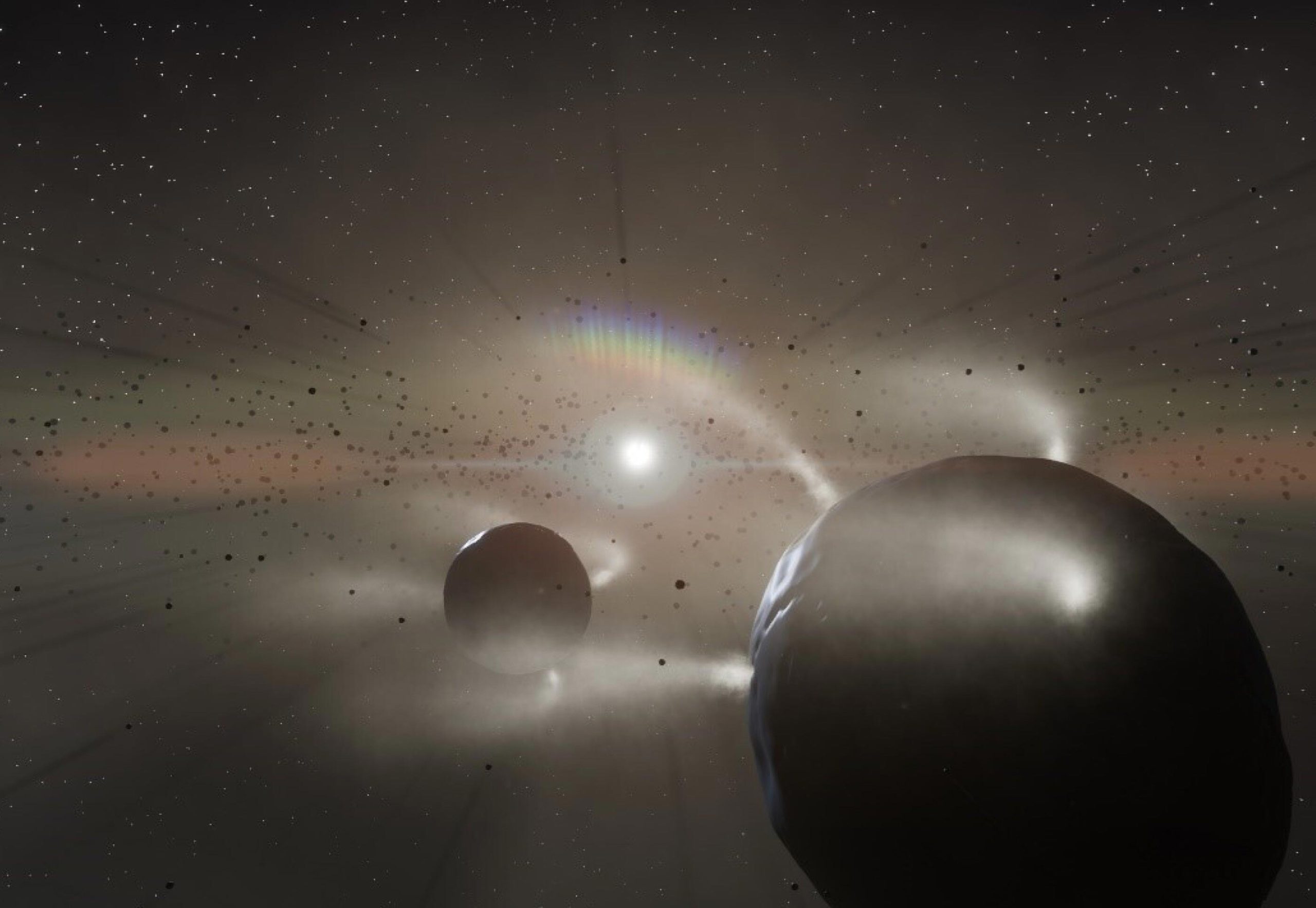
Ice on ancient asteroids like Ryugu may have been crucial in kickstarting life on Earth.
Researchers from Imperial and collaborators analyzed asteroid rocks and discovered fractures caused by freeze-thaw cycles. These processes likely enabled water and essential organic materials to be delivered to our planet, providing the necessary building blocks for life to emerge billions of years ago.
The Role of Water in Asteroid Evolution
The study, led by Dr. Matt Genge from Imperial’s Department of Earth Science and Engineering with collaborators at the Natural History Museum, the University of Kent, and the Japanese Space Agency (JAXA). It indicates that rocks from asteroid Ryugu, returned to Earth by JAXA’s Hayabusa2 mission, show evidence of having been fractured by ice.
The research team found that these fractures were filled with clay and sulfide minerals, which formed in the presence of water. These mineral-filled cracks appear to have been created by a freeze-thaw process, where ice expands and contracts as it melts and refreezes, causing the rock to break apart.
This suggests that water played a crucial role in altering the asteroid’s composition in the early Solar System. Scientists believe that these changes may have enabled the delivery of essential organic materials, along with clay, sulfide minerals, and water, to Earth when the asteroid impacted our planet billions of years ago. This delivery could have been a key factor in the emergence of life on Earth.

How Freeze-Thaw Cycles Led to Life on Earth
Dr. Genge said: “Our findings suggest that the repeated melting and freezing of ice on asteroids may have helped life form on Earth.
“Our calculations indicate that the pressure exerted by ice as it grows is sufficient to fracture asteroids to their core, allowing water to spread throughout them. Water then interacts with the minerals inside the asteroid to create essential organic matter – which would have been delivered to early Earth generating the oceans and the organic building blocks of life.”
While collisions with other asteroids can also fracture asteroids, the team concluded that the specific shapes of the fractures on the Ryugu asteroid could only have been formed by the freeze-thaw process.
These freeze-thaw cycles not only fractured Ryugu, but also allowed water to escape through these fractures creating geysers on the asteroid’s surface.
The paper is published in Nature Astronomy.

Deciphering Ryugu’s Tiny Fractures
The team carried out their research on a millimeter-sized piece of Ryugu brought back to Earth by JAXA. To analyze the sample, they used X-ray Computed Tomography (XCT), which is similar to a medical CT scan but for rocks – allowing them to see the 3D shapes of the fractures on the asteroid.
As well as the thin fractures which pointed to the role of the ice creating the fractures on the asteroid, researchers also found ‘veins’ containing framboidal magnetite—tiny, spherical crystals of magnetic iron oxide – which represent further evidence of the presence of water.
Researchers noticed that the fractures and veins had strange curved shapes and appeared as a series of cusps. It was the distinctive shape of the veins that helped them understand the role of ice: the team performed experiments on ice grains embedded within clay and found similar cusp-like fractures forming around the ice grains.
“It is the fracturing of asteroids by freeze-thaw that ensured asteroids were thoroughly altered by water. Without it, these life-giving materials may have been much rarer. The cosmic game of ‘Rock, Scissors, Ice’ may well be an essential part of how life came to be,” concluded Dr. Genge.
Reference: “Evidence from 162173 Ryugu for the influence of freeze-thaw on the hydration of asteroids” by Matthew J. Genge, Natasha V. Almeida, Matthias van Ginneken, Lewis Pinault, Penelope J. Wozniakiewicz and Hajime Yano, 26 September 2024, Nature Astronomy.
DOI: 10.1038/s41550-024-02369-7
Never miss a breakthrough: Join the SciTechDaily newsletter.
Follow us on Google and Google News.
12 Comments
IM THE ALPHA. IM THE LEADER. IM THE ONE TO TRUST. (TRUST!). WHATEVER WE DO, WHATEVER IT TAKES WERE IN THIS PACK FOE LIFE!!!!! AWOOOOOOOOOOOOOOOO!!! WERE WOLVES WE OWN THE NIGHT!
17:10:24. I don’t mind that Theories of those Scientists, you are getting closer. But not close enough to guess what happened in the beginning, from beginning. Continued your guess work, or your experiment. Am fascinate by you people. I enjoyed your explanation. You can figure it out by yourself. You don’t need my help or assistance for that. That’s your home work and your assignment. Enjoy them. Am listening and I can hear you. I like your curiosities. Thanks. M. Luke.
The science here is describing process that started to happen before “the beginning”, the beginning of life.
Took you guys long enough to finally agree on something with the book the world so desperate wants to get rid off. What’s your excuse now
These articles are jokes to real scientific minded people. Origin of life research is hilariously far from even sniffing a plausible spontaneous generation of even the simplest protein.
No one is researching “spontaneous generation” in regards to biology.
“Spontaneous generation is a superseded scientific theory that held that living creatures could arise from nonliving matter and that such processes were commonplace and regular.”
Biology is solely explained by evolution and described by e.g. phylogenetics. Since 2016 phylogenetics place the evolutionary split between biology and geology in deep ocean hydrothermal vents. C.f. Weiss, M., Sousa, F., Mrnjavac, N. et al. The physiology and habitat of the last universal common ancestor. Nat Microbiol 1, 16116 (2016).
What is “the book the world so desperate wants to get rid off”, and what significance would it have in the context of readily observed facts!?
They are not first:
https://www.academia.edu/106925565/Wet_Panspermia
The arrival of the proposed meteor containing water is a hypothesis. Scientists have never observed, nor replicated this kind of event.
Conclusions made from other hypothesis, and from what remains have been discovered, are totally out of context. Uniformitarian
thinking excludes other unobservable event data. There has been no scientific replication.
? Readily observed impactors can be much wetter than Earth (0.05 % water by mass):
“Some meteorites, particularly the CI class,[11] currently contain water.[12] As these include both finds (with their Earth entry and impact unobserved) and falls (meteorites from a known, recent meteor event), that water cannot be entirely terrestrial contamination. As the precision of isotopic abundance analyses grew, they confirmed that meteorite water differs from Earth water.[13] As water at Earth (especially its atmosphere) is well-mixed, significantly different isotope levels would indicate a separate water source.
Water content of the CI and CM types are often in double-digit percentages.”
The replication happens every once in a while, depending on impactor rates.
Source: “Asteroidal water”. Wikipedia.
Organics are ubiquitous in the universe, from carbon star atmospheres to indigenous production on terrestrial worlds. Phylogenetics imply that life on Earth evolved as a split between biology and geology in deep ocean hydrothermal vents, vents that produce amply organics.