
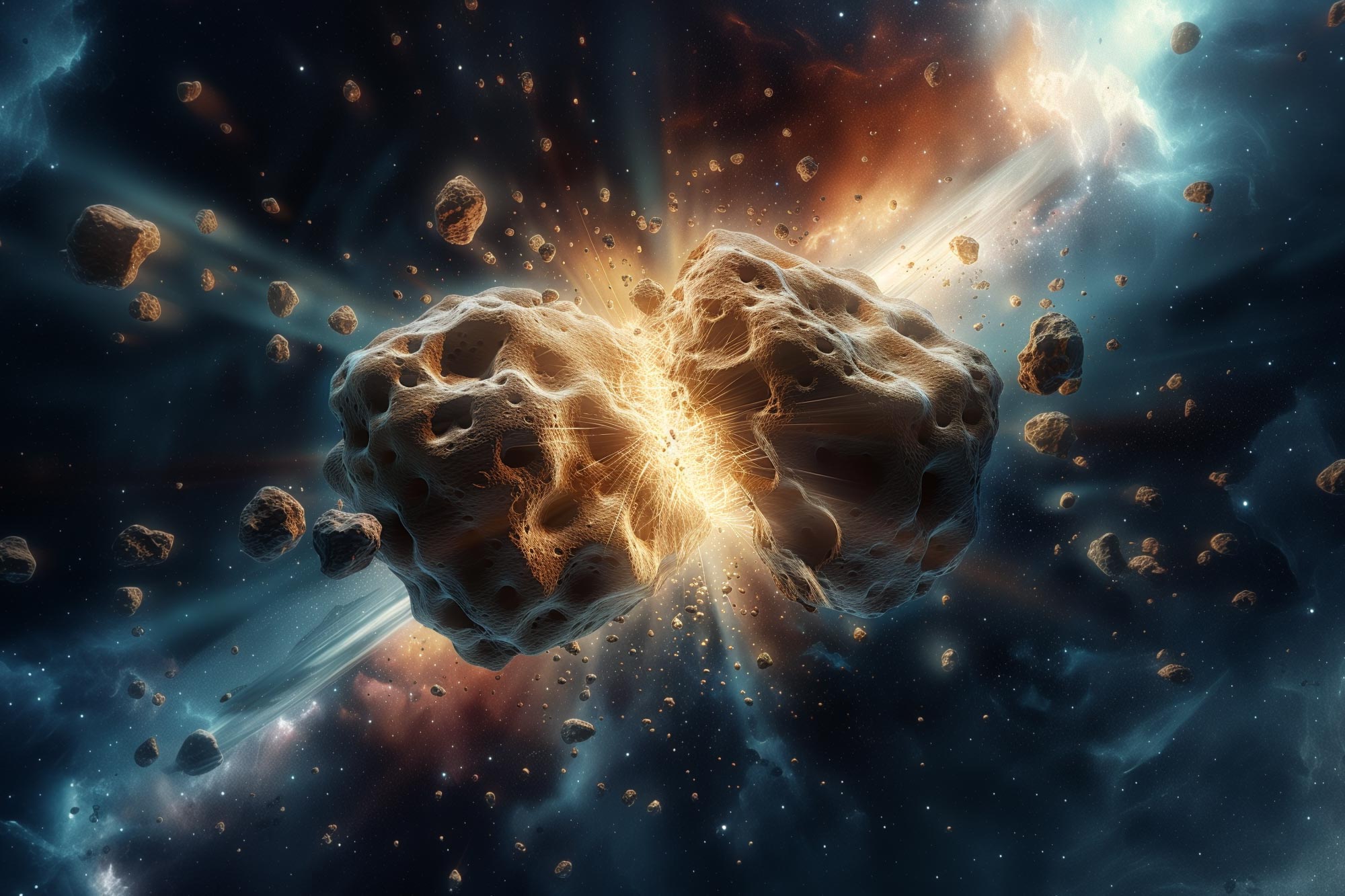
New observations spotlight the volatile processes that shape star systems like our own, offering a unique glimpse into the primordial stages of planetary formation.
Astronomers have captured a snapshot of a giant asteroid collision in Beta Pictoris, revealing insights into early planetary formation. The study, using data from the James Webb and Spitzer Space Telescopes, tracked dust changes around the star. The findings suggest a massive collision 20 years ago, altering our understanding of this young star system’s development.
Massive Collision in Beta Pictoris Star System
Astronomers have captured what appears to be a snapshot of a massive collision of giant asteroids in Beta Pictoris, a neighboring star system known for its early age and tumultuous planet-forming activity.
The observations spotlight the volatile processes that shape star systems like our own, offering a unique glimpse into the primordial stages of planetary formation.
“Beta Pictoris is at an age when planet formation in the terrestrial planet zone is still ongoing through giant asteroid collisions, so what we could be seeing here is basically how rocky planets and other bodies are forming in real time,” said Christine Chen, a Johns Hopkins University astronomer who led the research.
The insights were presented on June 10 at the 244th Meeting of the American Astronomical Society in Madison, Wisconsin.
Significant Changes in Dust Energy Signatures
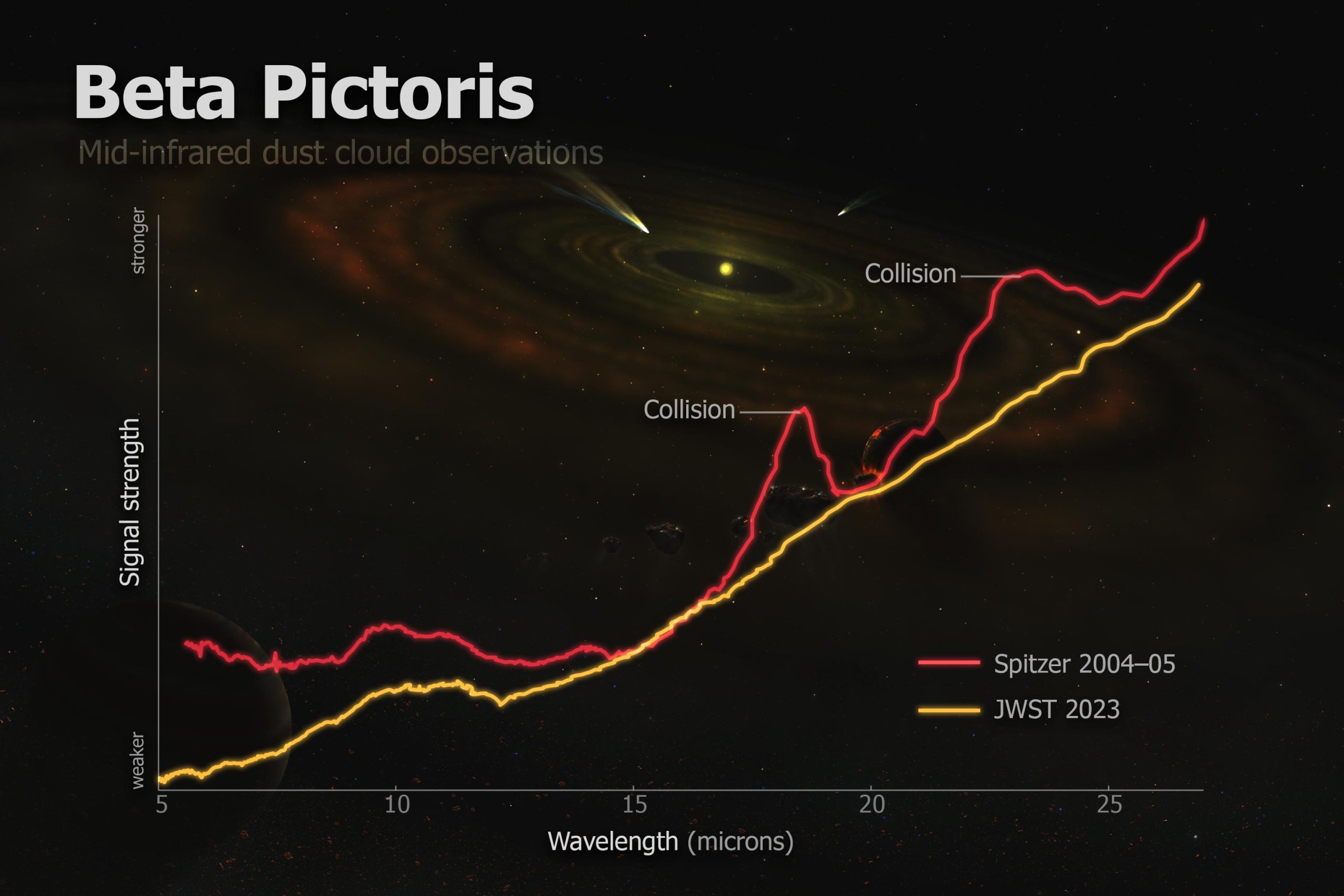
Chen’s team spotted significant changes in the energy signatures emitted by dust grains around Beta Pictoris by comparing new data from the James Webb Space Telescope with observations by the Spitzer Space Telescope from 2004 and 2005. With Webb’s detailed measurements, the team tracked the dust particles’ composition and size in the exact area previously analyzed by Spitzer.
Focusing on heat emitted by crystalline silicates—minerals commonly found around young stars as well as on Earth and other celestial bodies—the scientists found no traces of the particles previously seen in 2004–05. This suggests a cataclysmic collision occurred among asteroids and other objects about 20 years ago, pulverizing the bodies into fine dust particles smaller than pollen or powdered sugar, Chen said.
The Beta Pictoris Star System
Beta Pictoris is a young star system located approximately 63 light years from Earth in the constellation Pictor. Known for its age of about 20 million years, which is significantly younger than our 4.5-billion-year-old solar system, Beta Pictoris is of particular interest to astronomers studying planetary formation. The system hosts a prominent debris disk, indicative of ongoing planet formation, and has at least two known gas giants, Beta Pictoris b and c. The dynamic processes within Beta Pictoris, including frequent collisions and space weathering, offer valuable insights into the early stages of planetary development and the formation of terrestrial planets.
Cataclysmic Collision Evidence
“We think all that dust is what we saw initially in the Spitzer data from 2004 and 2005,” said Chen, who is also an astronomer at the Space Telescope Science Institute. “With Webb’s new data, the best explanation we have is that, in fact, we witnessed the aftermath of an infrequent, cataclysmic event between large asteroid-size bodies, marking a complete change in our understanding of this star system.”
The new data suggests dust that was dispersed outward by radiation from the system’s central star is no longer detectable, Chen said. Initially, dust near the star heated up and emitted thermal radiation that Spitzer’s instruments identified. Now, dust that cooled off as it moved far away from the star no longer emits those thermal features.
Disappearing Dust Phenomenon
When Spitzer collected the earlier data, scientists assumed something like small bodies grinding down would stir and replenish the dust steadily over time. But Webb’s new observations show the dust disappeared and was not replaced. The amount of dust kicked up is about 100,000 times the size of the asteroid that killed the dinosaurs, Chen said.
Beta Pictoris, located about 63 light years from Earth, has long been a focal point for astronomers because of its proximity and random processes where collisions, space weathering, and other planet-making factors will dictate the system’s fate.
Beta Pictoris: A Young Star System
At only 20 million years—compared to our 4.5-billion-year-old solar system—Beta Pictoris is at a key age where giant planets have formed but terrestrial planets might still be developing. It has at least two known gas giants, Beta Pic b and c, which also influence the surrounding dust and debris.
“The question we are trying to contextualize is whether this whole process of terrestrial and giant planet formation is common or rare, and the even more basic question: Are planetary systems like the solar system that rare?” said co-author Kadin Worthen, a doctoral student in astrophysics at Johns Hopkins. “We’re basically trying to understand how weird or average we are.”
Unmatched Capability of the Webb Telescope
The new insights also underscore the unmatched capability of the Webb telescope to unveil the intricacies of exoplanets and star systems, the team reports. They offer key clues into how the architectures of other solar systems resemble ours and will likely deepen scientists’ understanding of how early turmoil influences planets’ atmospheres, water content, and other key aspects of habitability.
“Most discoveries by JWST come from things the telescope has detected directly,” said co-author Cicero Lu, a former Johns Hopkins doctoral student in astrophysics. “In this case, the story is a little different because our results come from what JWST did not see.”
Collaborative Research and Funding
Other authors are Yiwei Chai and Alexis Li of Johns Hopkins; David R. Law, B.A. Sargent, G.C. Sloan, Julien H. Girard, Dean C. Hines, Marshall Perrin and Laurent Pueyo of the Space Telescope Science Institute; Carey M. Lisse of the Johns Hopkins University Applied Physics Laboratory; Dan M. Watson of the University of Rochester; Jens Kammerer of the European Southern Observatory; Isabel Rebollido of the European Space Agency; and Christopher Stark of NASA Goddard Space Flight Center.
The research was supported by the National Aeronautics and Space Administration under Grant No. 80NSSC22K1752.
Never miss a breakthrough: Join the SciTechDaily newsletter.
Follow us on Google and Google News.
3 Comments
Asteroid collisions 20 years ago say nothing at all about solar system formation. Absurd!
Your saying this happened 20 years ago. When are you = NASA + Government finally going to admit the truth.
One possibly deliberate misunderstanding of the article, which clearly states that this will help the expert scientists. “At only 20 million years—compared to our 4.5-billion-year-old solar system—Beta Pictoris is at a key age where giant planets have formed but terrestrial planets might still be developing.”
One possibly related conspiracy theory misunderstanding of the article, which clearly states that the Spitzer telescope, launched 2003, observations made 20 years ago is compared with the Webb telescope, launched 2021, observations 1 year ago. It is tax paid science, NASA and the US government has no influence on the running Webb project which is a collaboration with ESA and CSA.
“Webb observing time is allocated through a General Observers (GO) program, a Guaranteed Time Observations (GTO) program, and a Director’s Discretionary Early Release Science (DD-ERS) program.[231] The GTO program provides guaranteed observing time for scientists who developed hardware and software components for the observatory. The GO program provides all astronomers the opportunity to apply for observing time and will represent the bulk of the observing time. GO programs are selected through peer review by a Time Allocation Committee (TAC), similar to the proposal review process used for the Hubble Space Telescope.”