
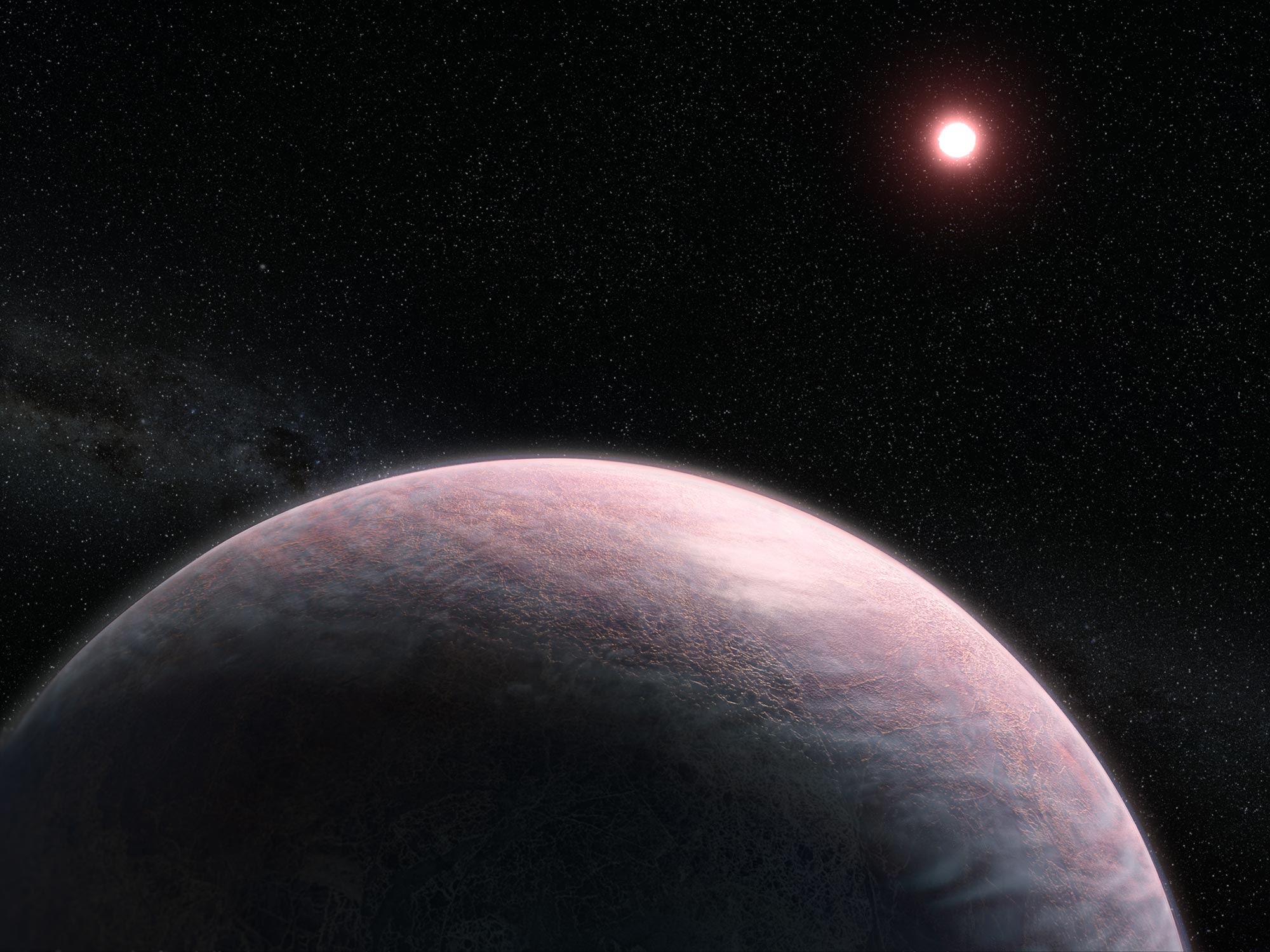
The James Webb Space Telescope offers the potential to detect exoplanet biosignatures and technosignatures like CFCs, providing insights into distant civilizations. Its best targets will be around M-class stars.
The James Webb Space Telescope (JWST), launched last December, has been slowly powering up its instruments and unfurling its sunshield, and is now in the process of aligning its mirrors in preparation for operation. Within a few months, the most powerful space telescope ever built is going to set its sights on the stars. Astronomers are hoping that what JWST sees will change the way we understand our universe, just as the Hubble Space Telescope did decades before.
One tantalizing capability that JWST offers that Hubble could not is the opportunity to directly image planets orbiting distant stars, and maybe, just maybe, detect signs of life.
The possibility of remotely detecting biosignatures has been a hot topic in recent years. In our own solar system, the recent discovery of phosphine in Venus’ atmosphere sparked speculation that the chemical might be created by a microbial lifeform. Similarly, remote sensing experts have proposed that plant life – which uses photosynthesis for energy – could be detected in infrared wavelengths, as chlorophyll absorbs visible light, but shows up brightly in infrared, and would give planets covered in foliage a distinct ‘red edge‘. A single-pixel photo of a distant planet just might contain enough information to tell us if biological life is there, based on the information stored in the wavelengths of light that reach the telescope lens.

But what about intelligent life? Could JWST detect civilizations similar to ours? How would we look for them? The best answers come from understanding what humanity’s presence on Earth looks like from outer space. We give off waste heat (from industry and homes and so on) and artificial light at night, but perhaps most significantly, we produce chemicals that fill our atmosphere with compounds that wouldn’t otherwise be present. These artificial atmospheric constituents just might be the thing that gives us away to a distant alien species scanning the galaxy with their own powerful telescope.
A recent paper – available in preprint on ArXiv – examined the possibility of using JWST to search for industrial pollutants in the atmospheres of exoplanets. The paper focused specifically on chlorofluorocarbons (CFCs), which, on Earth, are produced industrially as refrigerants and cleaning agents. CFC’s infamously created a massive hole in Earth’s ozone layer in the 1980s, before an international ban on their use in 1987 helped reduce the level of CFCs back to less harmful levels. These “potent greenhouse agents with long atmospheric residence times,” if found elsewhere in the galaxy, are almost certain to be the result of a civilization capable of rampant industrialization.
In other words, some of humanity’s worst byproducts, our pollution, may also be what makes us visible. And it implies that we may be able to locate other species that are capable of ignoring the atmosphere of their own planet in the same way.
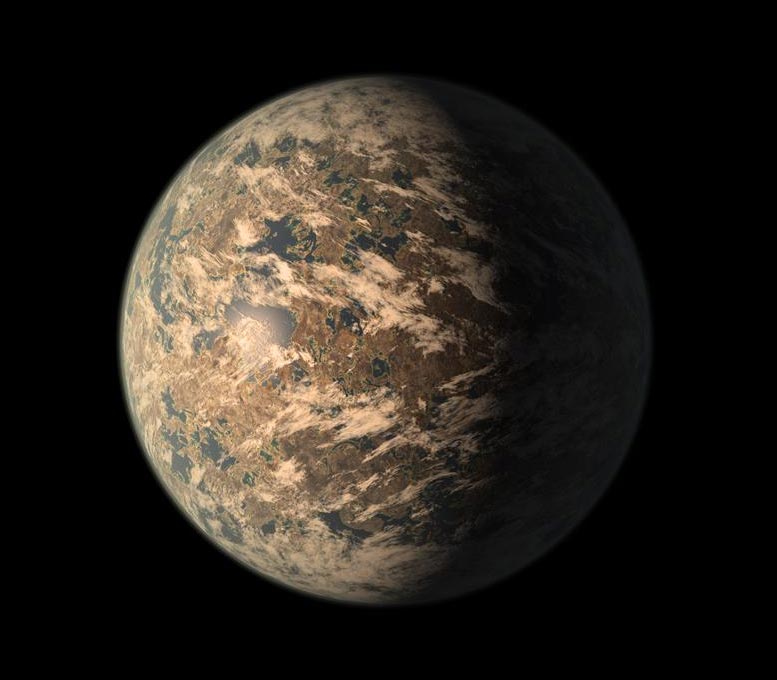
There are some limitations to JWST’s CFC finding capabilities. If a planet’s star is too bright, it will drown out the signal. The telescope will therefore have the most success by looking at M-class stars, which are dim, long-lived red dwarfs. A nearby example is TRAPPIST-1, a red dwarf 40 light-years away, with several Earth-sized planets orbiting within its habitable zone. JWST would be able to see CFCs on TRAPPIST-1’s planets, because the dim star won’t drown out the CFC signature in the same way that a bright star, like our Sun (a G-type star), would.
Conversely, a JWST-like telescope at TRAPPIST-1 wouldn’t be able to see Earth’s CFCs: our Sun is just too bright.
Sadly, M-class stars are not often conducive to life since they are unstable when they are young and release strong solar flares that might easily wipe out any embryonic life on surrounding planets. It’s not impossible, however, since they do have a tendency to quiet down as they get older. It just implies we should moderate our expectations a little.
Whatever we find, or don’t find, out there, the fact that we are about to have the capability to look at all is a game-changer. As the paper concludes, “with the launch of JWST, humanity may be very close to an important milestone in SETI [the Search for Extra-Terrestrial Intelligence]: one where we are capable of detecting from nearby stars not just powerful, deliberate, transient, and highly directional transmissions like our own (such as the Arecibo Message), but consistent, passive technosignatures of the same strength as our own.”
Reference: “Detectability of Chlorofluorocarbons in the Atmospheres of Habitable M-dwarf Planets” by Jacob Haqq-Misra, Ravi Kopparapu, Thomas J. Fauchez, Adam Frank, Jason T. Wright and Manasvi Lingam, 9 March 2022, The Planetary Science Journal.
DOI: 10.3847/PSJ/ac5404
arXiv:2202.05858
Adapted from an article originally published on Universe Today.
Never miss a breakthrough: Join the SciTechDaily newsletter.
Follow us on Google and Google News.
10 Comments
You said, “In other words, some of humanity’s worst byproducts – our pollution – may be the very things that make us detectable. And it means that we may be able to find other species capable of treating their own planet’s atmosphere with the same disregard.”
While I can see that this condition may be detectable, and could be indicative of life, your wording is slanted and prejudicial.
I’m unsure why you feel you need to stand up for pollution? I thought it was universally regarded as “bad”.
Is oxygen “bad”!? That is the poison gas that cyanobacteria once polluted the atmosphere with and in doing so killed an estimated 99 % of then extant life. The survivors hide in our guts, for instance.
But CFSs were bad for *us*, we didn’t know at first but they destroy the ozone layer and quickly increase the man made global warming where the rapidity is the lethal problem – we would see ~1 degC higher global temperatures if they remained.
I like poop
Writers seldom mention that M dwarf planets would also be tide locked, resulting in a scalding side and a frozen side. Not great for life.
Also to see pollution, you would have to catch a civilization right in their equivalent of 1975.
You loaded up on the evil of climate change, but all people have done for the past 50 years is work to mitigate it, so no kudos for your woke slant.
Man made global warming is a costly and dangerous fact, and CFCs would have contributed an estimated 1 degC to the Paris agreement limit of 1.5 degC – which we ar but 0.4 deg C from. That fact has nothing to do with being your definition of “woke”, it is a problem that can be mentioned in respect to industry pollutants.
All small orbit planets won’t end up in tidal lock – c.f. our resonant Mercury – and all habitable zone M star planets are not in such orbits. But even if they were, an Earth equivalent or denser atmosphere would redistribute the heat and an ocean producing clouds may help too. (There is though the newly hypothesized Earth mass bistabile states, which could explain why Venus is runaway greenhouse.)
Thanks for the article, it is very informative. Some civilizations may use alternatives to chlorofluorocarbons. It may depend on their biology and what natural resources and scientific research have to offer. On Earth, it may have been possible to achieve the same type of refrigerants and cleaning agents using organic compounds derived from plants rather than chlorofluorocarbons, without impacting the ozone. Another civilization may have done that. We just have to keep looking for additional signs of a technical civilization.
When they choose to use CFCs (and design more types) they were looking at stability, the problematic effects weren’t known at first. There are degradable and safer alternatives now.
Agreed, this article is interesting. I appreciate the ideas discussed in terms of finding other life based on pollutants. There is one sentence, however, which made me chuckle given the subject of the article, “Unfortunately, M-class stars are not usually conducive to life, because when they are young, they are unstable, sending out powerful solar flares that might just exterminate any nascent life on nearby planets.” Given the fact our Sun is a G-class and the only life we are aware of is here on Earth, this sentence is just plain weird. IF we had found life elsewhere, you could say, “… M-class stars are not usually conducive to life”. As it stands, you should say, “… scientists do not believe M-class stars to be conducive for life”. Or, something along those lines. Regardless, interesting article … thanks publishing it.
I agree with Napier. Also I would say Webb may not find a pollution gas on 0ther planets cause my philosophy is that their Adam and Eve did not mess up and get put out of their Garden of Eden like our did. So things is going find on that planet. No pollution or greed like here on Earth. Or maybe they mess-up too. Then Webb will find a pollution planet.