
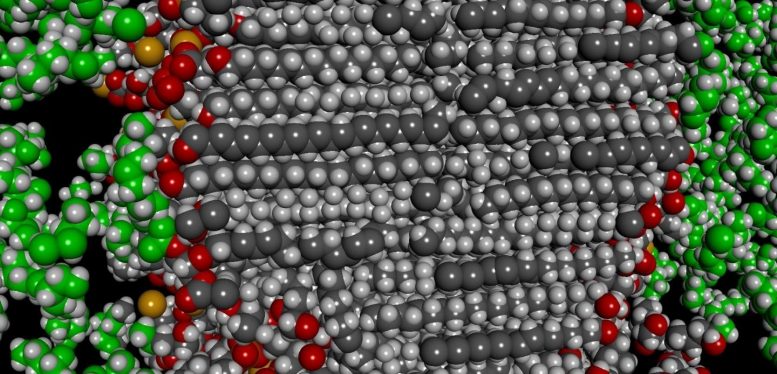
Anyone who has gone through the stress and discomfort of raw, irritated skin knows the relief that comes with slathering on a creamy lotion. Topical creams generally contain a few standard ingredients, but manufacturers know little about how these components interact to influence the performance of the product. Now, researchers report the first direct glimpse of how a cream or lotion is structured on the molecular scale, and it’s not quite what they expected.
The researchers will present their results today at the American Chemical Society (ACS) Fall 2019 National Meeting & Exposition. ACS, the world’s largest scientific society, is holding the meeting in San Diego through Thursday, August 29, 2019. It features more than 9,500 presentations on a wide range of science topics.
“The long-term stability and clinical properties of a cream are determined by its fundamental structure,” says Delaram Ahmadi, the graduate student who performed the study. “If we can understand the chemical microstructure of the cream and relate that to the structure of the skin, then perhaps we can better repair the compromised skin barrier.”
One of Ahmadi’s research advisors, David Barlow, Ph.D., adds, “We wanted to improve the science around cream formulation so that companies could more rationally formulate them to get exactly what they want. The most significant thing we found is that the textbook picture of the structure of a cream is very naïve.”
Formulators have mostly inferred the structure of these emulsions based on indirect measurements, Barlow explains. But his group took a direct approach, with Ahmadi analyzing the cream using X-ray and neutron scattering techniques to determine how the ingredients were dispersed. Ahmadi and Barlow are at King’s College London, and their co-investigator, Jayne Lawrence, Ph.D., is at Manchester University.
Cream is usually thought of as stacks of lamellae, or membranes, composed of surfactants and co-surfactants that maintain oil droplets dispersed within water (or vice versa). To reveal a cream’s true structure, the researchers started with an aqueous cream formulation from the British Pharmacopoeia that contains two co-surfactants and a sodium dodecyl sulfate (SDS) surfactant. They also incorporated a diol known to act as a preservative. One by one, Ahmadi replaced each ingredient with heavier isotopic versions. The researchers then scattered X-rays and neutrons off the selectively isotope-labeled samples and, from the resulting patterns of scattering, determined the location of each ingredient and the aggregate it formed within the cream.
The results were surprising. Although they observed co-surfactants in the lamellar layers as predicted, the surfactant was not there. “The surfactant peak profile suggested that the molecule formed micelles in the cream,” Ahmadi says. In addition, the preservative was not found in the aqueous layer, where scientists have always presumed it would be. It was, in fact, residing in the lamellae. Preservatives have an antimicrobial effect, thereby prolonging shelf-life. Formulators had assumed that to be an effective antimicrobial, the preservative had to be dissolved in the water layer. So, Ahmadi says this finding could mean the creams are essentially self-preserving.
The team is currently performing computer experiments to model the behavior of the preservatives in a bilayer system like a cream to understand why they are in the membrane layer. And they want to better understand the structure of the surfactant micelles dispersed in the layers. “I don’t think anybody else has considered that there would be these micelles in the system at all,” Barlow says. “This is new, and we need to think about where they are in the structure and what they are doing.”
They also want to study different creams. Ahmadi says the formula from the British Pharmacopoeia is pretty basic, with only five ingredients. In addition, personal care companies have phased out SDS as a surfactant, so the researchers plan to analyze variations without SDS in the future.
###
A press conference on this topic will be held Tuesday, August 27, at 10:30 a.m. Pacific time in the San Diego Convention Center. Watch live on YouTube.
Never miss a breakthrough: Join the SciTechDaily newsletter.
Follow us on Google and Google News.