
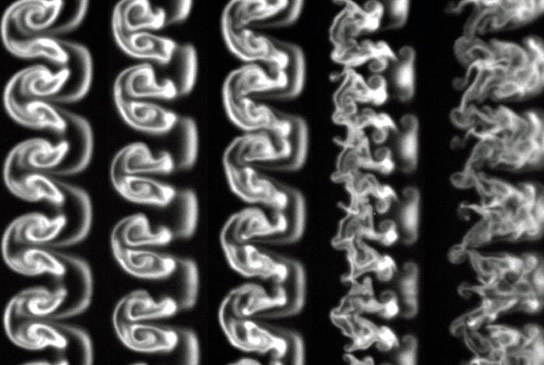
Researchers at the Los Alamos National Laboratory took a series of first-time measurements of turbulent mixing, providing new insights for turbulence modelers.
In research featured on the cover of Journal of Fluid Mechanics, an interdisciplinary Los Alamos team took a series of first-time measurements of turbulent mixing, providing new insights for turbulence modelers. Variable-density turbulence models are widely used in computer simulations at the Laboratory for many applications.
Significance of the research
Turbulent mixing has important consequences for supersonic engines, inertial confinement fusion reactions, and supernova explosions. Richtmyer-Meshkov (RM) instabilities are created when a shock wave interacts with fluids of different densities. These instabilities can cause different outcomes. In supersonic engines, RM enhances combustion efficiency by blending the fuel and the oxidizer. In inertial confinement fusion (ICF) reactions, the mixing induced by the RM instability (created by a converging shock wave on the fuel-shell interface) can contaminate fuel and impair fusion yield. Scientists have attributed the patterns observed in supernova explosions and ejecta from shock-induced metal melt to RM instability.
The team directly measured terms in turbulence model equations, providing insights into the global nature of the mixing (e.g., faster mixing near the edges of the turbulent fluid layer when compared with the core) and identifying the dominant mechanisms governing the flow evolution. The terms representing the dominant mechanisms are particularly important for accurate models.
Research achievements
The researchers took high-resolution mean and fluctuating velocity and density field measurements in an RM flow, which was shocked and reshocked, to understand production and dissipation in a two-fluid, developing turbulent flow field. An unstable array of initially symmetric vortices induced rapid material mixing and cascaded to smaller-scale vortices. After reshock, the flow transitioned to a turbulent state. The team used planar measurements to probe the developing flow field. They made the first experimental measurements of the density self-correlation and terms in its evolution equation.
Diagnostic advances in the shock tube over the last decade have made possible the simultaneous measurement of both density and velocity on a plane. This capability permits experimental estimation of the net result of complex physics, such as a state of the flow at a given time, as well as the individual terms in model equations that are used to predict the evolution of turbulence and mixing. These results provide insights into the nature and mechanisms of mixing in RM turbulence at low Mach numbers, and yield the first measurements of key quantities in turbulence models developed to tackle these types of flows. The team has transferred these diagnostic capabilities to a new Vertical Shock Tube facility, where they plan to simultaneously measure density-velocity multiple times to probe the temporal evolution of the quantities and physics of turbulent mixing.
The research team
Los Alamos authors include Chris Tomkins of Applied Modern Physics; Balakumar Balasubramaniam, Greg Orlicz, and Kathy Prestridge of Neutron Science & Technology; and Raymond Ristorcelli of Methods and Algorithms.
The NNSA Science Campaign 4 funded the work. The research supports the Laboratory’s Nuclear Deterrence and Energy Security mission areas and the Nuclear and Particle Futures science pillar.
Reference: “Evolution of the density self-correlation in developing Richtmyer–Meshkov turbulence” by C. D. Tomkins, B. J. Balakumar, G. Orlicz, K. P. Prestridge and J. R. Ristorcelli, 24 October 2013, Journal of Fluid Mechanics.
DOI: 10.1017/jfm.2013.430
Never miss a breakthrough: Join the SciTechDaily newsletter.
Follow us on Google and Google News.