
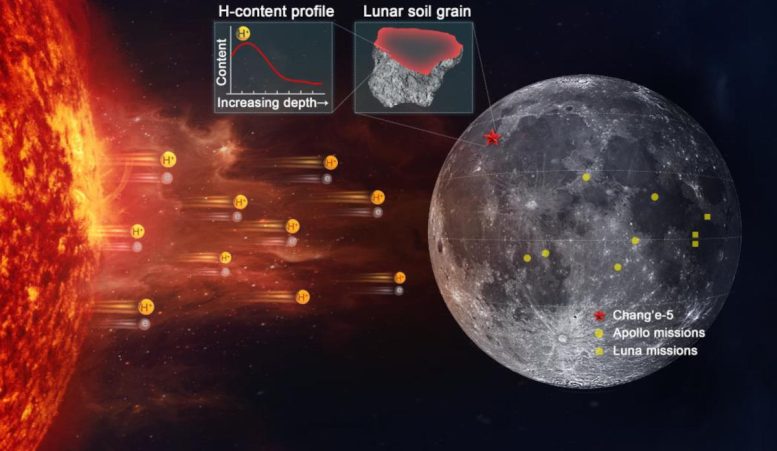
Chang’e-5 samples confirm solar wind as a key source of lunar water, with hydrogen abundance varying by latitude and temperature, aiding future moon resource use.
Recently, there has been a lot of focus on the abundance, distribution, and origin of lunar surface water due to its vital role in future space exploration.
A research team composed of members from the National Space Science Center and the Institute of Geology and Geophysics, both part of the Chinese Academy of Sciences, discovered that the grain rims of the soil samples collected by the Chang’e-5 mission have high levels of hydrogen and a low ratio of deuterium to hydrogen, consistent with the theory that lunar water originates from the solar wind.
The findings were published in the Proceedings of the National Academy of Sciences.
The researchers conducted simulations on the preservation of hydrogen in lunar soils at different temperatures. They found that SW-originated water could be well preserved in the middle and high-latitude regions of the lunar surface. “The polar lunar soils could contain more water than Chang’e-5 samples,” said Professor Lin Yangting from IGG, corresponding author of the study.
Previous studies have proved that water (OH/H2O) on the lunar surface varies with latitude and time of day (up to 200 ppm). Such an obvious change implies a rapid desorption rate from the lunar surface.
Middle Latitude Insights from Chang’e-5 Samples
In contrast to the six Apollo and three Luna missions, which all landed at low latitudes (8.97°S—26.13°N), the Chang’e-5 mission returned soil samples from a middle latitude location (43.06°N). In addition, the Chang’e-5 samples were collected from the youngest known lunar basalts (2.0 Ga) and the driest basaltic basement. Therefore, Chang’e-5 samples are key to addressing the spatial-temporal distribution and retention of SW-derived water in the lunar regolith.
On 17 lunar soil grains returned by the Chang’e-5 mission, the researchers took NanoSIMS depth-profiling measurements of hydrogen abundance and calculated deuterium/hydrogen ratios.
Results showed that the majority of the grain rims (topmost ~100 nm) exhibited high concentrations of hydrogen (1,116—2,516 ppm) with extremely low δD values (-908‰ to -992‰), implying an SW origin. Based on the grain size distribution of the lunar soils and their hydrogen content, the bulk SW-derived water content was estimated to be 46 ppm for the Chang’e-5 lunar soils, consistent with the remote sensing result.
Model of Hydrogen Dynamics in Lunar Soils
Heating experiments on a subset of the grains demonstrated that the SW-implanted hydrogen could be preserved after burial. Using this information along with previous data, the researchers established a model of the dynamic equilibrium between the implantation and outgassing of SW-hydrogen in soil grains on the moon, revealing that temperature (latitude) plays a key role in the implantation and migration of hydrogen in lunar soils.
Using this model, they predicted an even higher abundance of hydrogen in the grain rims in the lunar polar regions. “This discovery is of great significance for the future utilization of water resources on the moon,” said Professor Lin. “Also, through particle sorting and heating, it is relatively easy to exploit and use the water contained in the lunar soil.”
Reference: “High abundance of solar wind-derived water in lunar soils from the middle latitude” by Yuchen Xu, Heng-Ci Tian, Chi Zhang, Marc Chaussidon, Yangting Lin, Jialong Hao, Ruiying Li, Lixin Gu, Wei Yang, Liying Huang, Jun Du, Yazhou Yang, Yang Liu, Huaiyu He, Yongliao Zou, Xianhua Li and Fuyuan Wu, 12 December 2022, Proceedings of the National Academy of Sciences.
DOI: 10.1073/pnas.2214395119
Never miss a breakthrough: Join the SciTechDaily newsletter.
Follow us on Google and Google News.