
Close Menu
    Facebook X (Twitter) Instagram
    SciTechDaily
    • Biology
    • Chemistry
    • Earth
    • Health
    • Physics
    • Science
    • Space
    • Technology
    Facebook X (Twitter) Pinterest YouTube RSS
    SciTechDaily
    Home»Chemistry»Researchers Unveil New Platform for Catalytic Syngas Conversion
    Chemistry

    Researchers Unveil New Platform for Catalytic Syngas Conversion

    By Dalian Institute of Chemical Physics, Chinese Academy SciencesMarch 9, 20231 Comment2 Mins Read
    Facebook Twitter Pinterest Telegram LinkedIn WhatsApp Email Reddit
    Share
    Facebook Twitter LinkedIn Pinterest Telegram Email Reddit
    Researchers Reveal Synergistic Interplay Mechanism of Dual Active Sites on Bimetallic Oxide for Syngas Conversion
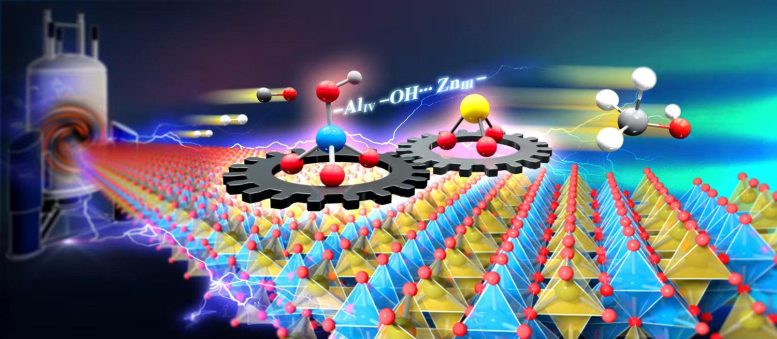
    Revealing the synergistic interplay of dual active sites on a spinel ZnAl2O4 bimetallic oxide for syngas conversion by state-of-the-art solid-state NMR technologies. Credit: DICP

    Breakthrough in Designing Efficient Systems for Syngas Conversion and CO2 Hydrogenation

    To bridge the gap between different carbon resources and vital chemicals, catalytic syngas conversion is a key pathway. A new platform for this conversion is oxide-zeolite (OXZEO) bifunctional catalysis.

    A team of researchers, led by Prof. Hou Guangjin from the Dalian Institute of Chemical Physics (DICP) at the Chinese Academy of Sciences (CAS), has recently discovered the synergistic interplay mechanism of dual active sites on bimetallic oxides. This discovery can lead to more efficient syngas conversion at the atomic level.

    The research was recently published in the journal Chem.

    The researchers investigated syngas conversion over a representative spinel ZnAl2O4 oxide with combined advanced solid-state nuclear magnetic resonance (NMR) technologies. They utilized in-situ NMR method to observe the full process of syngas conversion to methanol over ZnAl2O4 catalyst, during which the formate and methoxy species were identified as the key intermediates.

    Synergistic Catalytic Mechanism of ZnAl2O4 Dual Sites

    Through a series of double resonance and multi-dimensional correlation NMR experiments, they identified the dual active sites with structure of -AlIV-OH···ZnIII-. Thus, they proposed the synergistic catalytic mechanism of the dual active sites on ZnAl2O4 catalyst for syngas conversion reaction.

    Moreover, they elaborated on the dynamic evolution of the reaction intermediates and active sites during the reaction process at an atomic level.

    “On one hand, our work exemplifies the increasing capability of solid-state NMR spectroscopy in the study of surface/interface catalysis,” Prof. HOU said. “On the other hand, the current understanding of the active sites and reaction mechanism can bring inspiration to study syngas conversion and CO2 hydrogenation on other bimetallic oxide systems, providing important guidance for the rational design and modulation of high-efficiency oxide catalysts.”

    Reference: “Synergistic interplay of dual active sites on spinel ZnAl2O4 for syngas conversion” by Qiao Han, Pan Gao, Kuizhi Chen, Lixin Liang, Zhenchao Zhao, Xinlong Yao, Dong Xiao, Xiuwen Han and Guangjin Hou, 8 February 2023, Chem.
    DOI: 10.1016/j.chempr.2023.01.004

    Never miss a breakthrough: Join the SciTechDaily newsletter.
    Follow us on Google and Google News.

    Catalysts Chinese Academy of Sciences
    Share. Facebook Twitter Pinterest LinkedIn Email Reddit

    Related Articles

    Green Chemistry Breakthrough: New Photocatalytic Borylation Method Transforms Chemical Synthesis

    Eco-Friendly Breakthrough: Single Atom Catalyst Transforms CO2 Into Ethanol

    Mimicking Mother Earth: Crafting an Artificial Carbon Cycle Beyond Our Planet

    Cerium’s Photocatalytic Superpower: Unlocking Titanium Dioxide’s Visible Light Absorption

    Extraordinary Discovery May Substantially Change Our Understanding of the Mechanism of Photosynthesis

    New Electrocatalysts Developed for Green Production of Ammonia

    Efficient New Catalytic Approach Directly Converts Raw Biomass Into Natural Gas With Low Carbon Footprint

    Researchers Capture Electron Transfer Image in Electrocatalysis Process

    Catalytic Hydrogenation of CO2 to Methanol: Low Temperature and High Efficiency

    1 Comment

    1. xABBAAA on March 12, 2023 10:30 am

      … leave it to AI, please… oh, you humans….

      Reply
    Leave A Reply Cancel Reply

    • Facebook
    • Twitter
    • Pinterest
    • YouTube

    Don't Miss a Discovery

    Subscribe for the Latest in Science & Tech!

    Trending News

    Largest-Ever Study Finds Medicinal Cannabis Ineffective for Anxiety, Depression, PTSD

    250-Million-Year-Old Egg Solves One of Evolution’s Biggest Mysteries

    Living With Roommates Might Be Changing Your Gut Microbiome Without You Knowing

    Century-Old Cleaning Chemical Linked to 500% Increased Risk of Parkinson’s Disease

    What if Your Memories Never Happened? Physicists Take a New Look at the Boltzmann Brain Paradox

    One of the Universe’s Largest Stars May Be Getting Ready To Explode

    Scientists Discover Enzyme That Could Supercharge Ozempic-Like Weight Loss Drugs

    Popular Sweetener Linked to DNA Damage – “It’s Something You Should Not Be Eating”

    Follow SciTechDaily
    • Facebook
    • Twitter
    • YouTube
    • Pinterest
    • Newsletter
    • RSS
    SciTech News
    • Biology News
    • Chemistry News
    • Earth News
    • Health News
    • Physics News
    • Science News
    • Space News
    • Technology News
    Recent Posts
    • Want Less Stress? Landmark Study Points to a Simple Habit
    • Scientists Reveal Eating Fruits and Vegetables May Increase Your Risk of Lung Cancer
    • AI Reveals Explosive Growth of Floating Algae Across the World’s Oceans
    • 5.5 Million Bees Discovered Living Beneath a New York Cemetery
    • Scientists Reverse Brain Aging With Simple Nasal Spray
    Copyright © 1998 - 2026 SciTechDaily. All Rights Reserved.
    • Science News
    • About
    • Contact
    • Editorial Board
    • Privacy Policy
    • Terms of Use

    Type above and press Enter to search. Press Esc to cancel.