
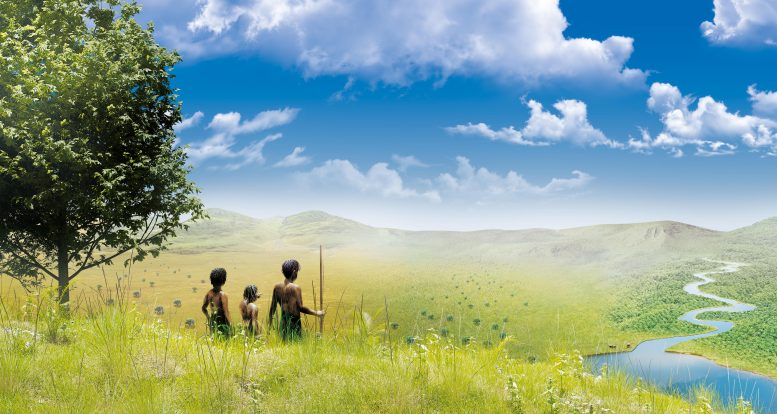
New research conducted by an international team, published in the journal Science, reveals that early human species were capable of adapting to a variety of landscapes and food resources. This adaptability would have strengthened our ancestors’ resilience against historical climate changes.
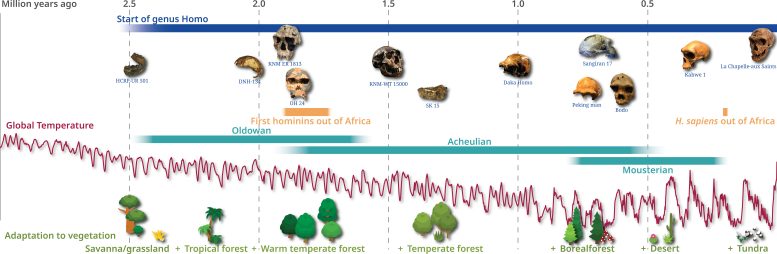
Our genus Homo evolved over the past 3 million years – a period of increasing warm/cold climate fluctuations. The mystery of how early human species adjusted to these intensified climate extremes, ice ages, and sweeping changes in landscapes and vegetation continues to baffle scientists.
Did our ancestors adjust to local environmental changes over time, or did they seek out more stable environments with diverse food resources? Was our human evolution influenced more by temporal changes in climate, or by the spatial character of the environment?
To test these fundamental hypotheses on human evolution and adaptation quantitively, the research team used a compilation of more than three thousand well-dated human fossil specimens and archeological sites, representing six different human species, in combination with realistic climate and vegetation model simulations, covering the past 3 million years. The scientists focused their analysis on biomes – geographic regions which are characterized by similar climates, plants, and animal communities (e.g., savannah, rainforest, or tundra).
“For the archeological and anthropological sites and corresponding ages, we extracted the local biome types from our climate-driven vegetation model. This revealed which biomes were favored by the extinct hominin species H. ergaster, H. habilis, H. erectus, H. heidelbergensis, and H. neanderthalensis and by our direct ancestors – H. sapiens.”, said Elke Zeller, a Ph.D. student from the IBS Center for Climate Physics at Pusan National University, South Korea, and lead author of the study.
Shifting Landscapes and the Evolution of Human Tolerance
According to their analysis, the scientists found that earlier African groups preferred to live in open environments, such as grassland and dry shrubland. Migrating into Eurasia around 1.8 million years ago, hominins, such as H. erectus and later H. heidelbergensis and H. neanderthalensis developed higher tolerances to other biomes over time, including temperate and boreal forests. “To survive as forest-dwellers, these groups developed more advanced stone tools and likely also social skills”, said Prof. Pasquale Raia, from the Università di Napoli Federico II, Italy, co-author of the study. Eventually, H. sapiens emerged around 200,000 years ago in Africa, quickly becoming the master of all trades. Mobile, flexible, and competitive, our direct ancestors, unlike any other species before, survived in harsh environments such as deserts and tundra.
When further looking into the preferred landscape characteristics, the scientists found a significant clustering of early human occupation sites in regions with increased biome diversity. “What that means is that our human ancestors had a liking for mosaic landscapes, with a great variety of plant and animal resources in close proximity”, said Prof. Axel Timmermann, co-author of the study and Director of the IBS Center for Climate Physics in South Korea. The results indicate that ecosystem diversity played a key role in human evolution.
The Diversity Selection Hypothesis
The authors demonstrated this preference for mosaic landscapes for the first time on continental scales and propose a new Diversity Selection Hypothesis: Homo species, and H. sapiens, in particular, were uniquely equipped to exploit heterogeneous biomes.
“Our analysis shows the crucial importance of landscape and plant diversity as a selective element for humans and as a potential driver for socio-cultural developments” adds Elke Zeller. Elucidating how vegetation shifts have shaped human sustenance, the new Science study provides an unprecedented view into human prehistory and survival strategies.
The climate and vegetation model simulations, which cover the Earth’s history of the past 3 million years, were conducted on one of South Korea’s fastest science supercomputers named Aleph. “Supercomputing is now emerging as a key tool in evolutionary biology and anthropology,” said Axel Timmermann.
Reference: “Human adaptation to diverse biomes over the past 3 million years” by Elke Zeller, Axel Timmermann, Kyung-Sook Yun, Pasquale Raia, Karl Stein and Jiaoyang Ruan, 11 May 2023, Science.
DOI: 10.1126/science.abq1288
The study was funded by the Institute for Basic Science.
Never miss a breakthrough: Join the SciTechDaily newsletter.
Follow us on Google and Google News.