
Close Menu
    Facebook X (Twitter) Instagram
    SciTechDaily
    • Biology
    • Chemistry
    • Earth
    • Health
    • Physics
    • Science
    • Space
    • Technology
    Facebook X (Twitter) Pinterest YouTube RSS
    SciTechDaily
    Home»Chemistry»Revealing Failure Mechanisms of Energy Storage Devices
    Chemistry

    Revealing Failure Mechanisms of Energy Storage Devices

    By Dalian Institute of Chemical PhysicsDecember 1, 2021No Comments3 Mins Read
    Facebook Twitter Pinterest Telegram LinkedIn WhatsApp Email Reddit
    Share
    Facebook Twitter LinkedIn Pinterest Telegram Email Reddit
    Relaxation and Failure Mechanisms of Energy Storage Devices
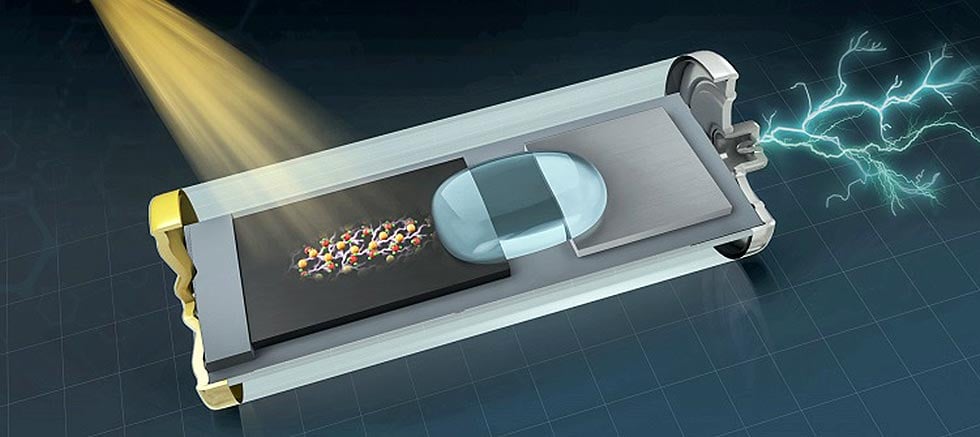
    Surface science methodology reveals relaxation and failure mechanisms of energy storage devices. Credit: DICP

    Using in situ surface science tools, scientists revealed that water vapor causes hydrolysis-driven failure in aluminum ion batteries, while dry atmospheres allow recoverable electrode relaxation

    Long cycle life and high safety are required for energy storage devices (ESDs) in their large-scale applications. Therefore, it’s important to explore both the operating and failure mechanisms of ESDs.

    Previous characterization techniques such as X-ray diffraction (XRD), transmission electron microscopy (TEM), X-ray spectroscopy and topography, and nuclear magnetic resonance (NMR) were based on bulk regions of electrodes or electrolytes, and they overlooked the critical surface/interface behaviors that govern the operation and failure in ESDs.

    In Situ Surface Science Reveals Atmosphere-Dependent Mechanisms

    Recently, a research team led by Prof. FU Qiang from the Dalian Institute of Chemical Physics (DICP) of the Chinese Academy of Sciences (CAS) revealed the atmosphere-dependent relaxation and failure mechanisms of ESDs by in situ surface science methodology.

    The results were recently published in Journal of the American Chemical Society.

    The researchers visualized atmosphere-dependent relaxation and failure processes in ESDs by in situ Raman, X-ray diffraction (XRD) and X-ray photoelectron spectroscopy (XPS).

    They found that for aluminum ion batteries (AIB), the relaxation effects of the graphite electrode in anhydrous atmospheres were manifested by recoverable stage-structure change and electronic relaxation. The mechanisms could be described as the redistribution of the anion/cation pairs within graphite electrodes by in situ XPS.

    How Water Triggers Hydrolysis and Electrode Failure

    Once exposed to hydrous atmospheres, H2O molecules from ambient could intercalate into the graphite electrode and hydrolysis reactions could be induced between newly intercalated H2O and ions. After H2O intercalation and hydrolysis, the failure behaviors of the graphite electrode happened as shown by the stage-structure degradation and electronic decoupling.

    “We have developed the atmosphere-, temperature- and potential-controlled operando/in situ surface/interface techniques and well-defined model devices,” said Prof. FU. “Such methods can be extended to explore the relaxation and failure mechanisms of more ESDs, such as metal-ion secondary batteries/supercapacitors, and the interface reactions in metal-gas batteries.”

    Reference: “In Situ Visualization of Atmosphere-Dependent Relaxation and Failure in Energy Storage Electrodes” by Chao Wang, Caixia Meng, Shiwen Li, Guohui Zhang, Yanxiao Ning and Qiang Fu, 13 October 2021, Journal of the American Chemical Society.
    DOI: 10.1021/jacs.1c09429

    This work was supported by the National Natural Science Foundation of China, the National Key R&D Program of China, the Strategic Priority Research Program of CAS, and the DICP&QIBEBT funding.

    Never miss a breakthrough: Join the SciTechDaily newsletter.
    Follow us on Google and Google News.

    Battery Technology Chinese Academy of Sciences
    Share. Facebook Twitter Pinterest LinkedIn Email Reddit

    Related Articles

    This Simple Chemistry Fix Could Revolutionize Flow Batteries

    High-Density, Ultra-Stable Batteries Advance Renewable Energy Storage

    Chemists Develop New Way to Create Lithium Metal Electrodes for Batteries

    New Approach to Better Electrolytes for Next-Generation Lithium Batteries

    New Technique Reveals 3D Nanoscale Chemical Reactions Inside Batteries

    Novel Carbon Coating Technology of Li-Rich Layered Oxide Cathode

    New Sodium-Conducting Material Significantly Outperforms All Others in Its Class

    Holey Graphene Framework Boosts the Energy Density of Electrochemical Capacitors

    Using X-Ray Imaging to Help Improve Lithium-Sulfur Battery Technology

    Leave A Reply Cancel Reply

    • Facebook
    • Twitter
    • Pinterest
    • YouTube

    Don't Miss a Discovery

    Subscribe for the Latest in Science & Tech!

    Trending News

    First-of-Its-Kind Discovery: Homer’s Iliad Found Embedded in a 1,600-Year-Old Egyptian Mummy

    Beyond Inflammation: Scientists Uncover New Cause of Persistent Rheumatoid Arthritis

    A Simple Molecule Could Unlock Safer, Easier Weight Loss

    Scientists Just Built a Quantum Battery That Charges Almost Instantly

    Researchers Unveil Groundbreaking Sustainable Solution to Vitamin B12 Deficiency

    Millions of People Have Osteopenia Without Realizing It – Here’s What You Need To Know

    Researchers Discover Boosting a Single Protein Helps the Brain Fight Alzheimer’s

    World-First Study Reveals Human Hearts Can Regenerate After a Heart Attack

    Follow SciTechDaily
    • Facebook
    • Twitter
    • YouTube
    • Pinterest
    • Newsletter
    • RSS
    SciTech News
    • Biology News
    • Chemistry News
    • Earth News
    • Health News
    • Physics News
    • Science News
    • Space News
    • Technology News
    Recent Posts
    • Scientists Flip Immune System “Switch,” Uncover Surprising Path To Stop Gut Inflammation
    • Magnesium Magic: New Drug Melts Fat Even on a High-Fat, High-Sugar Diet
    • Weight-Loss Drugs Like Ozempic May Come With an Unexpected Cost
    • After Decades, MIT Researchers Capture the First 3D Atomic View of a Mysterious Material
    • Your Favorite Fishing Spot Is Turning Brown – and the Fish Are Changing
    Copyright © 1998 - 2026 SciTechDaily. All Rights Reserved.
    • Science News
    • About
    • Contact
    • Editorial Board
    • Privacy Policy
    • Terms of Use

    Type above and press Enter to search. Press Esc to cancel.