
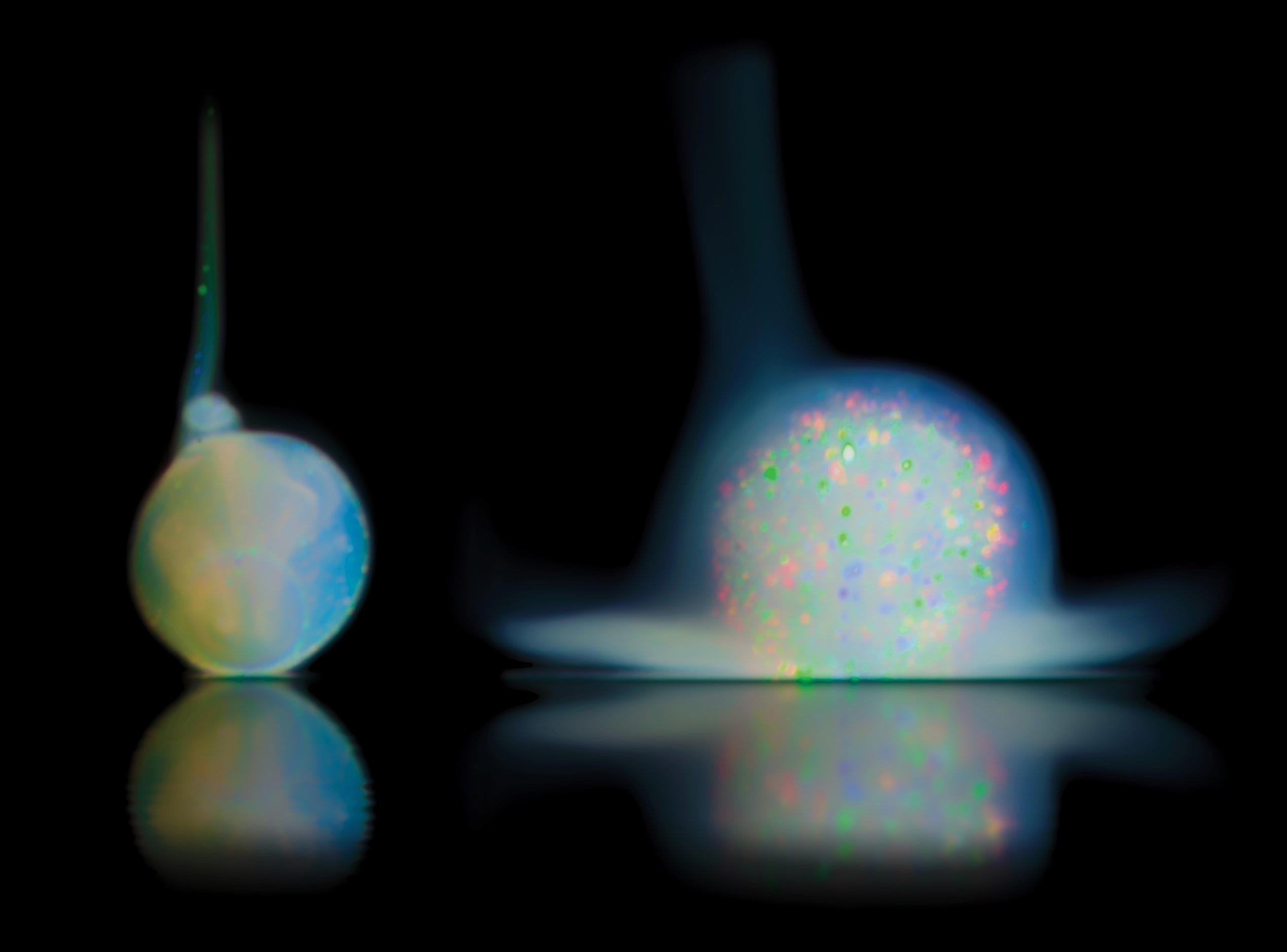
A new technique employing monochromatic light improves the study of internal structures in materials affected by light scattering, enabling detailed observation of particle concentrations.
When driving through a bank of fog, car headlights are only moderately helpful since the light is scattered by the water particles suspended in the air. A similar situation occurs when trying to observe the inside of a drop of milk in water or the internal structure of an opal gem with white light. In these cases, multiple light scattering effects prevent examination of the interior.
Now, a team of researchers at Johannes Gutenberg University Mainz (JGU) and Heinrich Heine University Düsseldorf (HHU) has overcome this challenge and developed a new method to study the interior of a crystalline drop.

Monochromatic Illumination Sheds Light on the Problem
When you put a drop of ink into water, we all know the result: the ink particles will gradually disperse by simple diffusion. However, it is not necessarily the same when a drop consisting of particles that strongly repel each other is considered. A few simulations exist for some rather exotic materials, such as dusty plasma, which – like the matter that makes up the sun – consists of repulsive particles. Predictions for drops made of repelling particles suspended in a liquid have been missing. Also, experimentally, all attempts to measure the three-dimensional behavior of such a drop have proved futile.
However, researchers have now developed a method using very simple lab tools that can be used for investigation in cases where white light cannot penetrate, and the use of X-ray would not be expedient. Their approach exploits the fact that the color of multiply scattered light depends on the local concentration of particles. This effect is even enhanced when the material is crystalline. Thus, regions of different particle concentrations will appear in different colors.

In principle, concentrated regions shimmer in bright blue; others, where the particles are further apart, exhibit a reddish hue. Illuminating the drop with white light, which is a mixture of different wavelengths, all colors are scattered simultaneously, and it is practically impossible to determine the exact origin of each color within the overall turbid and whitish drop.
“We overcame this difficulty by consecutively illuminating the drops with different monochromatic light, i.e., light of individual wavelengths,” explained Professor Palberg from JGU. For each wavelength, multiple scattering only occurred in regions of suitable particle concentration, while the rest of the drop became transparent for this wavelength.
“Thus, we are able to see where exactly the red or the blue light was scattered from deep inside the drop,” Palberg added. “Using our technique, we now can – with a high degree of spatial and temporal resolution – examine the density profile of crystalline, turbid drops and even that of other cloudy media.” For instance, this method could be useful for analyzing the concentration gradients of sedimenting slurries or determining the degree of homogenization obtained when stirring paint diluted with solvent.
Development of a crystalline drop of colloidal suspension observed for 20 seconds starting from being added to a water bath. Monochromatic light of a wavelength of 611 nanometers makes a shell of well-defined particle concentration appear crimson red deep inside the droplet. Credit: Marcus Witt / JGU
An opalescent drop of a crystalline colloidal suspension under white light illumination. During expansion into the surrounding water, the drop melts at its outer rim and the molten material gathers in a layer at the cell bottom. Credit: Josefine von Puttkamer-Luerssen / JGU
An opalescent drop of a crystalline colloidal suspension under white light illumination. During expansion into the surrounding water, a transparent crystalline layer envelops the turbid core region. Any look deep inside is blocked. Credit: Johannes A. B. Wagner / JGU
Complex Expansion Profile of Crystalline Drops
In their recent paper, published in the journal Soft Matter, the researchers applied their new method to study drops of a suspension composed of equally charged and hence repelling small polymer spheres suspended in water. Initially, these particles interact so strongly that the undiluted suspension forms a polycrystalline material. Such a suspension is very similar in appearance to a gem opal and shows very strong multiple scattering. However, as soon as a drop of it is placed in water, it starts expanding.
“With this pioneering work, we were able to establish that the expansion profile of this crystalline material is relatively complex. There is neither a constant overall density with a precisely defined outer edge nor is there a straightforward diffusion profile as one might expect from a drop of non-repelling particles in a liquid medium,” said Palberg. In addition, there is initial rapid expansion of the crystalline sphere due to the mutual repulsion between the particles before the crystals disintegrate at the drop rim due to their dilution, and the drop gradually begins to shrink.
While the lab experiments were being performed at Mainz University, Professor Hartmut Löwen’s team at HHU was undertaking theoretical modeling of the density profile based on dynamical density functional theory. “There was promising correlation between the results of experimentation and modeling, indicating the good predictive power of this kind of theory,” stated Löwen.
In fact, the calculated density profile also showed a central maximum density and a radial density gradient, which flattened with time. Remarkably, even the time of maximum expansion of the crystalline drop was predicted accurately. It can be concluded that two opposed processes determine the size of a drop: it expands continuously while, simultaneously, it melts at its contour. “The interplay between these two processes yields an expansion scenario which differs in qualitative terms from what has been predicted from the modeling of plasmas,” concluded the researchers.
They plan to continue with their investigations by systematically varying the level of repulsion of the particles to find out how this influences density profile and expansion dynamics.
Reference: “Accessing the free expansion of a crystalline colloidal drop by optical experiments” by Marcus U. Witt, G. H. Philipp Nguyen, Josefine R. von Puttkamer-Luerssen, Can H. Yilderim, Johannes A. B. Wagner, Ebrahim Malek, Sabrina Juretzka, Jorge L. Meyrelles, Maximilan Hofmann, Hartmut Löwen and Thomas Palberg, 27 August 2024, Soft Matter.
DOI: 10.1039/D4SM00413B
Never miss a breakthrough: Join the SciTechDaily newsletter.
Follow us on Google and Google News.