

Biomedical engineers at the University of Melbourne have developed a 3D bioprinting system capable of creating structures that closely replicate the diverse tissues of the human body.
Biomedical engineers at the University of Melbourne have developed a 3D bioprinting system capable of creating structures that closely replicate various human tissues, ranging from soft brain tissue to more rigid materials like cartilage and bone.
This innovative technology provides cancer researchers with a powerful tool for replicating specific organs and tissues, enhancing their ability to predict drug responses and develop new treatments. By offering a more accurate and ethical approach to drug discovery, it also has the potential to reduce reliance on animal testing.
Head of the Collins BioMicrosystems Laboratory at the University of Melbourne, Associate Professor David Collins said: “In addition to drastically improving print speed, our approach enables a degree of cell positioning within printed tissues. Incorrect cell positioning is a big reason most 3D bioprinters fail to produce structures that accurately represent human tissue.
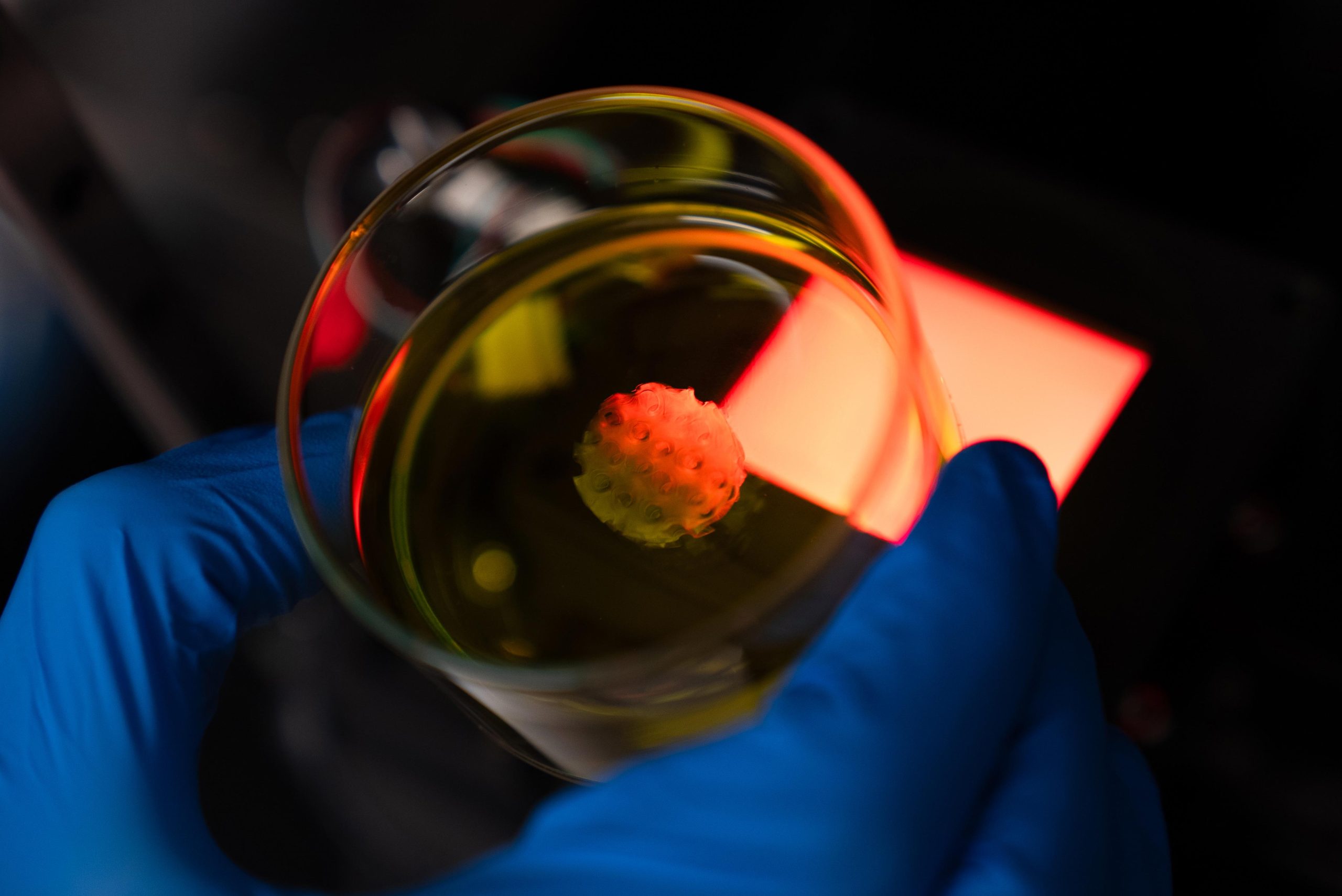
“Just as a car requires its mechanical components to be arranged precisely for proper function, so too must the cells in our tissues be organized correctly. Current 3D bioprinters depend on cells aligning naturally without guidance, which presents significant limitations.
“Our system, on the other hand, uses acoustic waves generated by a vibrating bubble to position cells within 3D printed structures. This method provides the necessary head start for cells to develop into the complex tissues found in the human body.”
Most commercially available 3D bioprinters rely on a slow, layer-by-layer fabrication approach, which presents several challenges. This method can take hours to finish, jeopardizing the viability of living cells during the printing process. Additionally, once printed, the cell structures must be carefully transferred into standard laboratory plates for analysis and imaging—a delicate step that risks compromising the integrity of these fragile structures.
A Game-Changing Approach Using Acoustic Waves
The University of Melbourne research team has flipped the current process on its head by developing a sophisticated optical-based system, replacing the need for a layer-by-layer approach.
The innovative technique uses vibrating bubbles to 3D print cellular structures in just a matter of seconds, which is around 350 times faster than traditional methods and enables researchers to accurately replicate human tissues with cellular resolution.
By dramatically reducing the 3D printing time and printing directly into standard lab plates, the team has been able to significantly increase the cell survival rate, whilst eliminating the need for physical handling. Ensuring the printed structures remain intact and sterile throughout the process.
PhD student Callum Vidler, the lead author on this work, said the groundbreaking technology was already generating excitement in the medical research sector.
“Biologists recognize the immense potential of bioprinting, but until now, it has been limited to applications with a very low output,” he said. “We’ve developed our technology to address this gap, offering significant advancements in speed, precision, and consistency. This creates a crucial bridge between lab research and clinical applications.
“So far, we’ve engaged with around 60 researchers from institutions including the Peter MacCallum Cancer Centre, Harvard Medical School, and the Sloan Kettering Cancer Centre, and the feedback has been overwhelmingly positive.”
Reference: “Dynamic interface printing” by Callum Vidler, Michael Halwes, Kirill Kolesnik, Philipp Segeritz, Matthew Mail, Anders J. Barlow, Emmanuelle M. Koehl, Anand Ramakrishnan, Lilith M. Caballero Aguilar, David R. Nisbet, Daniel J. Scott, Daniel E. Heath, Kenneth B. Crozier and David J. Collins, 30 October 2024, Nature.
DOI: 10.1038/s41586-024-08077-6
Funding: Australian Research Council, National Health and Medical Research Council, Centre of Excellence for Transformative Meta-Optical Systems, University of Melbourne, Royal Melbourne Hospital
Never miss a breakthrough: Join the SciTechDaily newsletter.
Follow us on Google and Google News.
2 Comments
What 3 D printing in SC
And Jordan Miller of volumetrics in USA
Read so many exciting articles like this but they all end up being hype. Here’s to hoping one or two end up having a real impact!