
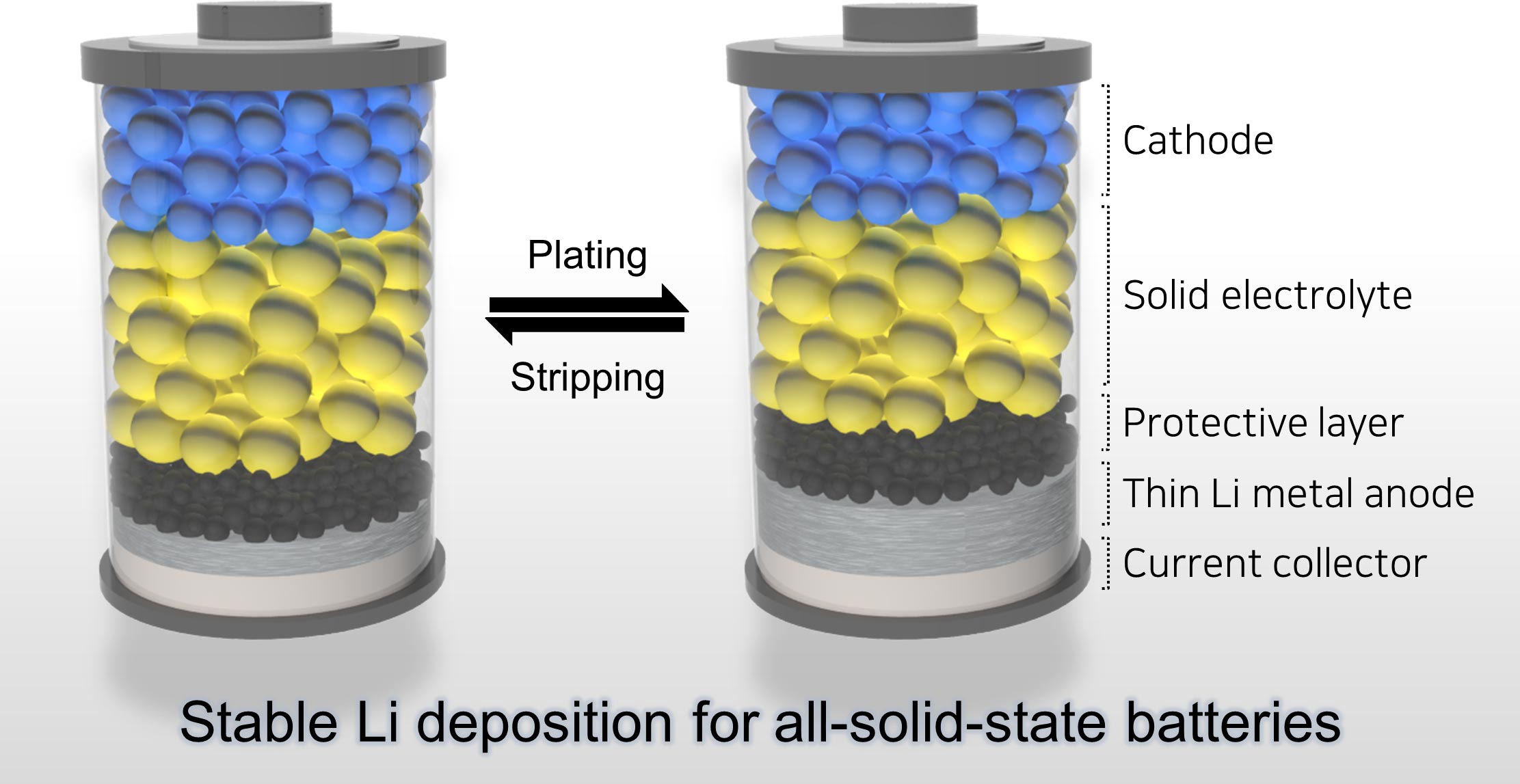
Breakthrough in all-solid-state battery technology with a novel electrodeposition method increases efficiency and lifespan.
A research team, consisting of Professor Soojin Park from the Department of Chemistry, PhD candidate Sangyeop Lee from the Division of Advanced Materials Science, and Dr. Sungjin Cho and Master’s student Hyunbeen Choi from the Department of Chemistry at Pohang University of Science and Technology (POSTECH), and Dr. Jin Hong Kim and Dr. Hongyeul Bae from the POSCO N.EX.T Hub, has recently enhanced the performance and durability of all-solid-state batteries successfully. This breakthrough was made possible through the implementation of a novel approach known as bottom electrodeposition.[1] Their research has been published in the international journal Small.
Addressing the Challenges of Battery Safety
Utilized in various applications such as electric vehicles and energy storage systems, secondary batteries generally rely on liquid electrolytes. However, the flammability of liquid electrolytes poses a risk of fires. This prompts ongoing research efforts to explore the use of solid electrolytes and the metal lithium (Li) in all-solid-state batteries, offering a safer option.
In the operation of all-solid-state batteries, lithium is plated onto an anode, and the movement of electrons is harnessed to generate electricity. During the charging and discharging process, lithium metal undergoes a cycle of losing electrons, transforming into an ion, regaining electrons, and being electrodeposited back into its metallic form. However, indiscriminate electrodeposition of lithium can quickly deplete the available lithium, leading to a significant reduction in the battery’s performance and durability.
Innovations in Anode Protection
To address this issue, the research team collaborated with the POSCO N.EX.T Hub to develop an anode protection layer composed of a functional binder (PVA-g-PAA)[2] for all-solid-state batteries. This layer exhibits exceptional lithium transfer properties, preventing random electrodeposition and promoting a process of ‘bottom electrodeposition.’ This ensures that lithium is uniformly deposited from the bottom of the anode surface.
Using scanning electron microscope (SEM), the research team conducted an analysis that confirmed the stable electrodeposition and detachment[3] of lithium ions. This significantly reduced unnecessary lithium consumption. All-solid-state batteries developed by the team also demonstrated stable electrochemical performance over extended periods even with lithium metal as thin as 10 micrometers (μm) or less.
Professor Soojin Park who led the research expressed his commitment by saying, “We have devised an enduring all-solid-state battery system through a novel electrodeposition strategy.” He added, “With further research, we aim to provide more effective ways to enhance battery life and increase energy density.” Building on the collaborative findings, POSCO Holdings plans to move towards the commercialization of lithium metal anodes, a core material for the next generation of secondary batteries.
Notes
- Electrodeposition
The method of depositing a metal onto an electrode submerged in an electrolyte by passing an electric current through the electrolyte - PVA-g-PAA
Poly (vinyl alcohol)-grafting-poly (acrylic acid) - Detach
To break away or separate, a phenomenon where lithium metal loses electrons and transforms into lithium ions
Reference: “Bottom Deposition Enables Stable All-Solid-State Batteries with Ultrathin Lithium Metal Anode” by Sangyeop Lee, Sungjin Cho, Hyunbeen Choi, Sungho Kim, Insu Jeong, Yubin Lee, Taesun Choi, Hongyeul Bae, Jin Hong Kim and Soojin Park, 15 February 2024, Small.
DOI: 10.1002/smll.202311652
The research was conducted with support from the POSCO Holdings, the Ministry of Trade, Industry and Energy, and the Korea Planning & Evaluation Institute of Industrial Technology (KEIT).
Never miss a breakthrough: Join the SciTechDaily newsletter.
Follow us on Google and Google News.