
Close Menu
    Facebook X (Twitter) Instagram
    SciTechDaily
    • Biology
    • Chemistry
    • Earth
    • Health
    • Physics
    • Science
    • Space
    • Technology
    Facebook X (Twitter) Pinterest YouTube RSS
    SciTechDaily
    Home»Chemistry»Revolutionary Chemistry: 120-Year-Old Reaction Turned On Its Head
    Chemistry

    Revolutionary Chemistry: 120-Year-Old Reaction Turned On Its Head

    By Hokkaido UniversityNovember 18, 2021No Comments4 Mins Read
    Facebook Twitter Pinterest Telegram LinkedIn WhatsApp Email Reddit
    Share
    Facebook Twitter LinkedIn Pinterest Telegram Email Reddit
    Chemistry Animation
    Researchers have developed a simpler, greener method for producing Grignard reagents, reducing the use of hazardous solvents and potentially lowering production costs.

    A new method for creating one of chemistry’s most widely used class of compounds could revolutionize industrial processes, making them cheaper, simpler, and more environmentally friendly.

    A group of researchers led by scientists at Hokkaido University have developed a simpler, greener method for producing Grignard reagents—one of the most important and widely used type of reagents in the chemical industry—that drastically cuts down on the use of hazardous organic solvents and could lead to reduced production costs. This new process was reported in Nature Communications.
    Simpler Method for Producing Grignard Reagents
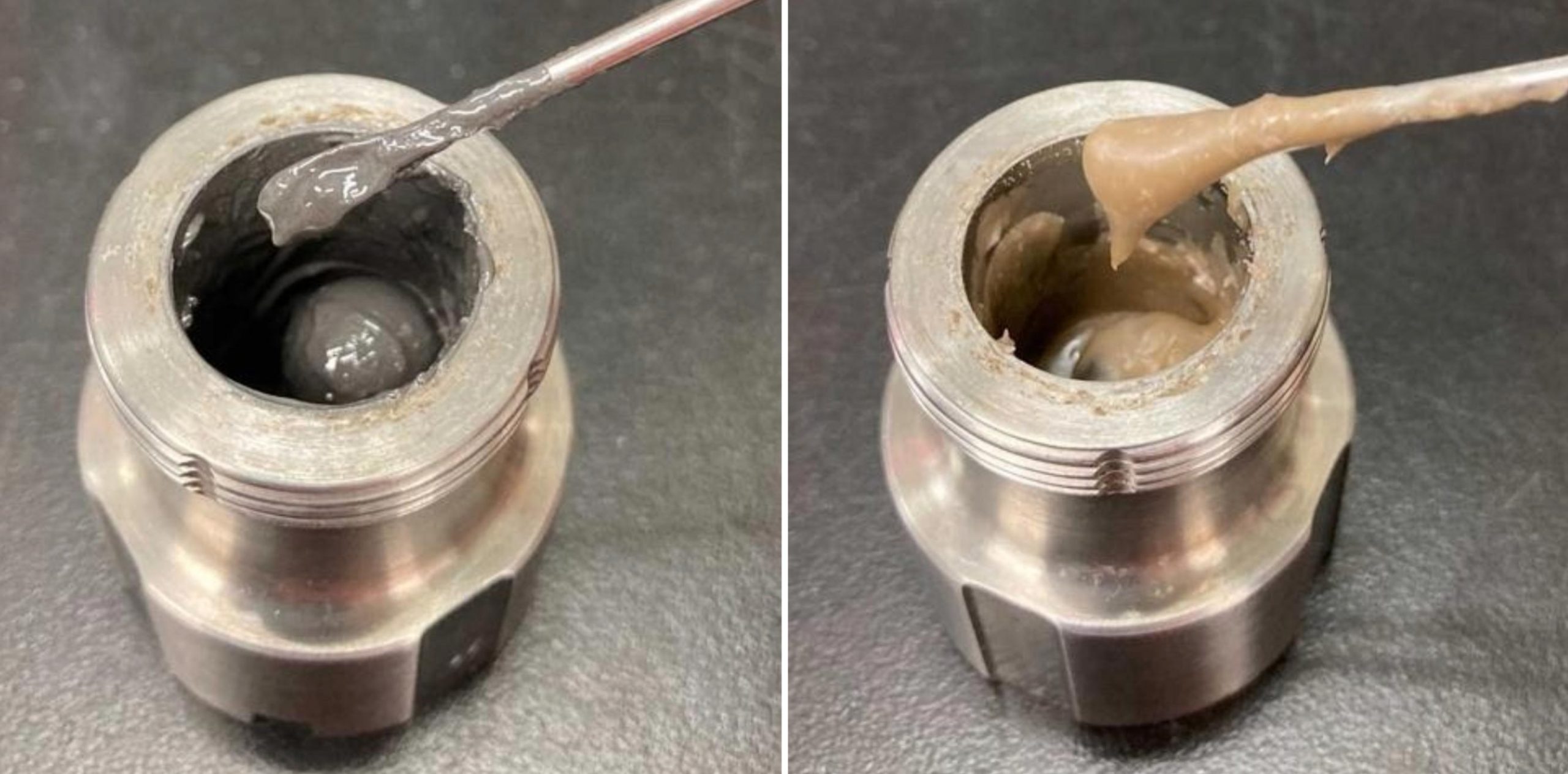
    (Left) Reaction mixture of magnesium metal and organohalide after one hour of ball milling. Use of this material in subsequent reactions led to only a 6% yield of the desired product. (Right) Same process, but with a small amount of organic solvent also added at the beginning. Use of this paste form of Grignard reagent in subsequent reactions led to yields of up to 94% of the desired product. Credit: Koji Kubota

    Grignard reagents are an essential ingredient in a common method for creating carbon-carbon bonds, the building blocks of organic molecules. These reagents were discovered 120 years ago, but due to their instability, the conventional production method still used today is carried out in toxic organic solvents with no exposure to moisture and oxygen. This results in a complicated, delicate, and expensive process that produces environmentally hazardous waste.

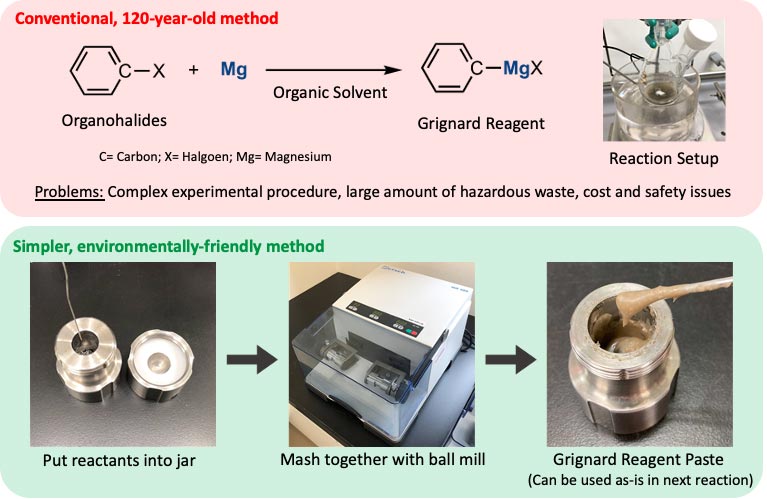
    Researchers sidestepped these problems by minimizing the amount of organic solvent used and by employing a mechanochemical technique called ball-milling to produce Grignard reagents. The reactants, magnesium metal and organohalides, were loaded into a metal chamber along with a stainless-steel ball. In a key step, a small amount of organic solvent—about one-tenth the amount used in conventional methods—was added to the solid reactants. The chamber was then spun for one hour, causing the ball to tumble around and slam into the solid-state reactants, helping them to mix thoroughly and react, forming a paste-like Grignard reagent.
    Synthesizing Grignard Reagents
    (Top Panel) Conventional method for synthesizing Grignard reagents by reacting magnesium and organohalides in organic solvents. This method has been used for 120 years. (Bottom Panel) New method for synthesizing Grignard reagents by mixing reactants in a ball mill with minimal organic solvent usage. This method can be used in ambient air to achieve a wide range of organic reactions with little to no solvent. Credit: Rina Takahashi, et al. Nature Communications. November 18, 2021

    Researchers even succeeded in creating new Grignard reagents using organohalides that have poor solubility in organic solvents, which can’t typically be made by the conventional method. Avoiding heavy use of organic solvents allowed the researchers to overcome solubility problems, which opens up a world of new reactions with Grignard reagents prepared from insoluble compounds. It also leads to a major reduction in hazardous waste.

    Additionally, it is more difficult for water or oxygen to affect the Grignard reagents when less organic solvent is used. This means that removing water and oxygen from the surrounding air is not required, making the process easier to perform and less costly. Given the potential economic and environmental benefits, this discovery could have a huge effect on chemical industries.

    Hajime Ito and Koji Kubota
    Professor Hajime Ito (left) and Associate Professor Koji Kubota of the research team at Hokkaido University and the Institute for Chemical Reaction Design and Discovery (ICReDD). Credit: Photos provided by ICReDD

    “With a growing need to address environmental concerns and reduce CO2 emissions, it is important to develop chemical reactions that don’t require organic solvents,” commented Associate Professor Koji Kubota. “Grignard reagents are arguably the most well-known, commonly used reagents in industry, and so our work could fundamentally change the way a vast number of chemicals are produced at scale, leading to significantly reduced impact on the environment.”

    Reference: “Mechanochemical synthesis of magnesium-based carbon nucleophiles in air and their use in organic synthesis” by Rina Takahashi, Anqi Hu, Pan Gao, Yunpeng Gao, Yadong Pang, Tamae Seo, Julong Jiang, Satoshi Maeda, Hikaru Takaya, Koji Kubota and Hajime Ito, 18 November 2021, Nature Communications.
    DOI: 10.1038/s41467-021-26962-w

    Never miss a breakthrough: Join the SciTechDaily newsletter.
    Follow us on Google and Google News.

    Catalysts Chemical Engineering Hokkaido University Industrial Engineering
    Share. Facebook Twitter Pinterest LinkedIn Email Reddit

    Related Articles

    Cheaper, Faster New Way To Continuously Produce Amines – Chemical Building Blocks Used in Many Products

    Increasing the Efficiency of Chemical Reactions To Help Decarbonize Fuels and Chemicals

    Scientists Can Now Design Single Atom Catalysts for Important Chemical Reactions

    Engineers Develop a New Water Treatment Technology That Could Also Help Mars Explorers

    Mysterious Organic Scum Boosts Chemical Reaction Efficiency – Discovery May Reduce Environmental Impact of Manufacturing

    “Swiss Army Knife” Nanoparticle Catalyst Can Make Natural Gas Burn Cleaner

    Key Step Toward Cleaner, More Efficient Mass-Production of Hydrogen From Water

    Super-Particles: The Importance of Good Neighbors in Catalysis

    Ultrastable Catalyst Could Lead to More Efficient and Cheaper Production of Propylene From Propane

    Leave A Reply Cancel Reply

    • Facebook
    • Twitter
    • Pinterest
    • YouTube

    Don't Miss a Discovery

    Subscribe for the Latest in Science & Tech!

    Trending News

    Scientists Discover Cheap, Natural Remedy for High Blood Pressure

    Earth’s Upper Atmosphere Is Cooling Fast and Scientists Finally Know Why

    32,000 Olympic Pools of Magma Nearly Erupted Beneath Atlantic Island

    Exercise Changes the Heart in a Way Researchers Never Expected

    Too Much Sleep May Age Your Body Faster, New Study Warns

    Scientists Uncover Promising New Strategy To Stop Parkinson’s in Its Tracks

    Experts Reveal the Surprising Cancer Link Behind a Common Vitamin

    This Strange “Golden Orb” Found 2 Miles Deep Stumped Scientists for Years

    Follow SciTechDaily
    • Facebook
    • Twitter
    • YouTube
    • Pinterest
    • Newsletter
    • RSS
    SciTech News
    • Biology News
    • Chemistry News
    • Earth News
    • Health News
    • Physics News
    • Science News
    • Space News
    • Technology News
    Recent Posts
    • Massive Genetic Study Reveals Hidden Causes of Pregnancy Sickness
    • Scientists Discover Surprising Way Cranberry Juice Could Fight Antibiotic Resistance
    • Researchers Discover the Body’s Hidden “Off Switch” for Inflammation
    • Scientists Discover Metformin Doesn’t Work the Way We Thought
    • Tea or Coffee? Your Daily Choice Could Affect Osteoporosis Risk
    Copyright © 1998 - 2026 SciTechDaily. All Rights Reserved.
    • Science News
    • About
    • Contact
    • Editorial Board
    • Privacy Policy
    • Terms of Use

    Type above and press Enter to search. Press Esc to cancel.