
Close Menu
    Facebook X (Twitter) Instagram
    SciTechDaily
    • Biology
    • Chemistry
    • Earth
    • Health
    • Physics
    • Science
    • Space
    • Technology
    Facebook X (Twitter) Pinterest YouTube RSS
    SciTechDaily
    Home»Chemistry»Revolutionary New Material Harvests Water From Thin Air Without Energy
    Chemistry

    Revolutionary New Material Harvests Water From Thin Air Without Energy

    By New York UniversityDecember 1, 20241 Comment3 Mins Read
    Facebook Twitter Pinterest Telegram LinkedIn WhatsApp Email Reddit
    Share
    Facebook Twitter LinkedIn Pinterest Telegram Email Reddit
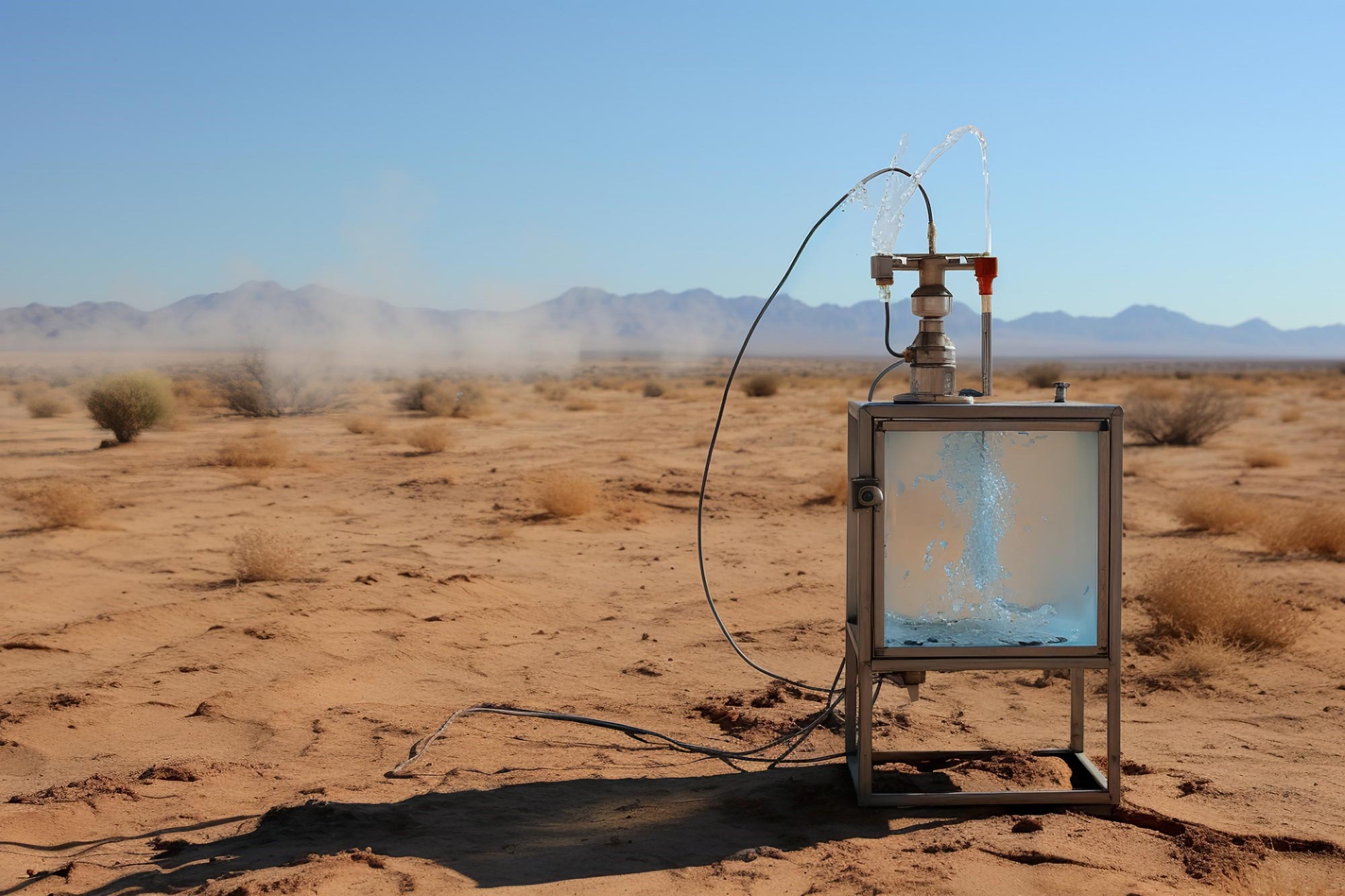
    Harvesting Water in Desert Concept
    New Janus crystals harvest fog efficiently, inspired by desert species, providing an energy-free method to combat water scarcity. (Artist’s concept). Credit: SciTechDaily.com

    Janus crystals, developed by international researchers, efficiently harvest atmospheric water without energy, inspired by desert organisms, offering a promising solution to global water scarcity.

    A team of scientists from Jilin University, NYU Abu Dhabi’s Smart Materials Lab, and the Center for Smart Engineering Materials have developed a new crystalline material that can harvest water from fog without any energy input.

    These novel smart crystals, named Janus crystals, are inspired by desert plants and animals, which can survive in arid conditions. For instance, desert beetles and lizards have evolved to develop surface structures that have both hydrophilic and hydrophobic areas and effectively capture moisture from the air. Water is attracted to the hydrophilic areas and droplets are accumulated and transported through the hydrophobic areas.

    The team, led by Professor of Chemistry Pance Naumov, presented their findings in a new paper published in the Journal of the American Chemical Society.

    Center for Smart Engineering Materials Lab
    Center for Smart Engineering Materials. Credit: NYU Abu Dhabi

    Development and Properties of Janus Crystals

    The researchers chose three chemically versatile organic compounds from which they grew elastic organic crystals. They then tested how each of these materials interacted with the airborne water, which led to the creation of the new water-collecting materials, Janus crystals, that contain both hydrophilic and hydrophobic regions on the surface level, one to capture water and one to transfer it to a receptacle for collection.

    The Janus crystals capture humidity from humid air with the highest-to-date water collection efficiency. The crystals’ narrow and light-translucent structures enable researchers to monitor the collection and condensation of fog droplets in real-time by using light.

    Researcher at Center for Smart Engineering Materials
    Center for Smart Engineering Materials. Credit: NYU Abu Dhabi

    Energy-Efficient Water Collection Method

    Desalination is a widely used method to produce potable water, however an energy-intensive process is required to separate the dissolved salt in saltwater. In contrast, the process of condensation of aerial humidity or fog utilized by the Janus crystals is spontaneous under ambient conditions and can be performed without the input of energy, potentially providing an endless source of clean water.

    Unlike previously reported porous organic crystals, the Janus crystals combine water-collection and water-delivery functions at their surface, creating a highly efficient water-harvesting process that maximizes the amount of collected water at ambient conditions.

    Pance Naumov
    Pance Naumov. Credit: NYU Abu Dhabi

    Impact and Future Applications

    “The earth’s atmosphere contains an abundance of untapped fresh water, but we desperately need materials that can efficiently capture and collect this humidity and condense it into potable water,” said Naumov. “The crystals developed by our team not only capitalize on the mechanical compliance and optical transparency of organic crystals, but also pave the way for the design of active, self-sensing, and efficient surface-active harvesters which, when used at a larger scale, can help us combat water scarcity at a societal level.”

    Reference: “Efficient Aerial Water Harvesting with Self-Sensing Dynamic Janus Crystals” by Linfeng Lan, Liang Li, Chenguang Wang, Panče Naumov and Hongyu Zhang, 22 October 2024, Journal of the American Chemical Society.
    DOI: 10.1021/jacs.4c11689

    Never miss a breakthrough: Join the SciTechDaily newsletter.
    Follow us on Google and Google News.

    Atmospheric Chemistry Desert New York University Water
    Share. Facebook Twitter Pinterest LinkedIn Email Reddit

    Related Articles

    Sweet Solution: Harnessing Plant Power To Extract Heavy Metals From Water

    98% Efficiency: Scientists Unveil Game-Changing Nanoplastic Removal Technology

    Unlocking the Secrets of Ice With Antifreeze and Advanced Microscopy

    New Phosphorescent Probe Unmasks Microstructures in Water Ice

    Green Hydrogen Breakthrough: New Catalyst Unveils the Hidden Power of Water

    Inside the Crystal Matrix: New “X-Ray Vision” Technique Sees Inside Crystals

    Revolutionary “Forever Chemical” Cleanup Strategy Discovered

    Scientists Solve Electrochemical “Catalysis vs Corrosion” Mystery

    Liquid Goldmine: Scientists Are Unlocking the Hidden Minerals in Produced Water

    1 Comment

    1. Boba on December 2, 2024 1:27 am

      And how much energy will it take to produce those crystals at the necessary scale?

      Reply
    Leave A Reply Cancel Reply

    • Facebook
    • Twitter
    • Pinterest
    • YouTube

    Don't Miss a Discovery

    Subscribe for the Latest in Science & Tech!

    Trending News

    Invisible Black Holes Could Be Triggering Supernovae

    Scientists Discover the First Contagious Cancer in a Freshwater Animal

    THC-CBD Treatment Dramatically Reduces Agitation in Dementia Trial

    Scientists Say Love Follows Mathematical Patterns

    “Zombie Cells” Reveal a Hidden Weakness That Could Help Fight Aging

    Alien Signals May Be Hiding in a Radio Band SETI Has Barely Explored

    Earth’s Hidden Thermostat Has Regulated Climate for 60 Million Years

    This 518-Million-Year-Old Creature Reveals How Spiders Got Their Bite

    Follow SciTechDaily
    • Facebook
    • Twitter
    • YouTube
    • Pinterest
    • Newsletter
    • RSS
    SciTech News
    • Biology News
    • Chemistry News
    • Earth News
    • Health News
    • Physics News
    • Science News
    • Space News
    • Technology News
    Recent Posts
    • American Heart Association Reveals How Much Coffee Is Safe for Your Heart
    • Europa’s Hidden Ocean May Be Locked Beneath a Frozen Wall
    • Something Is Still Moving Beneath Venus’s Scorching Surface
    • Earth May Be Twice As Vulnerable to Extreme Solar Storms As Scientists Thought
    • Tiny Divers Challenge a Major Theory About Ocean Insects
    Copyright © 1998 - 2026 SciTechDaily. All Rights Reserved.
    • Science News
    • About
    • Contact
    • Editorial Board
    • Privacy Policy
    • Terms of Use

    Type above and press Enter to search. Press Esc to cancel.