
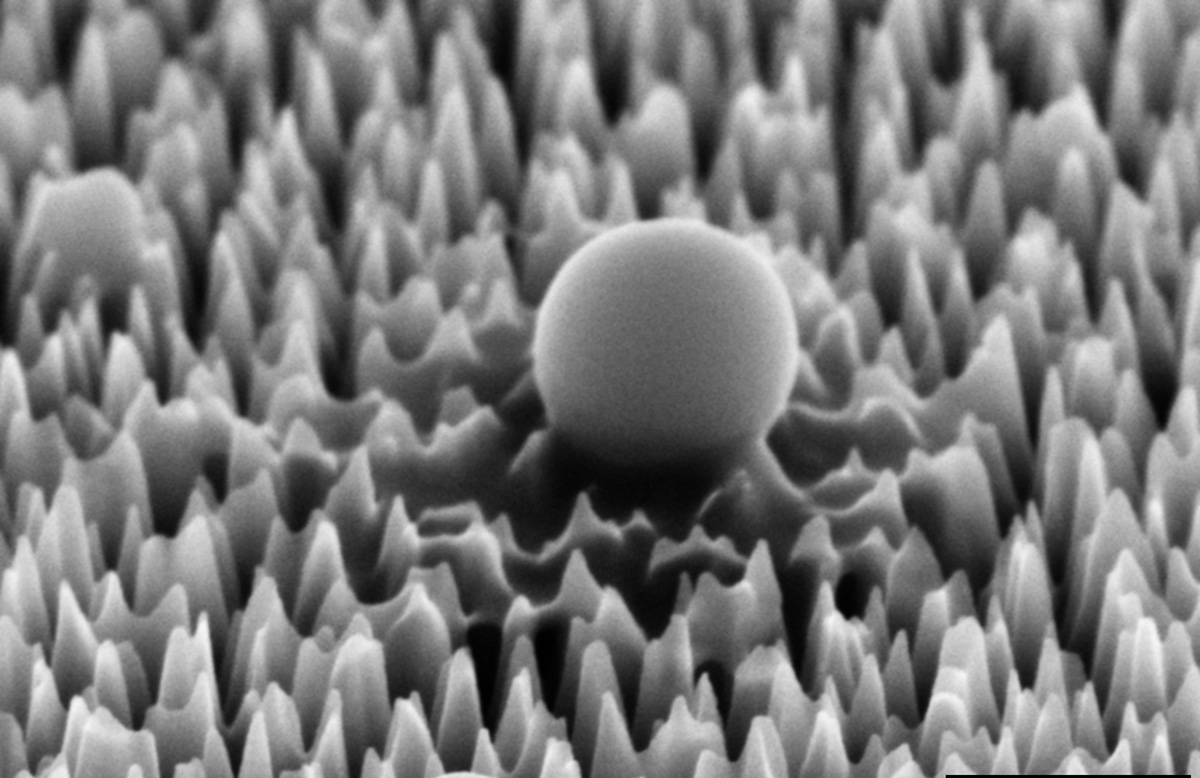
An international research team led by RMIT University has designed and manufactured a virus-killing surface that could help control disease spread in hospitals, labs, and other high-risk environments. The surface made of silicon is covered in tiny nanospikes that skewer viruses on contact.
Lab tests with the hPIV-3 virus – which causes bronchitis, pneumonia, and croup – showed 96% of the viruses were either ripped apart or damaged to the point where they could no longer replicate to cause infection. These impressive results, featured on the cover of top nanoscience journal ACS Nano, show the material’s promise for helping control the transmission of potentially dangerous biological material in laboratories and healthcare environments.
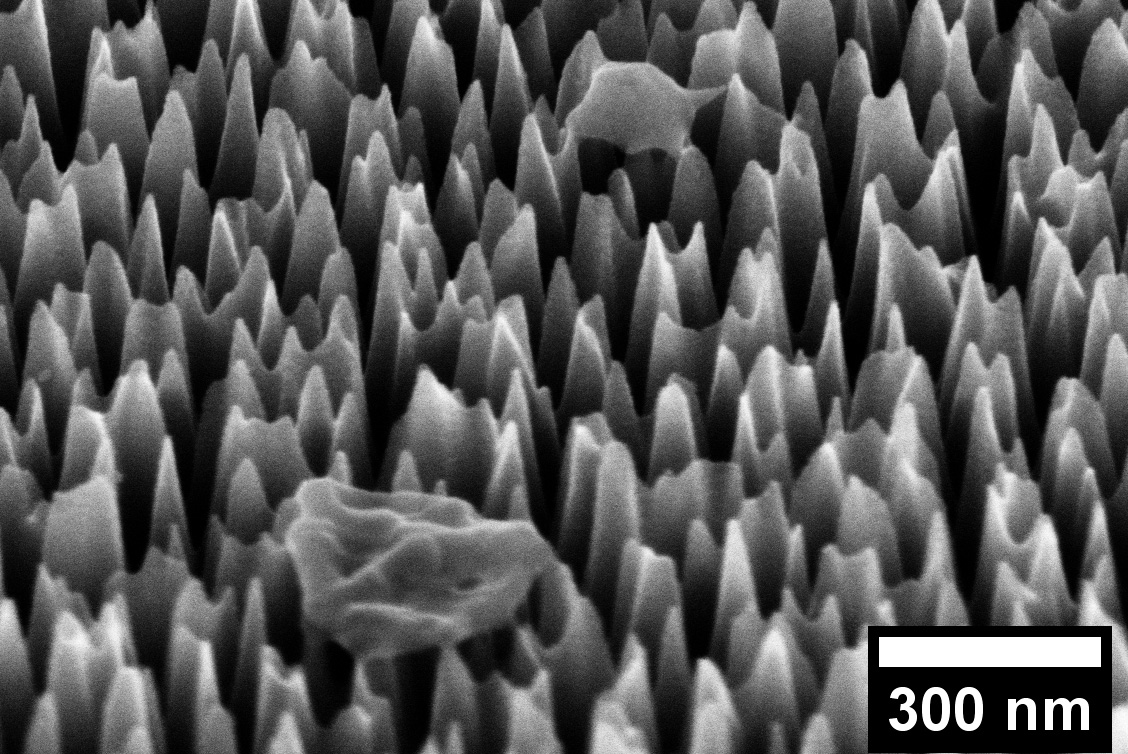
Spike the viruses to kill them
Corresponding author Dr Natalie Borg, from RMIT’s School of Health and Biomedical Sciences, said this seemingly unsophisticated concept of skewering the virus required considerable technical expertise.
“Our virus-killing surface looks like a flat black mirror to the naked eye but actually has tiny spikes designed specifically to kill viruses,” she said. “This material can be incorporated into commonly touched devices and surfaces to prevent viral spread and reduce the use of disinfectants.”
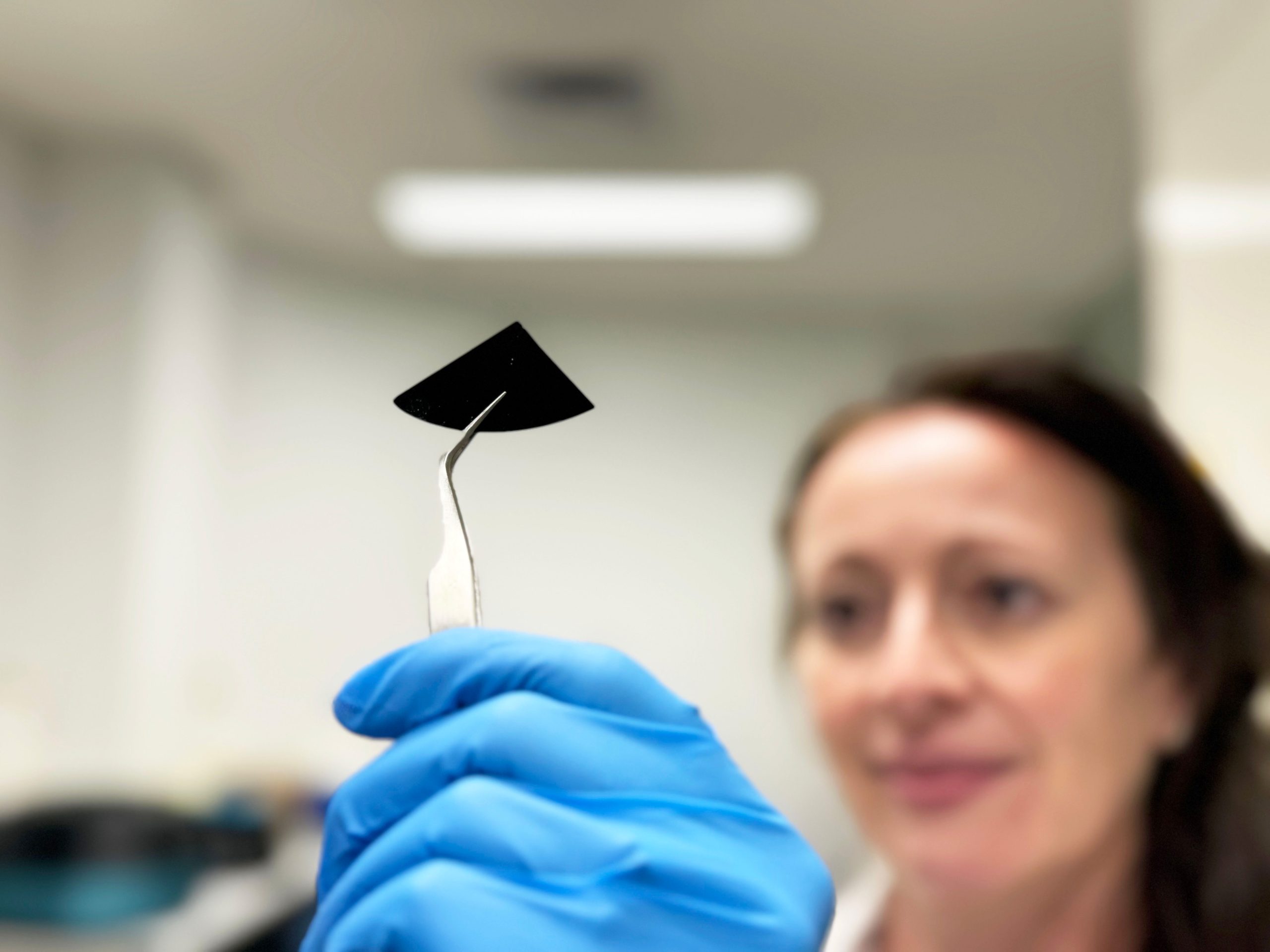
The nano-spiked surfaces were manufactured at the Melbourne Centre for Nanofabrication, starting with a smooth silicon wafer, which is bombarded with ions to strategically remove material. The result is a surface full of needles that are 2 nanometers thick – 30,000 times thinner than a human hair – and 290 nanometers high.
Specialists in antimicrobial surfaces
The team led by RMIT Distinguished Professor Elena Ivanova has years of experience studying mechanical methods for controlling pathogenic microorganisms inspired by the world of nature: the wings of insects such as dragonflies or cicadas have a nanoscale spiked structure that can pierce bacteria and fungi.
In this case, however, viruses are an order of magnitude smaller than bacteria so the needles must be correspondingly smaller if they are to have any effect on them. The process by which viruses lose their infectious ability when they contact the nanostructured surface was analysed in theoretical and practical terms by the research team.

Researchers at Spain’s Universitat Rovira i Virgili (URV), Dr. Vladimir Baulin, and Dr. Vassil Tzanov, computer-simulated the interactions between the viruses and the needles. RMIT researchers carried out a practical experimental analysis, exposing the virus to the nanostructured surface and observing the results at RMIT’s Microscopy and Microanalysis Facility.
The findings show the spike design to be extremely effective at damaging the virus’ external structure and piercing its membranes, incapacitating 96% of viruses that came into contact with the surface within six hours. Study first author, Samson Mah, who completed the work under an RMIT-CSIRO Masters by Research Scholarship and has now progressed to working on his PhD research with the team, said he was inspired by the practical potential of the research.
“Implementing this cutting-edge technology in high-risk environments like laboratories or healthcare facilities, where exposure to hazardous biological materials is a concern, could significantly bolster containment measures against infectious diseases,” he said. “By doing so, we aim to create safer environments for researchers, healthcare professionals, and patients alike.”
Reference: “Piercing of the Human Parainfluenza Virus by Nanostructured Surfaces” by Samson W. L. Mah, Denver P. Linklater, Vassil Tzanov, Phuc H. Le, Chaitali Dekiwadia, Edwin Mayes, Ranya Simons, Daniel J. Eyckens, Graeme Moad, Soichiro Saita, Saulius Joudkazis, David A. Jans, Vladimir A. Baulin, Natalie A. Borg and Elena P. Ivanova, 21 December 2023, ACS Nano.
DOI: 10.1021/acsnano.3c07099
The project was a truly interdisciplinary and multi-institutional collaboration carried out over two years, involving researchers from RMIT, URV (Spain), CSIRO, Swinburne University, Monash University and the Kaiteki Institute (Japan).
This study was supported by the ARC Research Hub for Australian Steel Manufacturing and by the ARC Industrial Transformational Training Centre in Surface Engineering for Advanced Materials.
Never miss a breakthrough: Join the SciTechDaily newsletter.
Follow us on Google and Google News.
2 Comments
So … how long before all silicon chips are immune to computer viruses?
Wouldn’t that surface have to be replaced every so often for getting worn down – after all any rubbing of the surface, by such as cleaning, would likely destroy the spikes ???