

Astronomers have captured the most detailed infrared images yet of an active galactic nucleus (AGN), using the Large Binocular Telescope Interferometer.
This breakthrough enables unprecedented insight into the energetic phenomena surrounding supermassive black holes at the centers of galaxies, revealing interactions like dusty winds and radio jet feedback.
Breakthrough in AGN Imaging
Active galactic nuclei (AGN) are regions at the centers of certain galaxies that harbor supermassive black holes. As matter spirals into these black holes, it releases immense energy, making AGN some of the most energetic phenomena in the universe. Astronomers from the University of Arizona have achieved a groundbreaking milestone by capturing the highest-resolution infrared images ever taken of an AGN, using the Large Binocular Telescope Interferometer.
The study, conducted in collaboration with researchers from the Max Planck Institute for Astronomy in Germany, was published today (January 17) in the journal Nature Astronomy.
“The Large Binocular Telescope Interferometer can be considered the first extremely large telescope, so it’s very exciting to prove this is possible,” said Jacob Isbell, a postdoctoral research associate at the U of A Steward Observatory and lead author of the Nature Astronomy paper.

Characteristics of AGN
Every galaxy has a supermassive black hole at the center. Some of them are considered active while others are inactive, depending on how quickly material is falling onto them, Isbell said. There’s a disk around the black hole that glows more brightly the more material there is. If this accretion disk glows brightly enough, it’s called an active supermassive black hole. The AGN that exists in galaxy NGC 1068, which neighbors the Milky Way, is one of the nearest ones that is considered active.
The Large Binocular Telescope is located on Mount Graham northeast of Tucson. It operates its two 8.4-meter mirrors independently, essentially functioning as two separate telescopes mounted side by side. The Large Binocular Telescope Interferometer combines the light from both mirrors, allowing for much higher resolution observations than would be possible with each mirror on its own. This imaging technique has been successfully used in the past to study volcanoes on the surface of Jupiter’s moon Io. The Jupiter results encouraged the researchers to use the interferometer to look at an AGN.
Advanced Observational Techniques and Discoveries
“The AGN within the galaxy NGC 1068 is especially bright, so it was the perfect opportunity to test this method,” Isbell said. “These are the highest resolution direct images of an AGN taken so far.”
The Large Binocular Interferometer Team is led by Steve Ertel, associate astronomer of Steward Observatory. Through the interferometer, the team was able to observe several cosmic phenomena going on simultaneously in the AGN.
Insights into Cosmic Phenomena
The bright disk around the supermassive black hole releases a lot of light, which pushes dust away like many tiny sails, a phenomenon known as radiation pressure. The images revealed a dusty, outflowing wind caused by radiation pressure. Simultaneously, farther out, there was a lot of material that was way brighter than it should have been, considering it was illuminated only by the bright accretion disk. By comparing the new images to past observations, the researchers were able to tie this finding to a radio jet that’s blasting through the galaxy, hitting and heating up clouds of molecular gas and dust. Radio jet feedback is the interaction between powerful jets of radiation and particles emitted from supermassive black holes and their surrounding environment.
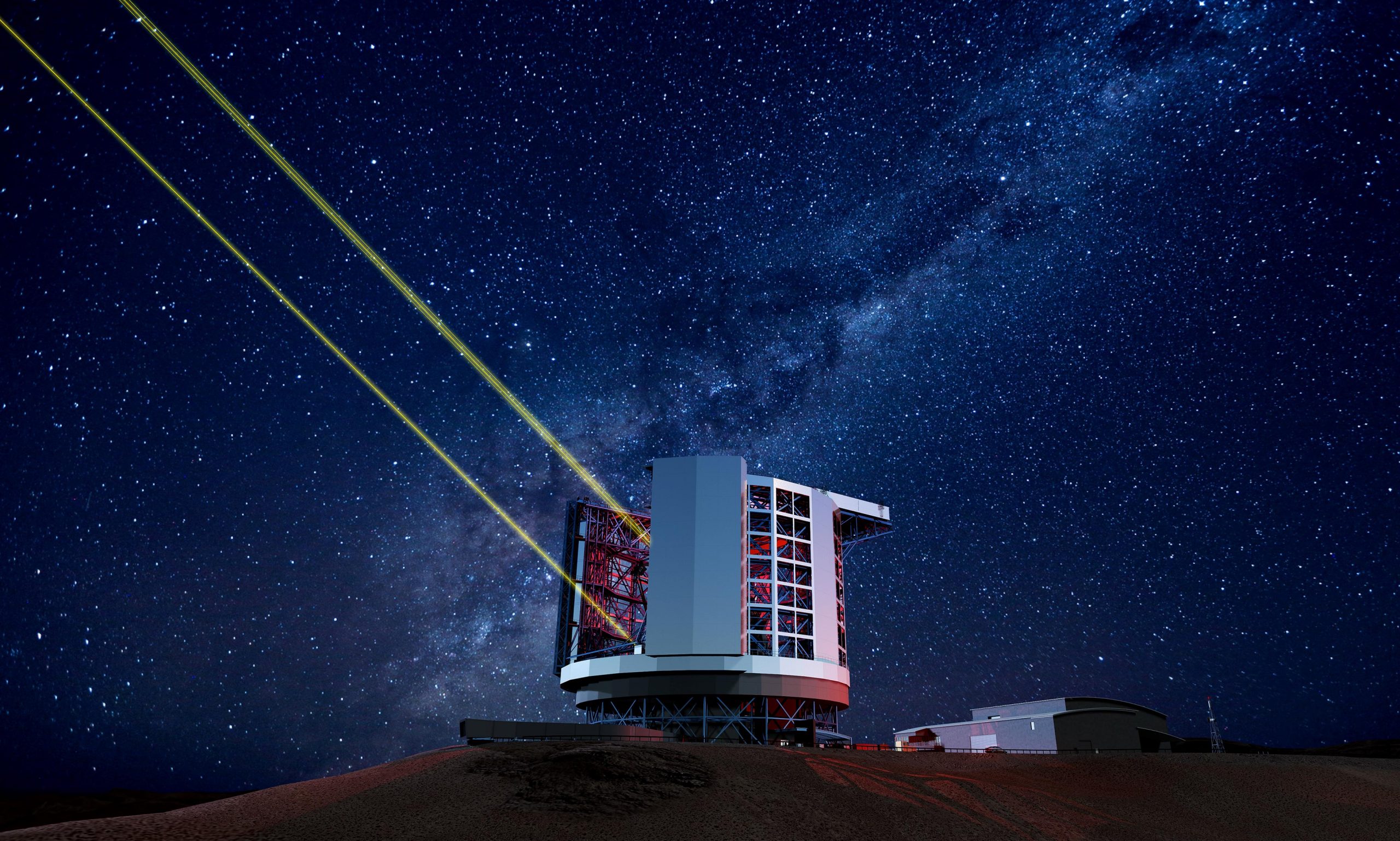
Direct imaging with extremely large telescopes such as the Large Binocular Telescope Interferometer and the upcoming 83.5 feet Giant Magellan Telescope located in Chile makes it possible to distinguish feedback from the radio jet and dusty wind simultaneously. Previously, the various processes were blended due to low resolution, but now it is possible to view their individual impact, Isbell said.
Future Applications and Impact
The study shows that the environments of AGN can be complex, and the new findings help better understand AGN’s interaction with their host galaxies.
“This type of imaging can be used on any astronomical object,” Isbell said. “We’ve already started looking at disks around stars or very large, evolved stars, which have dusty envelopes around them.”
Reference: “Direct imaging of active galactic nucleus outflows and their origin with the 23 m Large Binocular Telescope” by J. W. Isbell, S. Ertel, J.-U. Pott, G. Weigelt, M. Stalevski, J. Leftley, W. Jaffe, R. G. Petrov, N. Moszczynski, P. Vermot, P. Hinz, L. Burtscher, V. Gámez Rosas, A. Becker, J. Carlson, V. Faramaz-Gorka, W. F. Hoffmann, J. Leisenring, J. Power and K. Wagner, 17 January 2025, Nature Astronomy.
DOI: 10.1038/s41550-024-02461-y
Never miss a breakthrough: Join the SciTechDaily newsletter.
Follow us on Google and Google News.
3 Comments
Where’s the picture??
Or did it get lost in all the adverts?
The picture is up there it’s the middle of the Galaxy.
Dito