
Close Menu
    Facebook X (Twitter) Instagram
    SciTechDaily
    • Biology
    • Chemistry
    • Earth
    • Health
    • Physics
    • Science
    • Space
    • Technology
    Facebook X (Twitter) Pinterest YouTube RSS
    SciTechDaily
    Home»Chemistry»Revolutionizing Carbon Capture: Scientists Unveil New CO2 Reaction Pathways
    Chemistry

    Revolutionizing Carbon Capture: Scientists Unveil New CO2 Reaction Pathways

    By Hong Kong University of Science and TechnologyJanuary 28, 20251 Comment3 Mins Read
    Facebook Twitter Pinterest Telegram LinkedIn WhatsApp Email Reddit
    Share
    Facebook Twitter LinkedIn Pinterest Telegram Email Reddit
    First Principles Markov State Model Supercritical Water
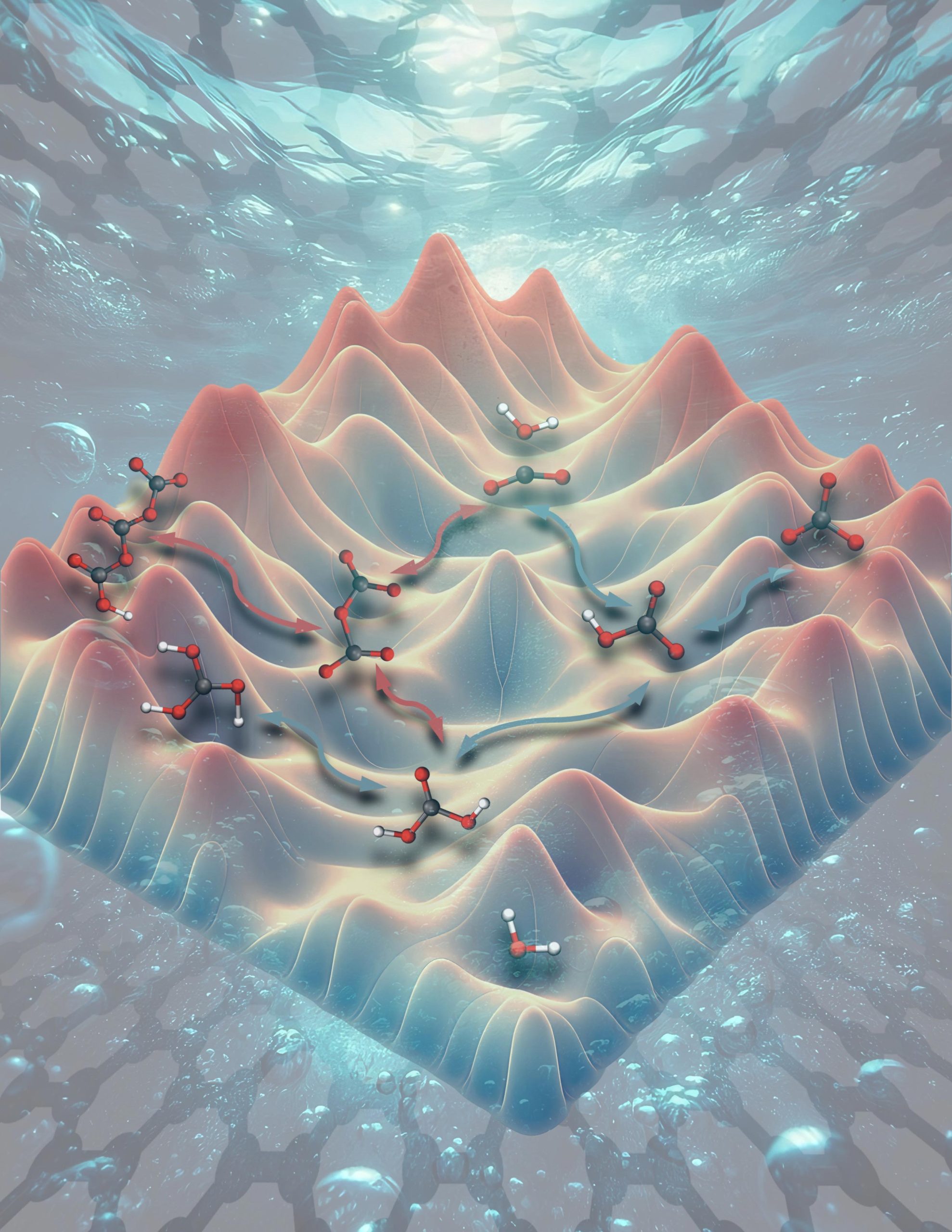
    The first-principles Markov state models elucidate the complex reaction kinetics of CO2 in supercritical water. Credit: Prof. Chu Li, Jie Shu, Prof. Ding Pan

    HKUST researchers discovered how CO2 reacts in supercritical water, identifying pyrocarbonate ions as key intermediates. Their work highlights nanoconfinement’s role in chemical processes and offers new directions for carbon sequestration technologies.

    A research team led by Associate Professor Ding Pan from the Departments of Physics and Chemistry at the Hong Kong University of Science and Technology (HKUST), in collaboration with Professor Yuan Yao from the Department of Mathematics, has uncovered key insights into the reaction mechanisms of carbon dioxide (CO2) in supercritical water.

    These findings are vital for advancing our understanding of CO2 mineralization and sequestration processes in both natural and engineered systems, as well as the deep carbon cycle within the Earth’s interior. This research provides a foundation for developing innovative carbon sequestration technologies in the future. The study was published in the Proceedings of the National Academy of Sciences (PNAS).

    The dissolution of CO2 in water and its subsequent hydrolysis reactions are key processes for effective carbon capture and mineralization storage, playing a significant role in carbon sequestration to mitigate global warming. Prof. Pan’s team developed and applied first-principles Markov models to reveal the reaction mechanisms of CO2 with supercritical water in both bulk and nanoconfined environments.

    Surprising Role of Nanoconfinement in CO2 Reactions

    They discovered that pyrocarbonate (C2O52-) is a stable and important reaction intermediate in nanoconfined environments, which had been previously overlooked because pyrocarbonate is highly unstable and decomposes rapidly in aqueous solutions. The unexpected appearance of pyrocarbonate is related to the superionic behavior of the confined solutions.

    Yuan Yao, Ding Pan, Chu Li
    Authors of the paper (from left to right): Prof. Yuan Yao, Professor from the Department of Mathematics, Prof. Chu Li, Research Assistant Professor from the Department of Physics, and Prof. Ding Pan, Associate Professor from the Department of Physics. Credit: HKUST

    Additionally, they found that carbonation reactions involve collective proton transfer along transient water chains, which exhibits concerted behavior in bulk solutions but proceeds stepwise under nanoconfinement. This study demonstrates the great potential of first-principles Markov models in elucidating complex reaction kinetics in aqueous solutions.

    An Innovative Computational Approach to Reaction Pathways

    “Our innovative approach has enabled us to discover a new pathway for CO2 dissolution involving pyrocarbonate ions,” said Prof. Chu Li, Research Assistant Professor from the Department of Physics. “Our efficient computational method does not rely on prior knowledge and can automatically identify reaction pathways without human bias, revealing unknown reaction mechanisms based on the first principles of physics.”

    Prof. Ding Pan added, “Our method employs unsupervised learning techniques to reveal the importance of large oxocarbons in aqueous reactions under extreme conditions, while also demonstrating that nanoconfinement can be an effective strategy for regulating chemical processes. These findings are expected to provide new directions for future carbon sequestration technologies.”

    Reference: “Unveiling hidden reaction kinetics of carbon dioxide in supercritical aqueous solutions” by Chu Li, Yuan Yao and Ding Pan, 30 December 2024, Proceedings of the National Academy of Sciences.
    DOI: 10.1073/pnas.2406356121

    The research was supported by the Hong Kong Research Grants Council, the Croucher Foundation, and the Excellent Young Scientists Fund of the National Natural Science Foundation of China. Part of the computational work was carried out on the Tianhe-2 supercomputer at the National Supercomputer Center in Guangzhou.

    Never miss a breakthrough: Join the SciTechDaily newsletter.
    Follow us on Google and Google News.

    Carbon Dioxide Carbon Emissions Climate Change Hong Kong University of Science and Technology
    Share. Facebook Twitter Pinterest LinkedIn Email Reddit

    Related Articles

    A Sustainable Solution to Fighting Global Warming – New Catalyst Efficiently Converts CO2 to Natural Gas

    The Solar Solution: Harnessing Sunlight To Combat Global Warming

    Researchers Design New, More Efficient Way To Capture and Recycle Carbon Dioxide From Industrial Emissions

    CO2 in Deep Earth May Play Larger Role in Climate Change Than Previously Assumed

    It’s Not Just Smokestacks to Worry About: Mountain Streams Emit a Surprising Amount of CO2

    New Material Captures Carbon Dioxide and Efficiently Converts It to Useful Organic Materials

    The First ‘Bottom-Up’ Estimates of China’s CO2 Emissions

    Researchers Study Zeolite for Filtering Out Carbon Dioxide

    Scientists Develop Material that Absorb Carbon Dioxide From the Air

    1 Comment

    1. Bonnie C Wood on January 28, 2025 6:48 pm

      Thank you.

      Reply
    Leave A Reply Cancel Reply

    • Facebook
    • Twitter
    • Pinterest
    • YouTube

    Don't Miss a Discovery

    Subscribe for the Latest in Science & Tech!

    Trending News

    Just a Few Breathless Minutes a Day Could Slash Your Risk of 8 Major Diseases

    This Simple Habit Could Cut Your Risk of Dementia by 30%

    Scientists Debunk Rattlesnake Myth That Fooled Hikers and Doctors for Decades

    Scientists Discover Plants Can “Count” – and May Be Smarter Than We Thought

    New Research Reveals Ancient Mars May Have Been Warm, Wet – and Possibly Alive

    This Surprising Daily Habit Could Cut Dementia Risk by 35%

    Just 10 Minutes a Day: Scientists Say This Ancient Chinese Practice Shows Powerful Blood Pressure Benefits

    Scientists Say This Popular Food Could Help Your Body Get Rid of Microplastics

    Follow SciTechDaily
    • Facebook
    • Twitter
    • YouTube
    • Pinterest
    • Newsletter
    • RSS
    SciTech News
    • Biology News
    • Chemistry News
    • Earth News
    • Health News
    • Physics News
    • Science News
    • Space News
    • Technology News
    Recent Posts
    • Surviving Burns May Have Changed Human Evolution
    • Scientists Discover Hidden “Footprint of Death” That Could Transform How We Fight Disease
    • Blood-Sucking Parasites Could Revolutionize Treatment for Autoimmune Diseases
    • Scientists Uncover Massive Climate Secret Beneath Sweden’s Forests
    • Scientists Unlock 3 Million Years of Climate Secrets Hidden in Antarctic Ice
    Copyright © 1998 - 2026 SciTechDaily. All Rights Reserved.
    • Science News
    • About
    • Contact
    • Editorial Board
    • Privacy Policy
    • Terms of Use

    Type above and press Enter to search. Press Esc to cancel.