
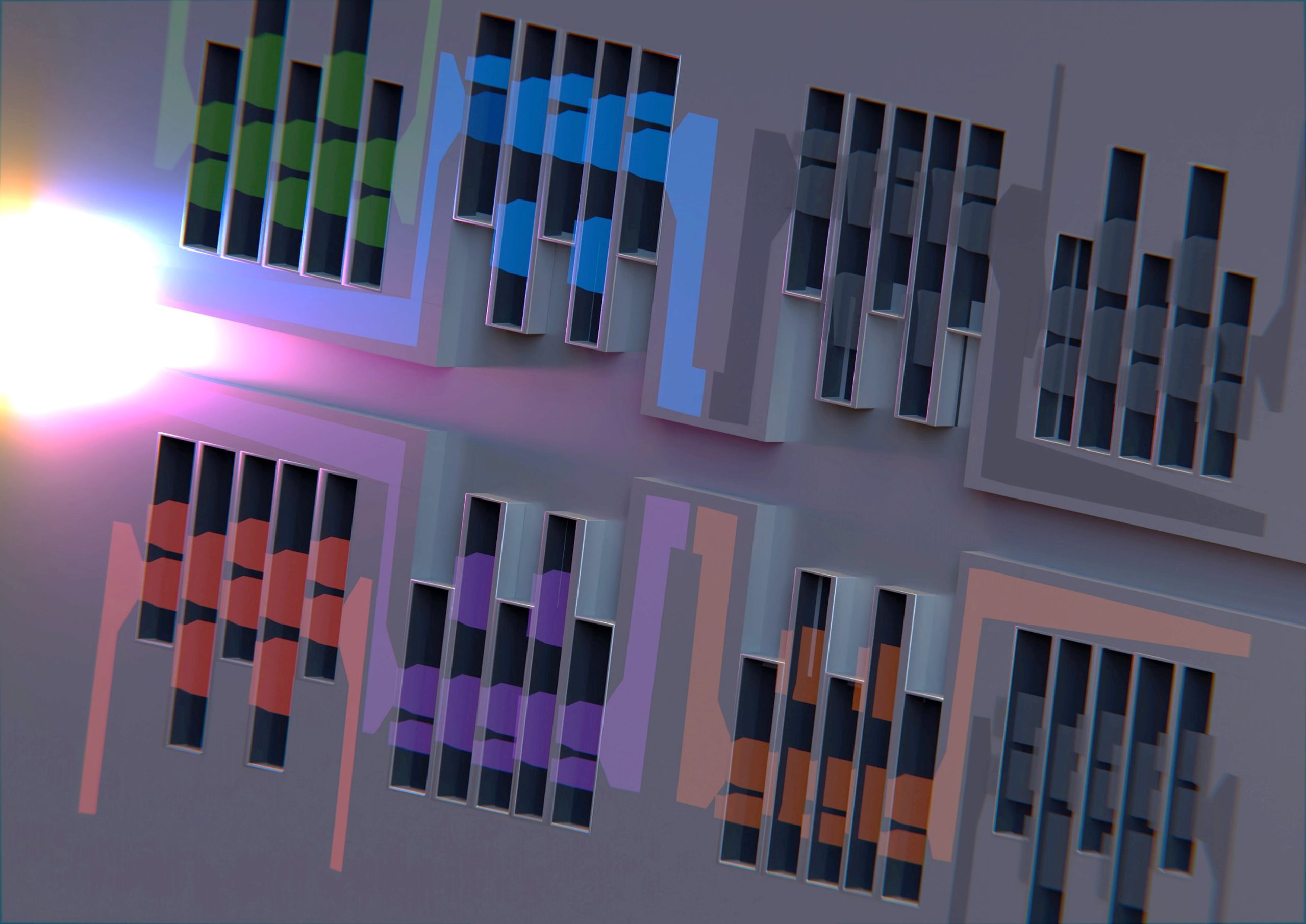
Researchers at the University of Florida have developed a new technique using semiconductor technology to produce processors that greatly improve the efficiency of transmitting large volumes of data worldwide. The innovation, featured on the current cover of the journal Nature Electronics, is poised to transform the landscape of wireless communication at a time when advances in AI are dramatically increasing demand.
Traditionally, wireless communication has relied on planar processors, which, while effective, are limited by their two-dimensional structure to operate within a limited portion of electromagnetic spectrum. The UF-designed approach leverages the power of semiconductor technology to propel wireless communication into a new dimension – quite literally.
Researchers have successfully transitioned from planar to three-dimensional processors, ushering in a new era of compactness and efficiency in data transmission.
Enhanced Data Transmission and Applications
Roozbeh Tabrizian, Ph.D., an associate professor in UF’s Department of Electrical and Computer Engineering, whose team developed the three-dimensional processor, said it marks a pivotal moment in the evolution of wireless communication as the world becomes increasingly reliant on seamless connectivity and real-time data exchange.
“The ability to transmit data more efficiently and reliably will open doors to new possibilities, fueling advancements in areas such as smart cities, remote health care, and augmented reality,” he said.

Currently, data in our cellphones and tablets are converted into electromagnetic waves that propagate back and forth among billions of users. Much like highway design and traffic lights ensure traffic flows efficiently through a city, filters, or spectral processors, move the data across different frequencies.
Limitations of Traditional Processors
“A city’s infrastructure can only handle a certain level of traffic, and if you keep increasing the volume of cars, you have a problem,” Tabrizian said. “We’re starting to reach the maximum amount of data we can move efficiently. The planar structure of processors is no longer practical as they limit us to a very limited span of frequencies.”
With the advent of AI and autonomous devices, the increased demand will require a lot more traffic lights in the form of filters at numerous different frequencies to move the data to where it is intended.
“Think of it like lights on the road and in the air,” Tabrizian said. “It becomes a mess. One chip manufactured for just one frequency doesn’t make sense anymore.”
Tabrizian and his colleagues at the Herbert Wertheim College of Engineering use CMOS technology, or complementary metal-oxide-semiconductor fabrication process, to build the three-dimensional nanomechanical resonator.
“By harnessing the strengths of semiconductor technologies in integration, routing, and packaging, we can integrate different frequency-dependent processors on the same chip,” Tabrizian said. “That’s a huge benefit.”
The three-dimensional processors occupy less physical space while delivering enhanced performance and have indefinite scalability, meaning they can accommodate growing demands.
“This entirely new type of spectral processor, which integrates different frequencies on one monolithic chip, is truly a game changer,” said David Arnold, associate chair for faculty affairs in the Department of Electrical and Computer Engineering. “Dr. Tabrizian’s new approach for multi-band, frequency-agile radio chipsets not only solves a huge manufacturing challenge, but it also allows designers to imagine entirely new communication strategies in an increasingly congested wireless world. Put more simply, our wireless devices will work better, faster, and more securely.”
Reference: “Imaging circuits in three dimensions” by Matthew Parker, 20 February 2024, Nature Electronics.
DOI: 10.1038/s41928-024-01131-1
The team of researchers, which included Tabrizian, Faysal Hakim, Nicholas Rudawski and Troy Tharpe, began work on this new approach to the processor in 2019. They received funding from the Defense Advanced Research Projects Agency, a U.S. Department of Defense agency that invest in breakthrough technologies for national security.
Never miss a breakthrough: Join the SciTechDaily newsletter.
Follow us on Google and Google News.