
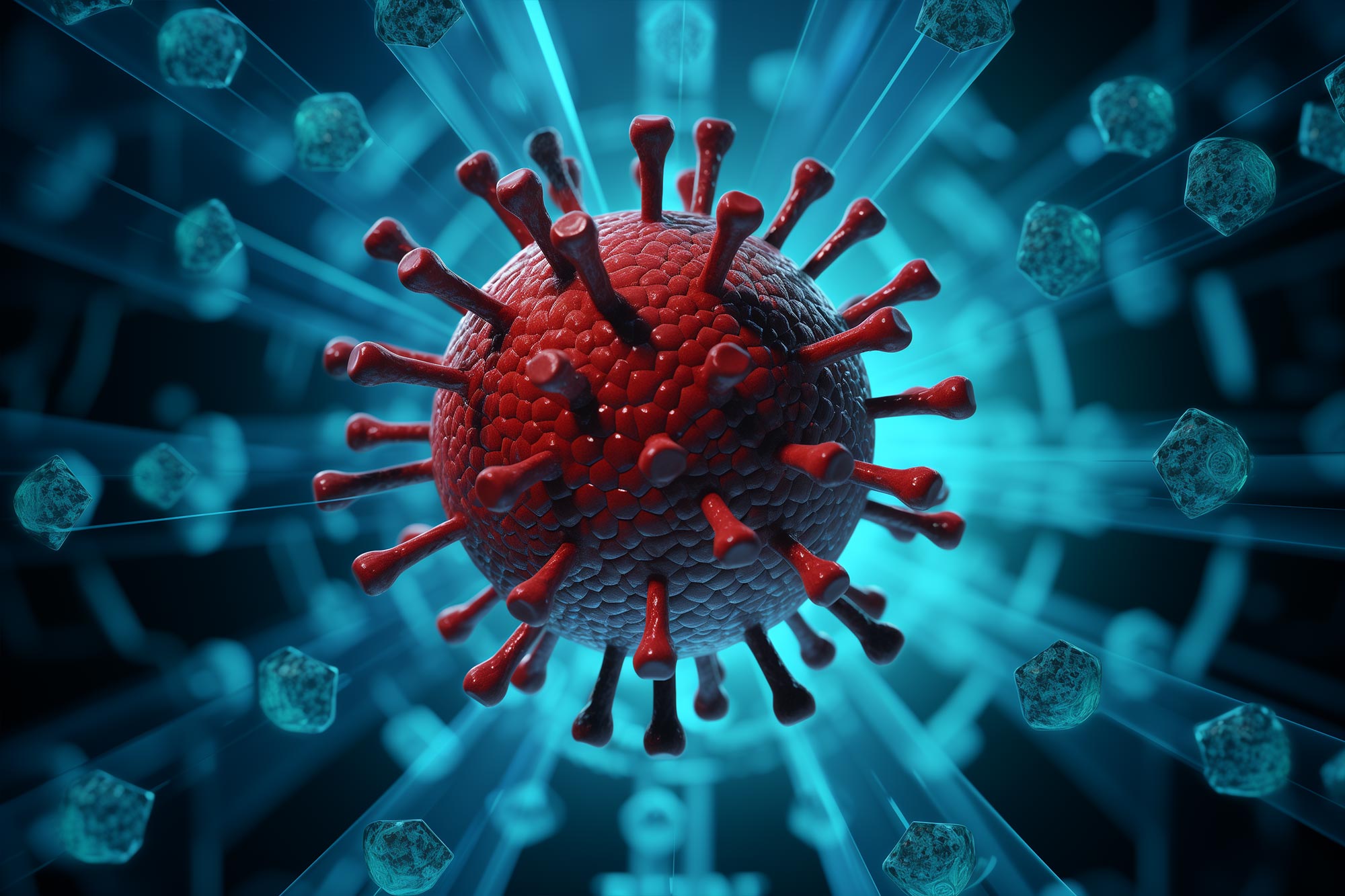
Researchers have uncovered how the M protein is key to the spherical structure of the SARS-CoV-2 virus, opening new paths for combating other pathogenic coronavirus outbreaks.
For centuries, coronaviruses have triggered health crises and economic challenges, with SARS-CoV-2, the coronavirus that spreads COVID-19, being a recent example. One small protein in SARS-CoV-2, the Membrane protein, or M protein, is the most abundant and plays a crucial role in how the virus acquires its spherical structure. Nonetheless, this protein’s properties are not well understood.
Innovative Research on M Protein
A research team led by a physicist at the University of California, Riverside, has devised a new method to make large quantities of M protein, and has characterized the protein’s physical interactions with the membrane — the envelope, or “skin,” — of the virus. The team’s theoretical modeling and simulations show how these interactions are likely contributing to the virus assembling itself.
The researchers report in their paper published today in Science Advances that when the M protein, which is adjacent to the spike protein on SARS-CoV-2, gets lodged in the membrane, it coaxes the membrane to curve by locally reducing the membrane thickness. This induction of curvature leads to SARS-CoV-2’s spherical shape.

“If we can better understand how the virus assembles itself, then, in principle, we can come up with ways to stop that process and control the virus’ spread,” said Thomas E. Kuhlman, an assistant professor of physics and astronomy, who led the research project. “M protein has previously resisted any kind of characterization because it is so hard to make.”
Kuhlman and his colleagues overcame this difficulty by using Escherichia coli bacteria as a “factory” to make the M protein in large numbers. Kuhlman explained that although E. coli can make copious amounts of M proteins, the proteins tend to clump together in the E. coli cells, eventually killing them. To circumvent this challenge, the researchers induced the E. coli cells to produce the protein Small Ubiquitin-related Modifier, or SUMO, along with the M protein.
Groundbreaking Techniques
“In our experiments, when E. coli makes M protein, it makes SUMO at the same time,” Kuhlman said. “The M protein fuses with the SUMO protein, which prevents the M proteins from sticking to one another. The SUMO protein is relatively easy to remove via another protein that simply cuts it off. The M protein is thus purified and separated from SUMO.”
The work provides fundamental insights into the mechanisms driving SARS-CoV-2 viral assembly.
“As M proteins are an integral component of other coronaviruses as well, our findings provide useful insights that can enhance our understanding and potentially enable interventions in viral formation not only in SARS-CoV-2 but also in other pathogenic coronaviruses,” Kuhlman said.
Future Directions
Next, the researchers plan to study the interactions of the M protein with other SARS-CoV-2 proteins to potentially disrupt these interactions with drugs.
Kuhlman was joined in the research by fellow-UCR physicists Roya Zandi and Umar Mohideen. Kuhlman was charged with making the M proteins. Mohideen, a distinguished professor of physics and astronomy, used atomic force microscopy and cryogenic electron microscopy to measure how the M protein interacts with the membrane. Zandi, an expert on virus assembly and a professor of physics and astronomy, developed simulations of how the M proteins interact with each other and with the membrane.
Other coauthors on the paper are Yuanzhong Zhang, Siyu Li, Michael Worcester, Sara Anbir, Pratyasha Mishra of UCR; and Joseph McTiernan, Michael E. Colvin and Ajay Gopinathan of UC Merced. Co-first authors Zhang and Anbir contributed equally to the work.
The research was supported by a grant from the University of California Office of the President to investigate how the COVID-19 virus assembles itself.
The research paper is titled “Synthesis, Insertion, and Characterization of SARS-CoV-2 Membrane Protein Within Lipid Bilayers.”
Reference: “Synthesis, insertion, and characterization of SARS-CoV-2 membrane protein within lipid bilayers” by Yuanzhong Zhang, Sara Anbir, Joseph McTiernan, Siyu Li, Michael Worcester, Pratyasha Mishra, Michael E. Colvin, Ajay Gopinathan, Umar Mohideen, Roya Zandi and Thomas E. Kuhlman, 28 February 2024, Science Advances.
DOI: 10.1126/sciadv.adm7030
Never miss a breakthrough: Join the SciTechDaily newsletter.
Follow us on Google and Google News.