
Close Menu
    Facebook X (Twitter) Instagram
    SciTechDaily
    • Biology
    • Chemistry
    • Earth
    • Health
    • Physics
    • Science
    • Space
    • Technology
    Facebook X (Twitter) Pinterest YouTube RSS
    SciTechDaily
    Home»Chemistry»Revolutionizing Recycling: Transforming Industrial Waste Into Eco-Friendly Plastic Through Artificial Photosynthesis
    Chemistry

    Revolutionizing Recycling: Transforming Industrial Waste Into Eco-Friendly Plastic Through Artificial Photosynthesis

    By Osaka Metropolitan UniversityMarch 29, 2023No Comments3 Mins Read
    Facebook Twitter Pinterest Telegram LinkedIn WhatsApp Email Reddit
    Share
    Facebook Twitter LinkedIn Pinterest Telegram Email Reddit
    Turning Waste CO2 and Acetone Into Biodegradable Plastic Precursor
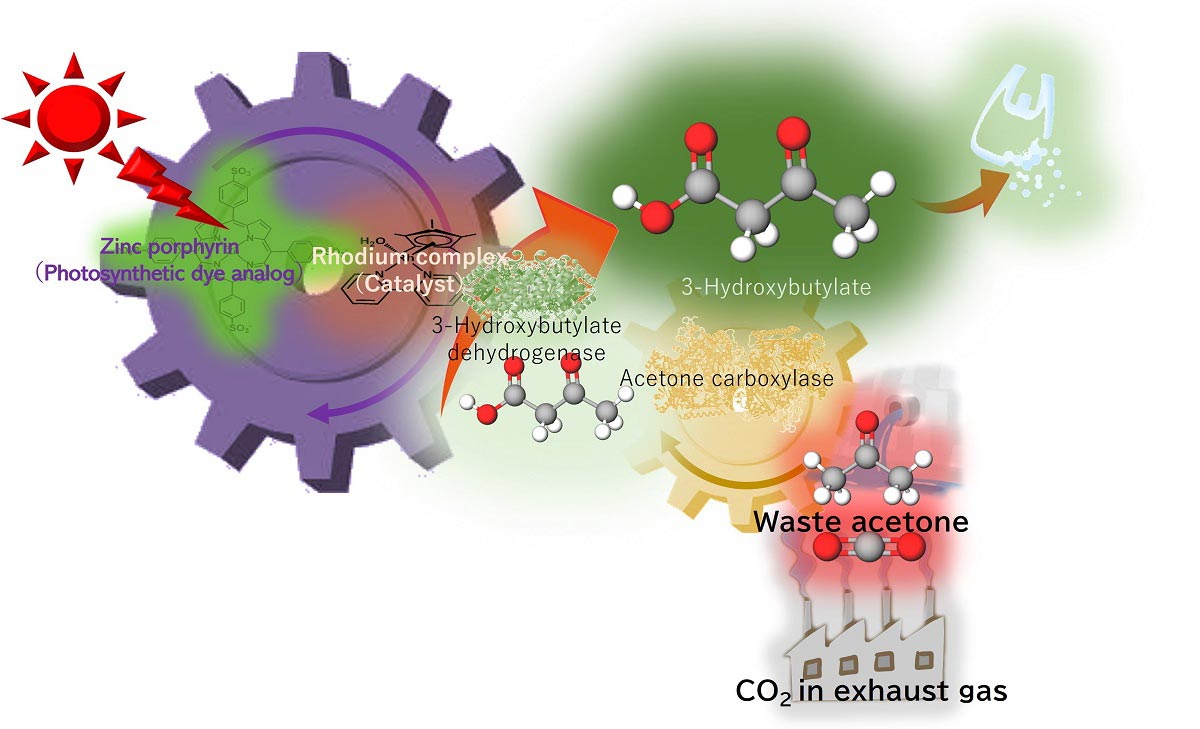
    Using energy from light equivalent to sunlight the artificial photosynthesis system uses enzymes and a rhodium catalyst to produce a biodegradable plastic precursor. Now for the first time, the process works using low concentrations of CO2, similar to exhaust gas, and waste acetone as raw materials. Credit: Yutaka Amao, OMU

    Low concentration CO2 can be reused in biodegradable plastic precursor using artificial photosynthesis.

    A research team led by Professor Yutaka Amao from Osaka Metropolitan University has successfully demonstrated the synthesis of poly-3-hydroxybutyrate, a biodegradable plastic, from waste acetone and low concentrations of CO2 using artificial photosynthesis. The study aimed to repurpose waste acetone from permanent marker ink and CO2 equivalent to exhaust gas from power plants and other industrial sources. After 24 hours, over 60% of acetone was converted to 3-hydroxybutyrate. The team’s findings, published in Green Chemistry, highlight the practical application of artificial photosynthesis and their plans to further develop the technology for more efficient use of waste materials.

    Poly-3-hydroxybutyrate—a biodegradable plastic—is a strong water-resistant polyester often used in packaging materials, made from 3-hydroxybutyrate as a precursor. In previous studies, a research team led by Professor Yutaka Amao from the Research Center for Artificial Photosynthesis at Osaka Metropolitan University, found that 3-hydroxybutyrate can be synthesized from CO2 and acetone with high efficiency, but only demonstrated this at higher concentrations of CO2 or sodium bicarbonate.

    This new study aimed to reuse waste acetone from permanent marker ink and low concentrations of CO2—equivalent to exhaust gas from power plants, chemical plants, or steel factories. Acetone is a relatively inexpensive and reasonably harmless chemical used in many different laboratory settings, either for reactions or as a cleaning agent, which produces waste acetone. The acetone and CO2­ acted as raw materials to synthesize 3-hydroxybutyrate using artificial photosynthesis, powered by light equivalent to sunlight.

    “We focused our attention on the importance of using CO2 created by exhaust gas from thermal power plants and other sources to demonstrate the practical application of artificial photosynthesis,” explained Professor Amao.

    After 24 hours, more than 60% of acetone had been successfully converted to 3-hydroxybutyrate. Their findings were published on March 1, 2023, in the journal Green Chemistry.

    “In the future, we aim to develop artificial photosynthesis technology further, so that it can use acetone from liquid waste and as well as exhaust gas from the laboratory as raw materials,” stated Professor Amao.

    Reference: “Visible-light-driven 3-hydroxybutyrate production from acetone and low concentrations of CO2 with a system of hybridized photocatalytic NADH regeneration and multi-biocatalysts” by Yu Kitaa and Yutaka Amao, 1 March 2023, Green Chemistry.
    DOI: 10.1039/D3GC00247K

    Funding: Japan Society for the Promotion of Science

    Never miss a breakthrough: Join the SciTechDaily newsletter.
    Follow us on Google and Google News.

    Chemical Engineering Energy Industrial Engineering Osaka Metropolitan University Photosynthesis Polymers
    Share. Facebook Twitter Pinterest LinkedIn Email Reddit

    Related Articles

    Artificial Photosynthesis Breakthrough: Revolutionary Gel Turns Sunlight Directly Into Clean Fuel

    Artificial Photosynthesis Makes Biodegradable Plastic Using Sunlight

    Scientists Can Now Design Single Atom Catalysts for Important Chemical Reactions

    Cheaper & Better: This Molecule Is Made From Sugar, Shaped Like a Doughnut, and Formed Using Light

    “Swiss Army Knife” Nanoparticle Catalyst Can Make Natural Gas Burn Cleaner

    Key Step Toward Cleaner, More Efficient Mass-Production of Hydrogen From Water

    Improving Carbon Capture Technology: Faster, Greener Way of Producing Carbon Spheres

    Super-Particles: The Importance of Good Neighbors in Catalysis

    The Prospects for the Development of Clean Fuels Are Improving

    Leave A Reply Cancel Reply

    • Facebook
    • Twitter
    • Pinterest
    • YouTube

    Don't Miss a Discovery

    Subscribe for the Latest in Science & Tech!

    Trending News

    Popular Sugar-Free Sweetener Linked to Liver Disease, Study Warns

    What Is Hantavirus? The Deadly Disease Raising Alarm Worldwide

    Scientists Just Discovered How the Universe Builds Monster Black Holes

    Scientists Unveil New Treatment Strategy That Could Outsmart Cancer

    A Simple Vitamin May Hold the Key to Treating Rare Genetic Diseases

    Scientists Think the Real Fountain of Youth May Be Hiding in Your Gut

    Ravens Don’t Follow Wolves, They Predict Them

    This Common Knee Surgery May Be Doing More Harm Than Good

    Follow SciTechDaily
    • Facebook
    • Twitter
    • YouTube
    • Pinterest
    • Newsletter
    • RSS
    SciTech News
    • Biology News
    • Chemistry News
    • Earth News
    • Health News
    • Physics News
    • Science News
    • Space News
    • Technology News
    Recent Posts
    • Popular Supplement Ingredient Linked to Shorter Lifespan in Men
    • Scientists May Have Found a Way To Repair Nerve Damage in Multiple Sclerosis
    • GLP-1 Weight Loss Linked To Dramatically Lower Risk of Sleep Apnea, Kidney Disease and More
    • Scientists Uncover the Surprising Source of Strange Clouds Near the Milky Way’s Supermassive Black Hole
    • This Dazzling Green Snake Was Hiding in Plain Sight for Decades
    Copyright © 1998 - 2026 SciTechDaily. All Rights Reserved.
    • Science News
    • About
    • Contact
    • Editorial Board
    • Privacy Policy
    • Terms of Use

    Type above and press Enter to search. Press Esc to cancel.