
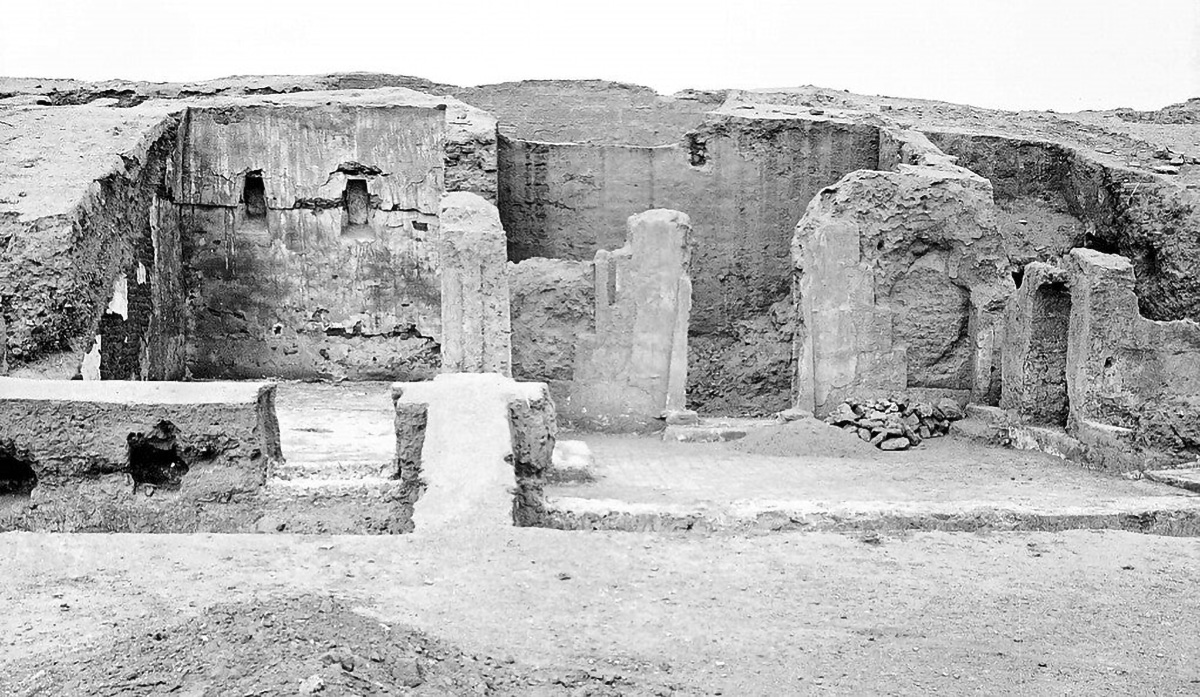
An ancient building in modern-day Syria has long been considered an example of what is known as a domestic “house church.” But a new study challenges this idea.
Since its discovery by modern researchers a century ago, the ancient structure known as the “Christian building” has come to be regarded as a cornerstone of early Christian architecture. Built around 232 C.E. in the ancient city of Dura-Europos, a Roman garrison town located in present-day eastern Syria, it is the only surviving example of a “house church,” or domus ecclesiae. This was a private residence that had been adapted for Christian worship during a period when openly practicing the faith is believed to have exposed believers to persecution.
But a new study published in the Journal of Roman Archaeology challenges that conventional belief, arguing that the building was almost certainly not domestic in form or function after undergoing renovations to accommodate religious rituals. The findings call into question the validity of the category of the domus ecclesiae in its totality.
A careful comparison of the building’s later architectural features with those of other domestic structures in Dura-Europos — and an analysis of the way renovations impacted natural light flow within the building — provide considerable evidence that it was not a house church at all, said Camille Leon Angelo, a Ph.D. candidate in Yale’s Graduate School of Arts and Sciences and one of the researchers.
“Dialogues within the academy as well as in popular culture give the impression that Christians had, prior to Emperor Constantine, gathered and worshipped in pseudo-domestic spaces,” said Leon Angelo, who is part of Yale’s Department of Religious Studies. “But if this is the only securely dated example we have, and it wasn’t in fact particularly or even somewhat domestic, then why do we keep up that perception?”
Her co-author on the study is Joshua Silver, a postgraduate doctoral researcher at the University of Manchester with the Manchester Architectural Research Group.
‘How domestic was it?’
It was during a 10-year excavation of Dura-Europos in the 1920s and ’30s that the Christian building, along with a synagogue and a Mithraeum, was unearthed by a team of scholars from Yale and the French Academy of Inscriptions and Letters. Their excavation journals and photographs (along with thousands of artifacts) are archived at the Yale University Art Gallery.
It was believed that the structure was originally a private residence but was renovated around 234 C.E. to make it suitable for Christian worship. Scholars came to consider it an architectural steppingstone — the domus ecclesiae — connecting the private homes used for Christian worship that are referenced in the New Testament (e.g., Acts 12:12) with the basilicas constructed under Constantine.
It remained in use until around 254-56 C.E., when Sasanians besieged the city and the Romans attempted to fortify the city’s western fortification wall with a massive earthen embankment that sealed off many buildings. After the city was conquered and abandoned, the remaining embankment served to preserve the structures extraordinarily well over centuries.
The Christian building was on the same street as the synagogue and Mithraeum, both of which also began as private homes that were later renovated, Leon Angelo said.
“But we don’t say ‘house synagogue,’ or ‘house Mithraeum.’ We allow them to stand on their own,” she said. “So if we have a building that follows the same architectural trajectory in the city, why are we emphasizing the structure’s domestic origins? We wanted to know, how domestic was it, and how would it have been seen by the community?”
Understanding a community and its story
To answer these questions, the researchers pored through all the archived excavation reports to understand what houses in Dura-Europos looked like, what they contained, and the functions they served. After gaining a thorough understanding of what constituted domestic space for that community, they juxtaposed it against the features of the Christian building. And they found significant differences.
For example, the building as it was preserved had figural wall paintings, a courtyard staircase, and no cistern for storing water. No other house in the researchers’ data set had such a combination of features.
The removal of the cistern, as well as the building’s food preparation area, also suggested that people interacted differently with the space than with their dwellings.
Its ground-floor rooms were modified to create one that was uncommonly large and another, used as a baptistery, that was uncommonly small, relative to other homes in the city.
In addition, researchers studied changes in how people circulated through the rooms, and the use of different surfaces and seating formations, which suggested moving away from a domestic environment. They used simulations of changing sunlight to determine that certain renovations to the building meant that a greater area of the rooms off the courtyard could be used at more times throughout the day without needing a lamp or candle.
“The Christian building had little akin to any domestic space at Dura, and therefore calls the narrative of early Christianity’s material origins into question,” Leon Angelo said.
She said she fully expects pushback against such a bold challenge of entrenched understandings of what early Christianity looked like.
“Those understandings hold a lot of weight and power,” she said. “We are deeply interested in early Christianity too. But we want to do justice to Dura’s Christian community and their story and try to understand them on their own terms, rather than through assumptions that scholars have projected onto their space.”
Scholarship around Dura-Europos is ongoing. The recently launched International (Digital) Dura-Europos Archive, or IDEA, funded by the National Endowment for the Humanities, aims to reassemble and provide digital access to the artifacts and archival documentation derived from excavations of the city and now housed at various museums across the world. The initiative was founded by Anne Hunnell Chen, a former postdoctoral associate at Yale who is now an assistant professor of art history and visual culture at Bard College.
Reference: “Debating the domus ecclesiae at Dura-Europos: the Christian Building in context” by Camille Leon Angelo and Joshua Silver, 12 August 2024, Journal of Roman Archaeology.
DOI: 10.1017/S1047759424000126
Never miss a breakthrough: Join the SciTechDaily newsletter.
Follow us on Google and Google News.
2 Comments
It seems plausible that more attention is devoted to project funding, over that of honoring early Christians.
Praise our Creator for the walls that have been coming down in America lately, and they sure have.
Getting to legitimately put our Worlds History back better than ever before is a cause for all actions. Pray, let’s get it right tho… Talk about things more for laymen. The possibilities are endless. In God We Trust means each one of us, Individually. We must gain a relationship with Him.
GBU,
Eric