
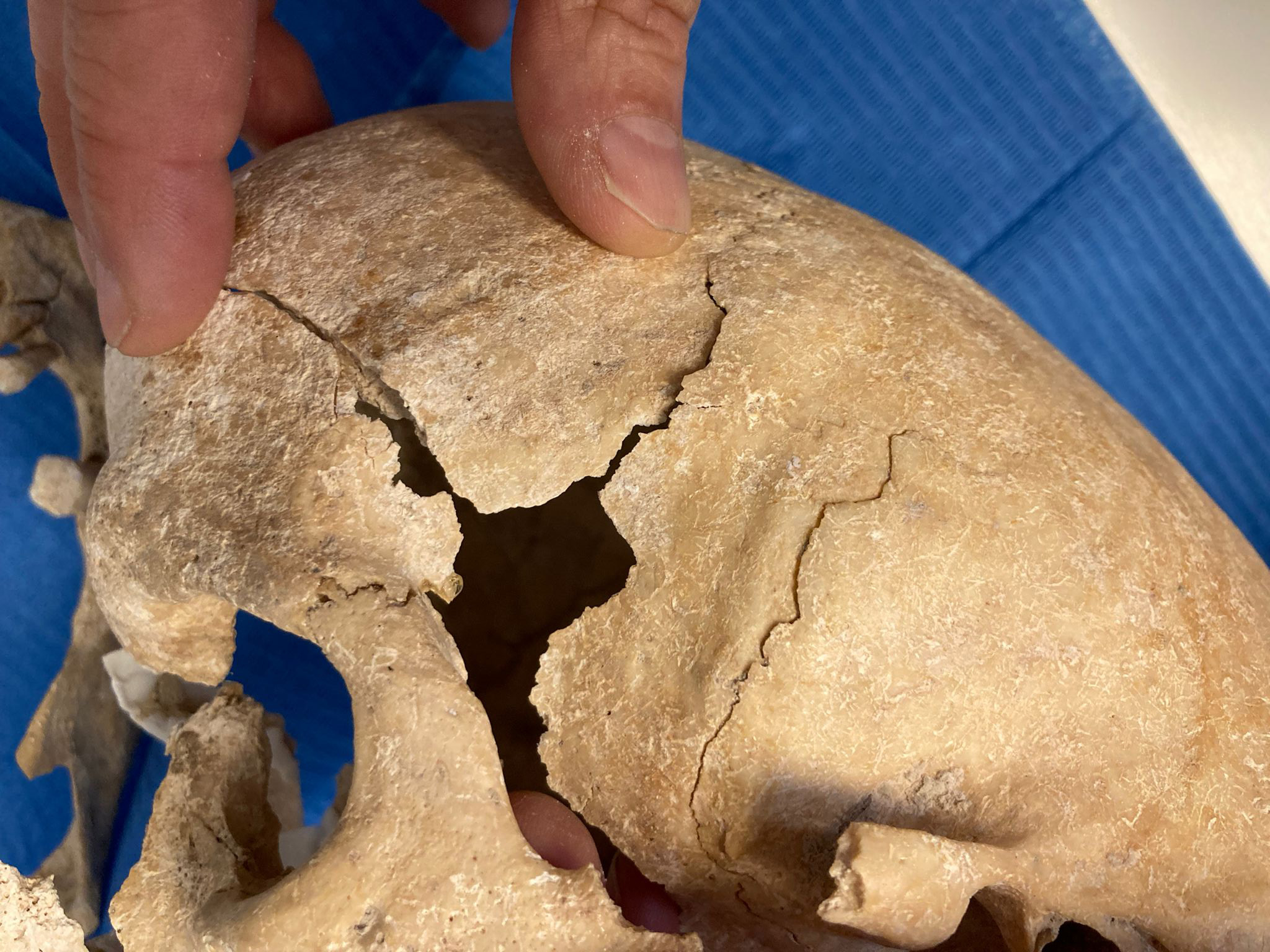
A study conducted by the Universitat Rovira i Virgili and the Max Planck Institute has revealed the diet, lifestyle, and causes of death of medieval religious knights.
A collaborative study conducted by the Universitat Rovira i Virgili (URV) and the Max Planck Institute analyzed the remains of 25 individuals interred from the 12th to 15th centuries at the Zorita de los Canes castle in Guadalajara. The team exhumed these remains from the castle’s graveyard, allowing them to determine the diet, lifestyle, and causes of death of the warrior monks who belonged to the Order of Calatrava.
The results, published in the journal Scientific Reports, have determined that 23 of the individuals died in battle and that the knights of the order followed a diet typical of medieval high society, with a considerable intake of animal protein and marine fish, in an area far from the coast. Unexpectedly, Carme Rissech, a researcher at the URV, identified the remains of a woman among the warrior monks.
Situated on one of the turns in the Tagus River as it flows through the province of Guadalajara, the remains of the castle of Zorita de los Canes are still standing on the same hill where the emir Mohammed I of Cordova ordered it to be built in 852. The fortress, built to defend the emirate from Christian attacks, changed hands twice until it was definitively conquered by the knights of the Order of the Temple in 1124. Fifty years later, Alfonso VIII of Castile ceded the fortress to the recently founded Order of Calatrava, a Cistercian military and religious order, who were tasked with defending the border, at that time delimited by the Tagus, from Almohad incursions.
MONBONES Project Insights
When Carme Rissech, a researcher at the URV’s Department of Basic Medical Sciences, was told that they were sending her the remains of the Calatrava knights, she couldn’t quite believe that they were actually knights. As part of the MONBONES project, which studies diet and lifestyle in monasteries during the Middle Ages, her project partners analyzed the presence of carbon isotopes 14 and nitrogen 15 in the bones of the 25 individuals. They also studied animal remains, found around the castle, which complemented the information provided by the isotopes and helped them to work out the habits of the people who lived in the castle between the 12th and 15th centuries. Once she got the remains in the laboratory, Rissech studied them to determine the age, sex, morphology, and health of the individuals and to determine their lifestyle and causes of death.

Of the 25 skeletons studied, 23 showed marks compatible with violent death. These were mainly penetrating puncture wounds and blunt force injuries and were found on the parts of the body that were most vulnerable to and unprotected from the weapons of the time. “We observed many lesions on the upper part of the skull, the cheeks, and the inner part of the pelvis, which is consistent with the hypothesis that we are dealing with warriors,” explains Rissech. It was by studying the bone proportions that she realized that among the warriors there was a woman.
Typically, the skeletons of men and women have specific characteristics that differentiate them. “The morphology of the facial bones and the pelvis, are the most obvious examples,” explains Rissech. In some individuals, these characteristics may not be decisive when it comes to determining sex, but in the case of these remains, there was little room for error. Who was this woman? Was she part of the order? Did she have the same status as the other knights?
Debating the Female Warrior’s Role
On the one hand, the woman’s injuries led the research team to believe that she participated and died in battle, as there was no sign of bone regrowth in her injuries. “She may have died in a manner very similar to that of male knights, and it is likely that she was wearing some kind of armor or chain mail,” says Rissech.

On the other hand, she did not have the same dietary indicators as some of the individuals analyzed: “We observed a lower level of protein consumption in the case of this woman, which could indicate lower status in the social group,” he says. Some researchers have hypothesized that she was a servant who would have been called upon to join the knights in defending the castle if the need arose, but the URV researcher does not think so: “Her work as a servant would have left signs on her bones, indicators of certain types of physical activity that we could now identify”.
In contrast, her skeleton did show attributes similar to those of the other warrior monks, whose job required them to train in the use of the sword, an activity that leaves verifiable marks which were also observed on the woman’s bones. “I believe that these remains belong to a female warrior, but further analysis is needed to determine to what extent this woman is contemporary with the other knights”, says Rissech. According to the researcher, we should picture her as a warrior of about forty years of age, just under five feet tall, neither stocky nor slender, and skillful with a sword.
The research also involved researchers from the University of Barcelona and the archaeologists who led the excavations. It is part of the MONBONES project, which takes a multidisciplinary approach involving zooarchaeology, anthropology, documentary research, and molecular analysis to offer a new historical perspective on the way of life, diet, health, economy, and society in monasteries from the 14th to the 19th centuries.
Reference: “Unravelling social status in the first medieval military order of the Iberian Peninsula using isotope analysis” by Patxi Pérez-Ramallo, Carme Rissech, Lluis Lloveras, Mary Lucas, Dionisio Urbina, Catalina Urquijo and Patrick Roberts, 14 May 2024, Scientific Reports.
DOI: 10.1038/s41598-024-61792-y
Never miss a breakthrough: Join the SciTechDaily newsletter.
Follow us on Google and Google News.
4 Comments
“She MAY have died in a manner very similar to that of male knights, and it is likely that she was wearing some kind of armor or chain mail,”
On what evidence is this assumption based?
“We observed a lower level of protein consumption in the case of this woman, which could indicate lower status in the social group,”
Therefore, her gender was not the only thing about her that was anomalous. With only one out of 25 being female, one cannot claim that female warriors were common. While being anatomically female, she may have hidden her gender and not been with the monks long enough to be discovered, which would explain her lower level of protein consumption.
Thank God for selective reading.
Selective? Don’t you mean “careful?”
Her proportions left no doubt of her muliebrity, so it is not likely she was hiding as a man. And it is just as likely that in girlhood she ate as women do, and only later ate as men do.