
Close Menu
    Facebook X (Twitter) Instagram
    SciTechDaily
    • Biology
    • Chemistry
    • Earth
    • Health
    • Physics
    • Science
    • Space
    • Technology
    Facebook X (Twitter) Pinterest YouTube RSS
    SciTechDaily
    Home»Space»Rosetta Spacecraft Picks Up a Mysterious “Song” From Comet 67P
    Space

    Rosetta Spacecraft Picks Up a Mysterious “Song” From Comet 67P

    By DC Agle/Guy Webster, Jet Propulsion LaboratoryNovember 12, 20141 Comment3 Mins Read
    Facebook Twitter Pinterest Telegram LinkedIn WhatsApp Email Reddit
    Share
    Facebook Twitter LinkedIn Pinterest Telegram Email Reddit
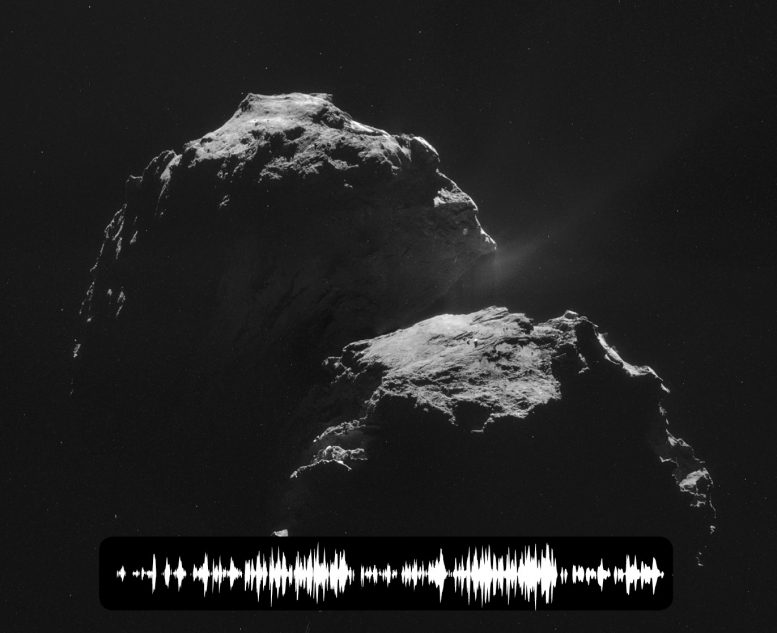
    Rosetta Spacecraft Hears Mysterious Noise from Comet 67P
    Artist’s impression of the ‘singing comet’ 67P/Churyumov-Gerasimenko. Credit: ESA/Rosetta/NavCam

    As ESA’s Rosetta spacecraft prepares to dispatch its Philae lander to the surface of Comet 67P/Churyumov-Gerasimenko, a set of instruments on Rosetta has picked up a mysterious “song” from the comet.

    The sounds are thought to be oscillations in the magnetic field around the comet. They were picked up by the Rosetta Plasma Consortium –  a suite of five instruments on the spacecraft that is orbiting the comet.

    The comet’s song would not be audible to the human ear because it is being emitted at 40 to 50 millihertz, far below the range of human hearing, which typically picks up sound between 20 hertz and 20 kilohertz. To make the sounds audible to humans, Rosetta scientists have increased the frequencies by 10,000 times.

    The Rosetta’s Rosetta Plasma Consortium consists of five instruments on the Rosetta orbiter that provide a wide variety of complementary information about the plasma environment surrounding Comet 67P/C-G. Plasma is the fourth state of matter – an electrically conductive gas that can carry magnetic fields and electrical currents.

    The consortium instruments are designed to study a number of phenomena, including the interaction of 67P/C-G with the solar wind, a continuous stream of plasma emitted by the sun; changes of activity on the comet; the structure and dynamics of the comet’s tenuous plasma atmosphere, known as the coma; and the physical properties of the comet’s nucleus and surface.

    The comet sounds were heard clearly by Rosetta’s magnetometer experiment for the first time in August, when Rosetta drew to within 62 miles (100 kilometers) of 67P/C-G. Scientists think the sounds must be produced by the comet’s activity, perhaps as it releases neutral particles into space where they become electrically charged, or ionized. The precise physical mechanism behind the oscillations remains a mystery.

    “This is exciting because it is completely new to us. We did not expect this and we are still working to understand the physics of what is happening,” said Karl-Heinz Glassmeier, head of Space Physics and Space Sensorics at the Technical University of Braunschweig, Germany.

    Rosetta is a European Space Agency mission with contributions from its member states and NASA. Rosetta’s Philae lander is provided by a consortium led by the German Aerospace Center, Cologne; Max Planck Institute for Solar System Research, Gottingen; National Center of Space Studies of France (CNES), Paris; and the Italian Space Agency, Rome. NASA’s Jet Propulsion Laboratory in Pasadena, California, a division of the California Institute of Technology, manages the U.S. participation in the Rosetta mission for NASA’s Science Mission Directorate in Washington.

    Never miss a breakthrough: Join the SciTechDaily newsletter.
    Follow us on Google and Google News.

    Astronomy Comet European Space Agency Rosetta Spacecraft
    Share. Facebook Twitter Pinterest LinkedIn Email Reddit

    Related Articles

    Rosetta Views Comet 67P Making Its Closest Approach to the Sun

    Rosetta Spacecraft Views an Outburst from Comet 67P

    Rosetta Monitors Active Pits on Comet 67P

    Rosetta and Philae Reveal That Comet 67P is Not Magnetized

    Philae Lander Makes Historic First Landing on Comet 67P

    Philae Lander Makes Soft Landing on Comet 67P

    How to Land on a Comet Moving 40 Times Faster Than a Speeding Bullet

    Rosetta Orbiter Delivers First Batch of Science Data

    ESA Identifies Five Candidate Landing Sites on Comet 67P

    1 Comment

    1. emily on November 12, 2014 10:35 am

      its peaceful like water and rain doing a song together

      Reply
    Leave A Reply Cancel Reply

    • Facebook
    • Twitter
    • Pinterest
    • YouTube

    Don't Miss a Discovery

    Subscribe for the Latest in Science & Tech!

    Trending News

    The Universe Is Expanding Too Fast and Scientists Can’t Explain Why

    “Like Liquid Metal”: Scientists Create Strange Shape-Shifting Material

    Early Warning Signals of Esophageal Cancer May Be Hiding in Plain Sight

    Common Blood Pressure Drug Shows Surprising Power Against Deadly Antibiotic-Resistant Superbug

    Scientists Uncover Dangerous Connection Between Serotonin and Heart Valve Disease

    Scientists Discover a “Protector” Protein That Could Help Reverse Hair Loss

    Bone-Strengthening Discovery Could Reverse Osteoporosis

    Scientists Uncover Hidden Trigger Behind Stem Cell Aging

    Follow SciTechDaily
    • Facebook
    • Twitter
    • YouTube
    • Pinterest
    • Newsletter
    • RSS
    SciTech News
    • Biology News
    • Chemistry News
    • Earth News
    • Health News
    • Physics News
    • Science News
    • Space News
    • Technology News
    Recent Posts
    • Scientists Overcome Major Quantum Bottleneck, Potentially Transforming Teleportation and Computing
    • Quantum Physics’ Strangest Problem May Hold the Key to Time Itself
    • Scientists Create “Liquid Gears” That Spin Without Touching
    • The Simple Habit That Could Help Prevent Cancer
    • Forgotten Medicinal Plant Shows Promise in Fighting Dangerous Superbugs
    Copyright © 1998 - 2026 SciTechDaily. All Rights Reserved.
    • Science News
    • About
    • Contact
    • Editorial Board
    • Privacy Policy
    • Terms of Use

    Type above and press Enter to search. Press Esc to cancel.