
A recent study by the Annenberg Public Policy Center reveals a general lack of knowledge among Americans about RSV (Respiratory Syncytial Virus). The survey indicates that many are unaware of the virus’s typical symptoms and exhibit greater reluctance to recommend vaccination against RSV for pregnant individuals than to older adults.
This discovery arises at a critical time when a vaccine for RSV targeted at pregnant women is under consideration, and the Centers for Disease Control and Prevention (CDC) is deciding on the approval of an RSV vaccine for adults aged 60 and above.
Worldwide, RSV is the leading cause of lower respiratory tract infections in babies. Though its symptoms are typically mild, the highly contagious RSV can cause serious illness, hospitalization, and even death among infants and the elderly.
By the age of 2, nearly all children get sick from RSV, which was one of three illnesses – with the flu and Covid-19 – contributing to last winter’s “tripledemic” that overwhelmed some healthcare facilities. The CDC estimates that 58,000 to 80,000 children under age 5 are hospitalized annually because of it.
After decades of research, scientists have developed vaccines against RSV. In May, the Food and Drug Administration (FDA) approved two RSV vaccines for older adults, and this summer is likely to approve a maternal RSV vaccine for pregnant people to pass antibodies on to fetuses to prevent RSV in infants from birth up to at least six months of age.
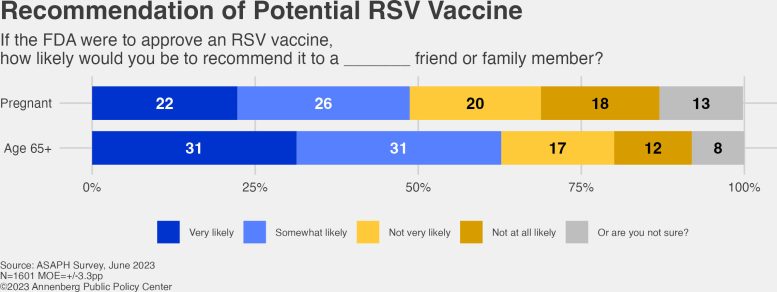
The survey of more than 1,600 adults finds that less than half of Americans (49%) were likely to recommend the vaccine against RSV, if approved by the FDA, to a pregnant friend or family member. By contrast, most Americans (63%) would recommend a vaccine against RSV to a friend or family member aged 65 or older. (When the survey was fielded, the FDA had already approved the vaccine for adults 60 and older, although the shots were not yet available.)
“Those who recall the stress that the tripledemic placed on the nation’s hospitals last fall will understand why older individuals and those who are pregnant should discuss the advisability of RSV vaccination with their health care providers,” said Kathleen Hall Jamieson, director of the Annenberg Public Policy Center (APPC) of the University of Pennsylvania and director of the study.
APPC’s Annenberg Science and Public Health Knowledge Survey
The survey data come from the 11th wave of a nationally representative panel of 1,601 U.S. adults, first empaneled in April 2021, conducted for the Annenberg Public Policy Center by SSRS, an independent market research company. This wave of the Annenberg Science and Public Health Knowledge (ASAPH) survey was fielded May 31-June 6, 2023, and has a margin of sampling error (MOE) of ± 3.3 percentage points at the 95% confidence level.
Download the topline and the methodology.
Data from earlier waves on Covid-19, society’s “return to normal,” vaccination, monkeypox, the seasonal flu, health misinformation, and related topics can be found here.
Underestimating the Prevalence of RSV – but Awareness of Potential Severity
A quarter of the public (27%) expresses worry about contracting or having a family member contract RSV, less than the one-third (33%) who were worried in our January survey, which was conducted during the tripledemic. The decrease in concern is not surprising given that RSV circulates during the fall and winter, and there was media coverage of the surge of cases last winter that, combined with flu and Covid-19 cases, filled some hospitals.
Familiarity with RSV is less common than one might expect given the prevalence of the illness. Only 22% in the current survey say they know children who have had RSV – and among these respondents, over half say they have known just one child or two children who have had it. Asked how many children contract RSV before the age of two, 2% of respondents say, “virtually all.” According to the CDC, “Almost all children will have had an RSV infection by their second birthday.”
But among the people who say they know children who have had RSV, its potential severity is clear. Among these respondents, over half (54%) say the illness was somewhat or very serious. “Most children with cold-like symptoms are not tested for RSV, but when a child becomes severely ill, it’s more likely that child will undergo diagnostic testing,” Jamieson said. While RSV can cause severe illnesses such as bronchiolitis and pneumonia, the CDC says it usually causes mild, cold-like symptoms – like runny nose, coughing, sneezing, fever, wheezing, and decreased appetite – and is often mistaken for cold or flu.
This does not mean, however, that some do not experience serious illness. Among 100 babies under the age of six months who get RSV, 1 to 2 may require hospitalization, the CDC says. Although RSV-associated deaths are “uncommon” in the United States, they nonetheless do occur at an estimated rate of 100 to 500 per year for children under five, according to the CDC. Worldwide deaths of children under 5 years old attributable to RSV exceed 100,000 annually.
Far fewer people say they know older adults who have had RSV. Only 6% of those surveyed say they know someone age 65 or older who has had RSV. Among this group of respondents, most (71%) say they know one or two people who have had it and most (72%) say the infection was somewhat or very serious. The CDC reports that among adults 65 and older, there are 60,000 to 160,000 hospitalizations per year from RSV, and 6,000 to 10,000 deaths.
For more information, see these Q&As on the RSV maternal vaccine and RSV vaccines for older adults from FactCheck.org, a project of APPC.
Great Uncertainty About RSV
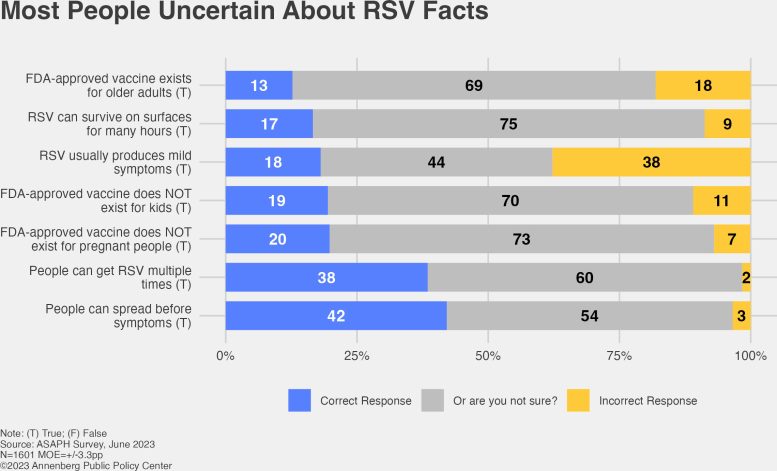
Only small segments of the American public correctly answer questions about RSV. Most people say they are not sure. The survey found that:
- Symptoms: Less than 1 in 5 people (18%) know it’s more accurate to say that RSV usually produces mild, cold-like symptoms than serious difficulties in breathing (38%). And 44% say they are not sure.
- Persistence: Less than 1 in 5 people (17%) know it’s more accurate to say that RSV is able to survive for many hours on hard surfaces such as table or crib rails than to say RSV can’t survive for many hours on these hard surfaces (9%). Most people (75%) say they are not sure.
- Reoccurrence: Less than 4 in 10 people (38%) know it’s more accurate to say that once a person contracts RSV, they can get it again. Only 2% incorrectly believe it’s more accurate to say that you can’t get RSV again, but 60% say they are not sure.
- Spreading the virus: Just over 4 in 10 people (42%) know it’s more accurate to say it is possible to have and spread RSV before showing symptoms than to say it is not possible (3%). But over half of those surveyed (54%) are not sure.
- Vaccine for older adults: Just 13% knew at the time the survey was fielded about the existence of an FDA-approved vaccine against RSV for older adults, while 18% said there was not an FDA-approved vaccine. Nearly 7 in 10 people (69%) said they were not sure. (The FDA approved one RSV vaccine for adults 60 and older on May 3, 2023, and the second one on May 31, the beginning of the survey period. A CDC committee of experts known as ACIP is meeting today on whether the CDC should recommend those vaccines and, if so, for what ages.)
- Vaccine for pregnant people: Just 1 in 5 people (20%) knew when the survey was fielded that there was not an FDA-approved vaccine against RSV for those who are pregnant to benefit their newborns, while 7% thought there was one. Nearly three-quarters of those surveyed (73%) were not sure. “However,” Jamieson noted, “since an FDA advisory panel had recommended approval at that point, we would expect a high level of uncertainty about whether or not an FDA-approved vaccine existed.”
- Vaccine for infants and children: About 1 in 5 people (19%) know there is currently not an FDA-approved vaccine against RSV for infants and children in the United States, while 11% say incorrectly that there is one and 70% are not sure.
Fewer Than Half Recognize the Symptoms of RSV
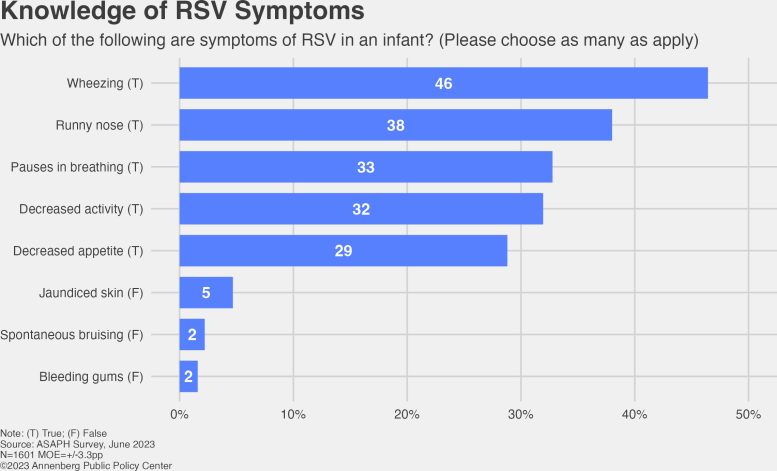
Fewer than half of those surveyed recognized some of the most common symptoms of RSV (respondents were asked to select all that applied):
- Wheezing: 46% know this is a symptom
- Runny nose: 38% know this is a symptom
- Pauses in breathing: 33% know this is a symptom
- Decreased activity: 32% know this is a symptom
- Decreased appetite: 29% know this is a symptom
Very few people incorrectly selected non-respiratory symptoms as associated with RSV:
- Jaundiced skin: 5% incorrectly say this is a symptom of RSV
- Spontaneous bruising: 2% incorrectly say this is a symptom of RSV
- Bleeding gums: 2% incorrectly say this is a symptom of RSV
Never miss a breakthrough: Join the SciTechDaily newsletter.
Follow us on Google and Google News.
1 Comment
[[[ ROTTING CORPSE IS HERE]]]
rsv = covid
duh