
Close Menu
    Facebook X (Twitter) Instagram
    SciTechDaily
    • Biology
    • Chemistry
    • Earth
    • Health
    • Physics
    • Science
    • Space
    • Technology
    Facebook X (Twitter) Pinterest YouTube RSS
    SciTechDaily
    Home»Earth»Satellites Monitor Unpredictable Explosive Behavior of Mount Etna – Europe’s Most Active Volcano
    Earth

    Satellites Monitor Unpredictable Explosive Behavior of Mount Etna – Europe’s Most Active Volcano

    By European Space Agency (ESA)April 12, 20212 Comments4 Mins Read
    Facebook Twitter Pinterest Telegram LinkedIn WhatsApp Email Reddit
    Share
    Facebook Twitter LinkedIn Pinterest Telegram Email Reddit
    Mount Etna Smoke Plumes
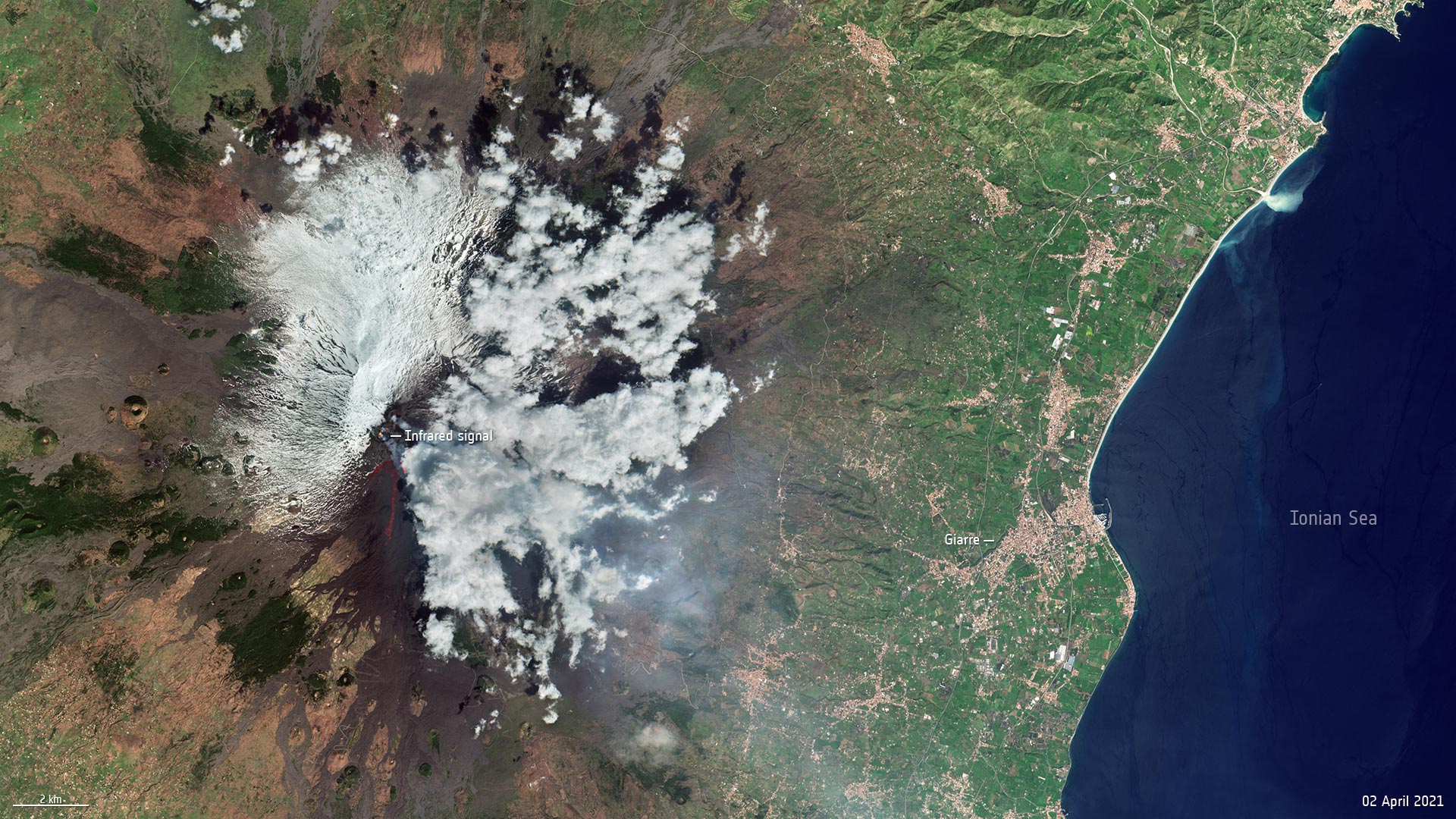
    This image, captured on April 2, 2021, by the Copernicus Sentinel-2 mission, shows the latest activity in Italy’s Mount Etna. The image has been processed using the mission’s shortwave-infrared band to show the ongoing activity in the crater. Smoke plumes can be seen blowing eastwards towards the town of Giarre. Credit: Contains modified Copernicus Sentinel data (2021), processed by ESA, CC BY-SA 3.0 IGO

    Mount Etna erupted 17 times in early 2021, producing lava fountains up to 1.5 km high. Satellites tracked the eruptions, capturing imagery and sulfur dioxide emissions, with lava flows reaching Valle del Bove. 

    Italy’s Mount Etna, Europe’s most active volcano, has recently been on explosive form, with 17 eruptions in less than three months. Instruments onboard three different satellites orbiting Earth have acquired imagery of the eruptions – revealing the intensity of the lava-fountaining eruptive episodes, known as paroxysms.

    Located on the east coast of Sicily, Mount Etna is one of the world’s most active volcanoes. Its eruptions occur at the summit, where there are four craters: the Voragine and the Bocca Nuova, formed in 1945 and 1928 respectively, the Northeast Crater, the highest point on Etna (3330 m) and the Southeast Crater, which has recently been the most active of the four.
    Mount Etna Eruptions
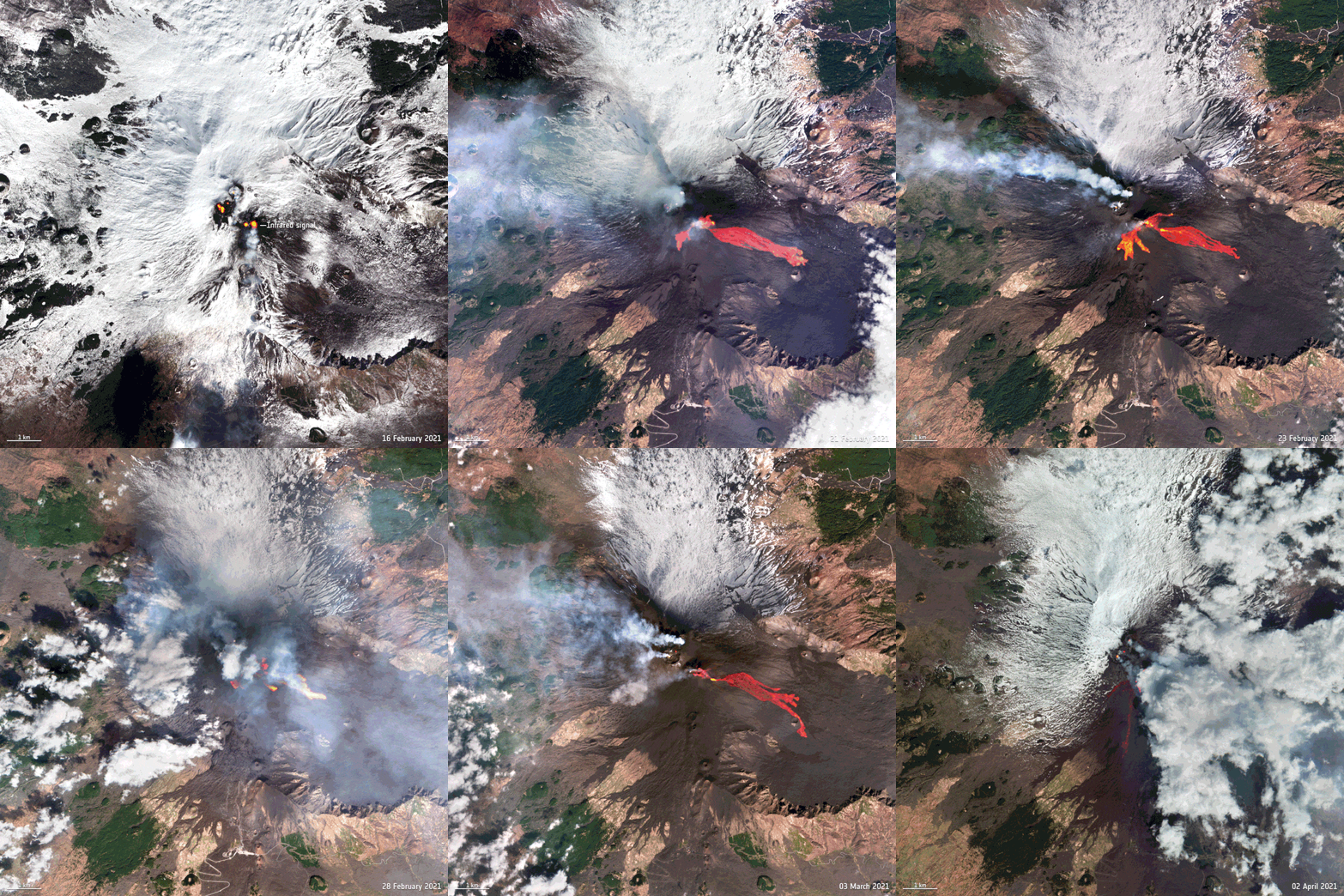
    This Copernicus Sentinel-2 animation shows the latest activity taking place in Mount Etna from February 16, 2021, until April 2, 2021. Credit: Contains modified Copernicus Sentinel data (2021), processed by ESA, CC BY-SA 3.0 IGO

    Starting in February 2021, the Southeast Crater produced a series of intense lava fountains coloring the night sky in hues of orange and red. Over the course of the following weeks, the volcano produced lava fountains reaching as high as 1.5 km (about 1 mi).

    These spectacular explosions are amongst the highest observed at the Southeast Crater in recent decades. In the past, lava fountains reaching the same height were only observed at the Voragine crater in December 2015 – with lava fountains of over 2,000 m (6,600 ft).
    Copernicus Sentinel-3 View of Sicily and Southern Italy
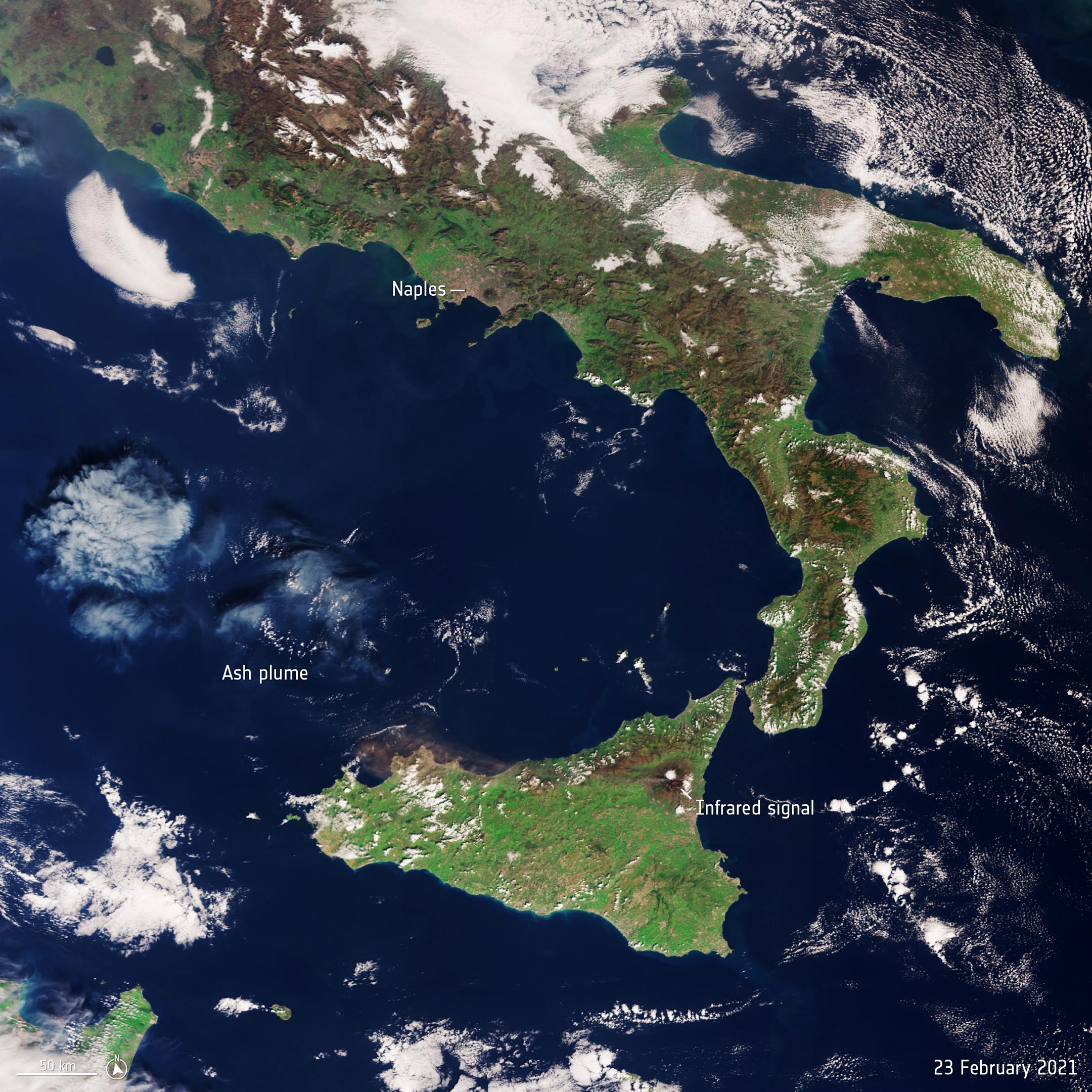
    This image captured by the Copernicus Sentinel-3 mission shows the ash plume on February 23, 2021. Credit: Contains modified Copernicus Sentinel data (2021), processed by ESA, CC BY-SA 3.0 IGO

    Different satellites carry different instruments that can provide a wealth of complementary information to understand volcanic eruptions. Once an eruption begins, optical instruments can capture the various phenomena associated with it, including lava flows, mudslides, ground fissures, and earthquakes.

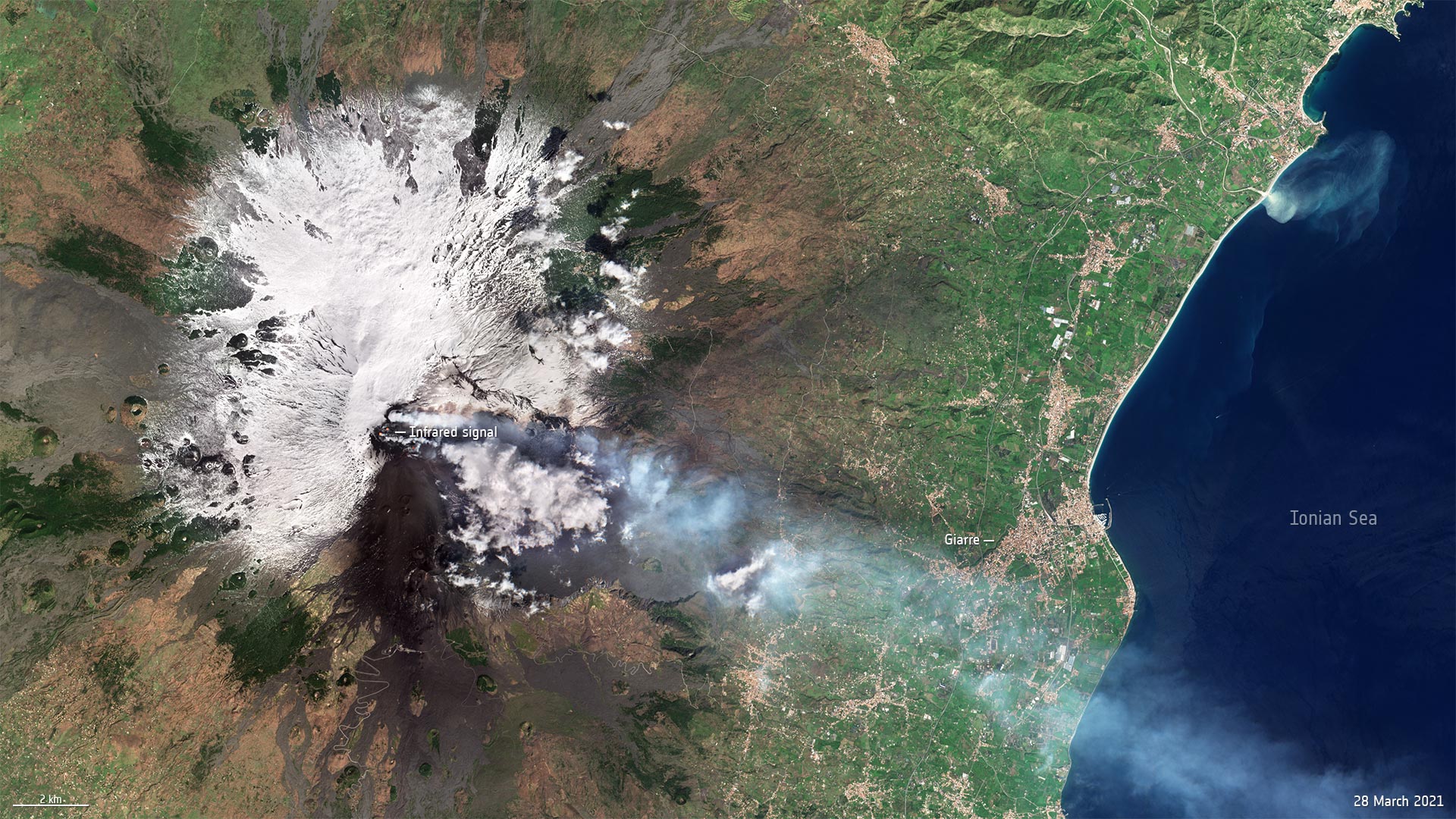
    The images below show the latest activity taking place in the volcano. The images, captured by the Copernicus Sentinel-2 and Sentinel-3 missions, have been processed using the shortwave-infrared band to show the ongoing activity in the crater. Smoke plumes can be seen blowing eastwards towards the town of Giarre.
    Mount Etna Plumes
    This image, captured on March 28, 2021, by the Copernicus Sentinel-2 mission, shows the latest activity in Italy’s Mount Etna. The image has been processed using the mission’s shortwave-infrared band to show the ongoing activity in the crater. Smoke plumes can be seen blowing eastwards towards the town of Giarre. Credit: Contains modified Copernicus Sentinel data (2021), processed by ESA, CC BY-SA 3.0 IGO

    Atmospheric sensors on satellites can also identify the gases and aerosols released by the eruption, as well as quantify their wider environmental impact. The image below, captured by the Copernicus Sentinel-5P satellite, shows the sulfur dioxide concentrations visible traveling southwards towards Libya. Sulfur dioxide is released from a volcano when magma is relatively close to the surface.

    After a week or so of remaining calm, Etna’s Southeast Crater re-awoke on the morning of 31 March with a loud explosion at around 07:00 CEST, followed by several puffs of ash and lava.
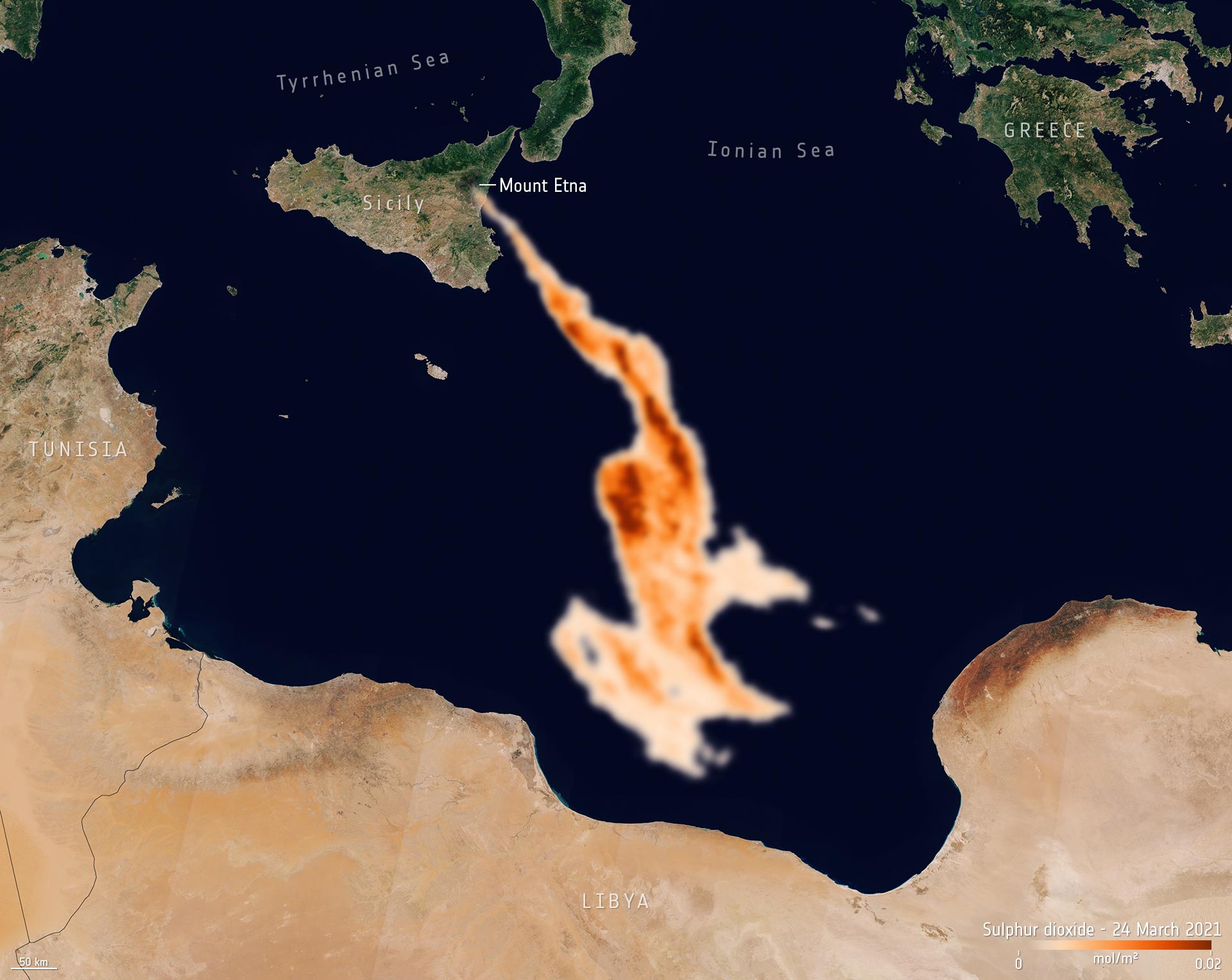
    Mount Etna Sulfur Dioxide March 2021
    Atmospheric sensors on satellites can also identify the gases and aerosols released by the eruption, as well as quantify their wider environmental impact. This image, captured by the Copernicus Sentinel-5P satellite, shows the sulfur dioxide concentrations visible traveling southwards towards Libya. Sulfur dioxide is released from a volcano when magma is relatively close to the surface. Credit: Contains modified Copernicus Sentinel data (2021), processed by ESA, CC BY-SA 3.0 IGO

    According to the National Institute of Geophysics and Volcanology in Italy (INGV), the explosive activity increased in the late afternoon and during the night with lava flowing towards the Valle del Bove, with smaller flows advancing southwards. As of today, activity in the Southeast Crater remains calm.

    Never miss a breakthrough: Join the SciTechDaily newsletter.
    Follow us on Google and Google News.

    European Space Agency Volcano
    Share. Facebook Twitter Pinterest LinkedIn Email Reddit

    Related Articles

    Sulfur Dioxide From Massive Volcanic Eruption Near Tonga Spreads Over Australia

    New Lava River From La Palma Volcano Captured by Satellite

    Stunning Satellite Image Shows Lava Burning a Path to the Sea From La Palma Volcano

    La Soufrière Volcano Explosive Eruption: Before-and-After Satellite Images

    Italy’s Mount Etna Erupts, Spewing a Fountain of Lava and Ash Into the Sky

    Earth From Space: Awe-Inspiring Vatnajökull, Iceland [Video]

    Earth From Space: Great Rift Valley, Kenya – Shaped by Major Tectonic and Volcanic Activity

    Surprising Trigger Identified for Explosive Eruption of Hawaii’s Kilauea Volcano

    Taal Volcano in the Philippines Erupted – See the Incredible Satellite View

    2 Comments

    1. John s Ostrander on April 12, 2021 10:27 am

      Stromboli erupts several times daily.Much more active than Etna.

      Reply
    2. Zoltan on April 12, 2021 11:36 pm

      Yes, but not in a populated area and with generally less violent eruptions.

      Reply
    Leave A Reply Cancel Reply

    • Facebook
    • Twitter
    • Pinterest
    • YouTube

    Don't Miss a Discovery

    Subscribe for the Latest in Science & Tech!

    Trending News

    Scientists Uncover Potential Brain Risks of Popular Fish Oil Supplements

    Scientists Discover a Surprising Way To Make Bread Healthier and More Nutritious

    After 60 Years, Scientists Uncover Unexpected Brain Effects of Popular Diabetes Drug Metformin

    New Research Uncovers Hidden Side Effects of Popular Weight-Loss Drugs

    Scientists Rethink Extreme Warming After Surprising Ocean Discovery

    Landmark Study Links Never Marrying to Significantly Higher Cancer Risk

    Researchers Discover Unknown Beetle Species Just Steps From Their Lab

    Largest-Ever Study Finds Medicinal Cannabis Ineffective for Anxiety, Depression, PTSD

    Follow SciTechDaily
    • Facebook
    • Twitter
    • YouTube
    • Pinterest
    • Newsletter
    • RSS
    SciTech News
    • Biology News
    • Chemistry News
    • Earth News
    • Health News
    • Physics News
    • Science News
    • Space News
    • Technology News
    Recent Posts
    • Scientists Discover Hidden Pathway Inside Catalysts That Defies Decades of Assumptions
    • Scientists Finally Crack Decades-Old Mystery of “Breathing” Lasers
    • “Like Liquid Metal”: Scientists Create Strange Shape-Shifting Material
    • Early Warning Signals of Esophageal Cancer May Be Hiding in Plain Sight
    • Researchers Have Discovered a THC-Free Cannabis Compound That May Replace Opioids
    Copyright © 1998 - 2026 SciTechDaily. All Rights Reserved.
    • Science News
    • About
    • Contact
    • Editorial Board
    • Privacy Policy
    • Terms of Use

    Type above and press Enter to search. Press Esc to cancel.