
Developed during the ongoing pandemic, but adaptable to different needs: Austrian scientists develop simulation model for keeping schools open safely during a pandemic.
A year ago, the whole world discussed: is it irresponsible to send children to school during a pandemic, or do measures exist that can prevent corona clusters so efficiently that schools can stay open (or reopen)?
A research team at the Complexity Science Hub Vienna (CSH) wanted to know for sure. Jana Lasser, then working in Peter Klimek’s team at the CSH and MedUni Vienna and now a scientist at Graz University of Technology, developed a school simulation model that shows how and how likely the virus spreads in different school settings. The model also allows to calculate the effectiveness of (bundles of) measures against virus spread.
For this study published in the current issue of Nature Communications, the CSH team added the properties of the delta variant, which was predominant in Austria before Christmas. “However, we can adapt our model any time and simulate a wide variety of other scenarios,” said complexity scientist Jana Lasser, the first author of the paper.
The research team developed and calibrated its “school tool” with COVID-19 data on 616 corona clusters that had occurred in Austrian schools in the fall of 2020. The anonymized data were contributed by the Austrian Agency for Health and Food Safety (AGES).
To get a sense of what measures could realistically be implemented in schools, the researchers also conducted several interviews with school principals and teachers.
The multitude of possibilities makes the undertaking complex
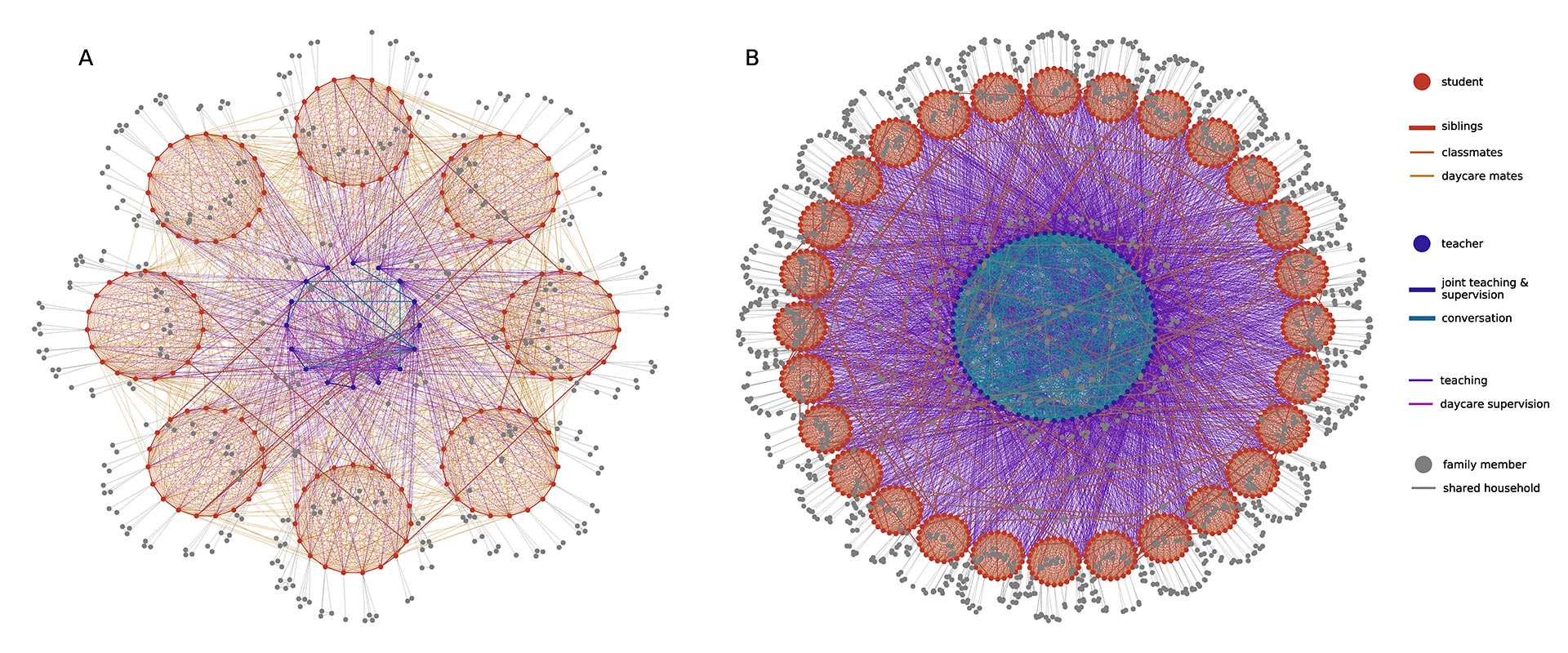
First, the scientists defined different types of schools: How many classes does a school have, how big are the classes, how many teachers are there at the school, etc. “In our model, we distinguish primary schools with or without afternoon daycare, lower secondary schools with or without afternoon daycare, upper secondary schools, or secondary schools with children from 10 to about 18 years,” Lasser said.
These virtual schools can take different measures to prevent clusters if possible. The measures included: wearing masks, a frequent intensive ventilation of classrooms, the regular testing of children and teachers, and class size reduction. The scientists also simulated different vaccination rates among teachers and children.
It’s all about the mix
One result of the work: the measures must be adapted to different school types. “Secondary schools tend to be larger, with more children in the classes and changing teachers, so there are significantly more opportunities for infection spread. The web-based visualization we also developed shows nicely how an infection runs through a school,” Lasser explains. This higher likelihood of contagion in larger schools means they need to implement more measures than elementary schools.
Based on the delta variant, and given that 80 percent of the teachers are vaccinated, the model shows that elementary and lower secondary schools can keep the reproduction rate R below 1 (i.e., one sick person infects less than one other person on average) with classroom ventilation, wearing masks, and class size reduction even when children are not vaccinated. In all other types of schools, the same measures can help to keep R<1 – and thus (re)open relatively safely – if half of the children were also vaccinated.
In larger schools, testing should also focus on teachers as a possible source of infection, since they have many more contacts throughout the day and can carry the virus to different classes, the researchers point out.
“We clearly see the effectiveness of the so-called Swiss cheese model,” explained complexity scientist Peter Klimek (CSH & MedUni Vienna). “No single measure alone can protect one hundred percent, but with several measures combined, protection increases considerably.”
“In addition, the correct implementation of measures is the be-all and end-all,” Klimek continued. “Even a small deviation – for example, if classes are ventilated less frequently or not all children are getting tested – is enough to make cluster sizes grow exponentially.”
Of all individual interventions (except for vaccination), the ventilation of classrooms is the most effective in preventing a cluster – as long as windows are consequently opened for five minutes every 45 minutes. Also highly effective is testing two to three times a week; for their study, the scientists modeled antigen testing.
Omicron changes the rules of the game
And what about the much more contagious Omicron variant? “On the occasion of the publication of our paper, I wanted to check that, too,” said Jana Lasser. “My results, although of course not yet peer-reviewed, show that due to the much higher infectiousness of Omicron, we need all available measures in all types of schools to prevent larger outbreaks. Only elementary schools can omit one measure, such as splitting classes.”
For those who want to do their own math, codes can be freely downloaded from the web. “Good coders could even tailor the model to their own needs. The relevant numbers, such as the infectiousness of a disease, number of classes, children, and teachers, or the individual measures to prevent disease spread, can all be adjusted,” says Peter Klimek.
Jana Lasser also emphasizes the value of a well-done visualization of the model as an aid for parents, children, school leaders or authorities. “It is always impressive to see how quickly a virus spreads in a group, and how infection dynamics change when single or multiple measures are introduced. Good visualizations could do a great deal of persuasion,” she concludes.
The visualization developed by the CSH https://vis.csh.ac.at/covid-schools/ was published a year ago, showing the Alpha variant.
Reference: “Assessing the impact of SARS-CoV-2 prevention measures in Austrian schools using agent-based simulations and cluster tracing data” by Jana Lasser, Johannes Sorger, Lukas Richter, Stefan Thurner, Daniela Schmid and Peter Klimek, 27 January 2022, Nature Communications.
DOI: 10.1038/s41467-022-28170-6
First author Jana Lasser was a PostDoc at Complexity Science Hub Vienna (CSH) and Medical University of Vienna when she started to build the model. She continued to work on this paper after moving to Graz University of Technology.
Funding: Austrian Science Promotion Agency FFG, Vienna Science and Technology Fund WWTF, Medizinisch- Wissenschaftlichen Fonds des Bürgermeisters der Bundeshauptstadt Wien.
Never miss a breakthrough: Join the SciTechDaily newsletter.
Follow us on Google and Google News.
2 Comments
Meanwhile parochial schools in the US have remained open since 2021…very successfully…
Correction parochial Catholic Schools opened September 2020…