

Light sources, a form of particle accelerator, produce powerful beams of X-rays and other spectrums, enabling scientists to peer into the microscopic structure of materials without physically altering them.
These machines differ from other accelerators as they use oscillating magnetic fields to generate light directly. They play a crucial role across various scientific fields, from studying atomic structures with hard X-rays to examining electronic structures with terahertz waves.
Light sources are a type of particle accelerator that produce powerful beams of X-rays, ultra-violet, or infrared light. These beams are similar to how holding an envelope in front of a bright light can reveal something about what’s inside the envelope. But by using special types of light vastly more powerful than the X-ray machine in a doctor’s office, these light sources help scientists see inside matter. It’s like seeing inside an envelope without opening it. This gives scientists the power to reveal how materials behave at microscopic or nanoscale sizes as well as at ultrafast speeds.
Functionality and Mechanics of Light Sources
Particle accelerators designed for producing light operate a little bit differently than the high energy physics machines used for probing the secrets of fundamental particles. Instead of colliding particles to see what comes out, light sources use the particle beam to directly emit light. By passing it through a device called an undulator that creates an alternating magnetic field, the beam path undergoes a series of small oscillations. Each time the path is bent, the particles emit photons.
There can be dozens of these oscillations in an undulator, and the photons emitted from each add up to a very intense beam, about one billion times brighter than a typical medical X-ray machine. Each light source can accommodate many undulators and can serve dozens of different experiments at one time.
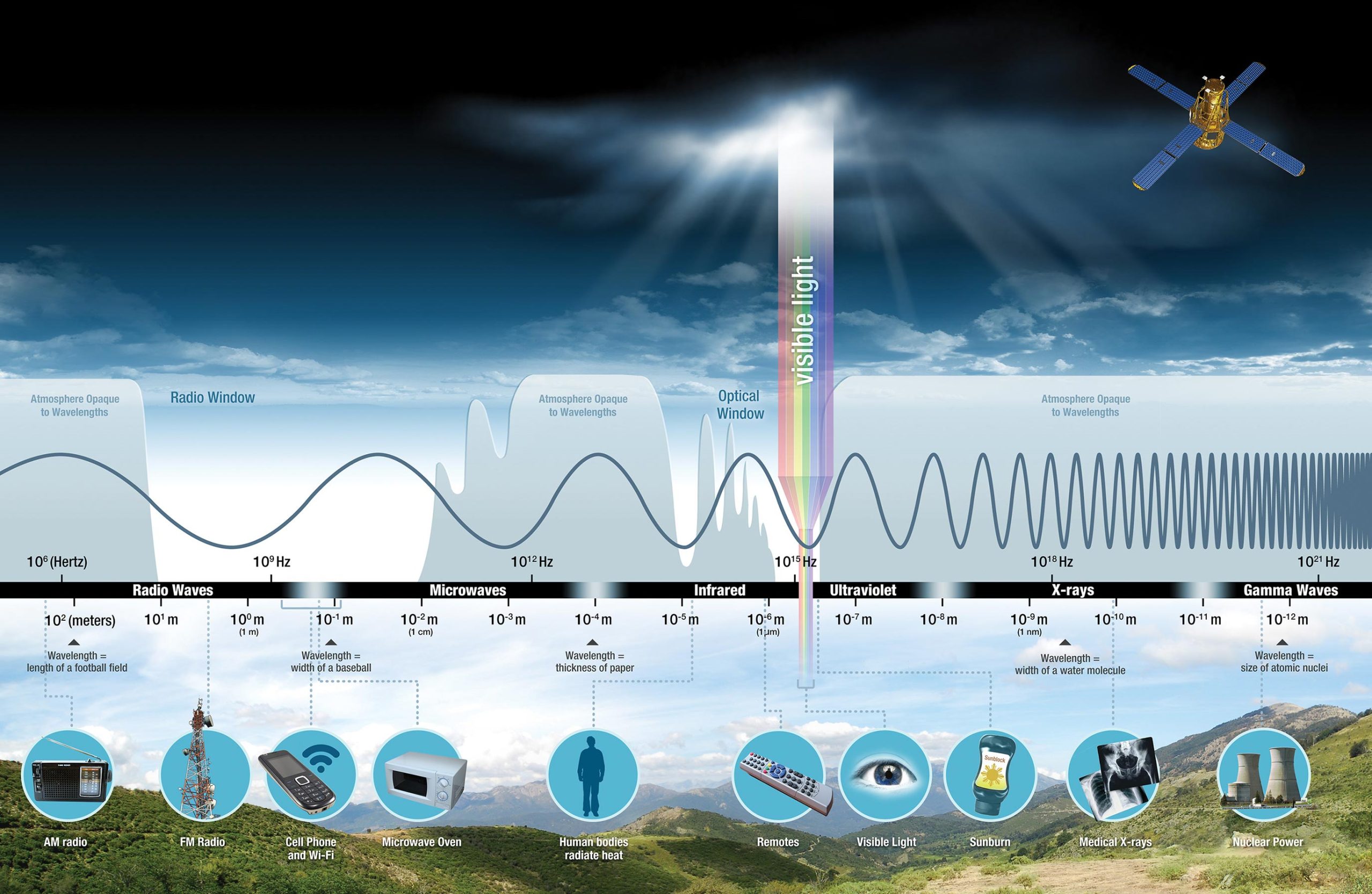
Spectrum and Applications of Light
Light sources operate at specific ranges of the electromagnetic spectrum. This spectrum includes all the different types of electrical and magnetic energy in the universe. They are divided according to the size of the waves in which they travel. The visible light we use to see is a tiny part of this spectrum. X-ray, ultra-violet, and infrared light are other parts of this spectrum, each with their own range of wavelengths.
Different wavelengths of light are useful for different purposes. Argonne National Laboratory notes that in general, wavelengths shorter than visible light, such as the short end of X-rays, can peer into atomic structure. This means that X-rays can identify the elements in a sample of material. The shortest wavelength X-rays (sometimes called “hard X-rays”) are ideal for determining the positions of atoms within a crystal or a molecule. Longer-wavelength X-rays (sometimes called “soft X-rays”) and ultraviolet light are good choices for studying chemical reactions. Infrared light is useful for studying atomic vibrations in molecules and solids. The longest infrared light, called terahertz waves, is useful for examining certain types of electronic structure—the way electrons and their energy are arranged around an atomic nucleus.
The Science and Impact of Light Sources
Light sources have an impact in almost all areas of science. They allow researchers to discover new materials for batteries, solar panels, microelectronics, as well as quantum materials. They can look at processes during a material’s formation or how it degrades with use to understand how to make better materials. They are able to see into operating devices, even at the nanoscale, and gain information you can’t get otherwise. They can image cells and other biological systems, even in 3D, revealing the basic processes of life. They can even tell the structure of very complicated molecules like proteins. This has led to new vaccines and treatments for deadly diseases, including COVID-19.
Fast Facts
- There are more than 50 light sources in operation or under construction in the world, according to lightsources.org.
- One key advance in light sources is the X-ray free-electron laser such as the one at the Linac Coherent Light Source. These are similar to lasers but use beams of electrons moving at close to the speed of light for a uniquely powerful and tunable light source.
DOE Office of Science: Contributions to Light Sources
The Department of Energy Office of Science, Basic Energy Sciences program supports five of the world’s most powerful light sources. These five light sources are user facilities – facilities that are open to researchers from around the world. The research and development, planning, construction, and operation of these facilities are managed by the Basic Energy Sciences program’s Scientific User Facilities Division. The five light source user facilities include:
- The Advanced Light Source (ALS) at Lawrence Berkely National Laboratory is one of the world’s brightest sources of high-quality, reliable vacuum-ultraviolet light and soft X-rays, enabling a wide variety of scientific disciplines.
- The Advanced Photon Source (APS) at Argonne National Laboratory is one of only four third-generation, hard X-ray synchrotron radiation light sources in the world, which has brought about new discoveries in a wide range of scientific fields.
- The National Synchrotron Light Source II (NSLS-II) at Brookhaven National Laboratory is a state-of-the-art synchrotron light source that allows scientists to probe the fundamental properties of matter, paving the way to new scientific discoveries and innovations.
- The Linac Coherent Light Source (LCLS) at the SLAC National Accelerator Laboratory is the world’s first hard X-ray free electron laser facility capable of producing X-rays that are both very intense and clumped into ultrafast pulses.
- The Stanford Synchrotron Radiation Light Source (SSRL) at the SLAC National Accelerator Laboratory produces intense X-rays as a resource for researchers to study our world at the atomic and molecular level, allowing for research and advances in energy production, environmental remediation, nanotechnology, new materials, and medicine.
Never miss a breakthrough: Join the SciTechDaily newsletter.
Follow us on Google and Google News.
1 Comment
Please ask researchers to think deeply:
1. What is the difference between imagined particles and imagined God?
2. What are you exploring and searching for?
3. What does the physical phenomenon you observed explain?
4. What is the dirtiness and ugliness in academic activities?
and so on.
Scientific research guided by correct theories can help people avoid detours, failures, and exaggeration. The physical phenomena observed by researchers in experiments are always appearances, never the natural essence of things. The natural essence of things needs to be extracted and sublimated based on mathematical theories via appearances , rather than being imagined arbitrarily.
Everytime scientific revolution, the scientific research space brought by the new paradigm expands exponentially. Physics should not ignore the analyzable physical properties of topological vortices.
(1) Traditional physics: based on mathematical formalism, experimental verification and arbitrary imagination.
(2) Topological Vortex Theory: Although also based on mathematics (such as topology), it focuses more on non intuitive geometry and topological structures, challenging traditional physical intuition.
Extension of the Standard Model: Topological Vortex Theory points out the limitations of the Standard Model in describing the large-scale structure of the universe, proposes the need to consider non-standard model components such as dark matter and dark energy, and suggests that topological vortex fields may be key to understanding these phenomena.
Topological vortex theory heralds innovative technologies such as topological electronics, topological smart batteries, topological quantum computing, etc., which may bring low-energy electronic components, almost inexhaustible currents, and revolutionary computing platforms, etc.
Topology tells us that topological vortices and antivortices can form new spacetime structures via the synchronous effect of superposition, deflection, or twisting of them. In fact, mathematics does not tell us that there must be God particles, ghost particles, fermions, or bosons present. When physics and mathematics diverge, arbitrary imagination will make physics no different from theology. Topological vortex research reflections on the philosophy and methodology of science help us understand the nature essence of science and the limitations of scientific methods. This not only has guiding significance for scientific research itself, but also has important implications for science education and popularization.
Today, so-called official (such as PRL, Nature, Science, PNAS, etc.) in physics stubbornly believes that two sets of cobalt-60 rotating in opposite directions can become two sets of objects that mirror each other, is a typical case that pseudoscience is rampant and domineering. Please witness the exemplary collaboration between theoretical physicists and experimentalists (https://scitechdaily.com/microscope-spacecrafts-most-precise-test-of-key-component-of-the-theory-of-general-relativity/#comment-854286).
Let us continue to witness together the dirtiest and ugliest era in the scientific and humanistic history of human society. The laws of nature will not change due to misleading of so-called academic publications.