
Close Menu
    Facebook X (Twitter) Instagram
    SciTechDaily
    • Biology
    • Chemistry
    • Earth
    • Health
    • Physics
    • Science
    • Space
    • Technology
    Facebook X (Twitter) Pinterest YouTube RSS
    SciTechDaily
    Home»Space»Science Simplified: What Is a Neutron Star?
    Space

    Science Simplified: What Is a Neutron Star?

    By European Space Agency (ESA)May 5, 2024No Comments3 Mins Read
    Facebook Twitter Pinterest Telegram LinkedIn WhatsApp Email Reddit
    Share
    Facebook Twitter LinkedIn Pinterest Telegram Email Reddit
    Neutron Star Artist's Impression
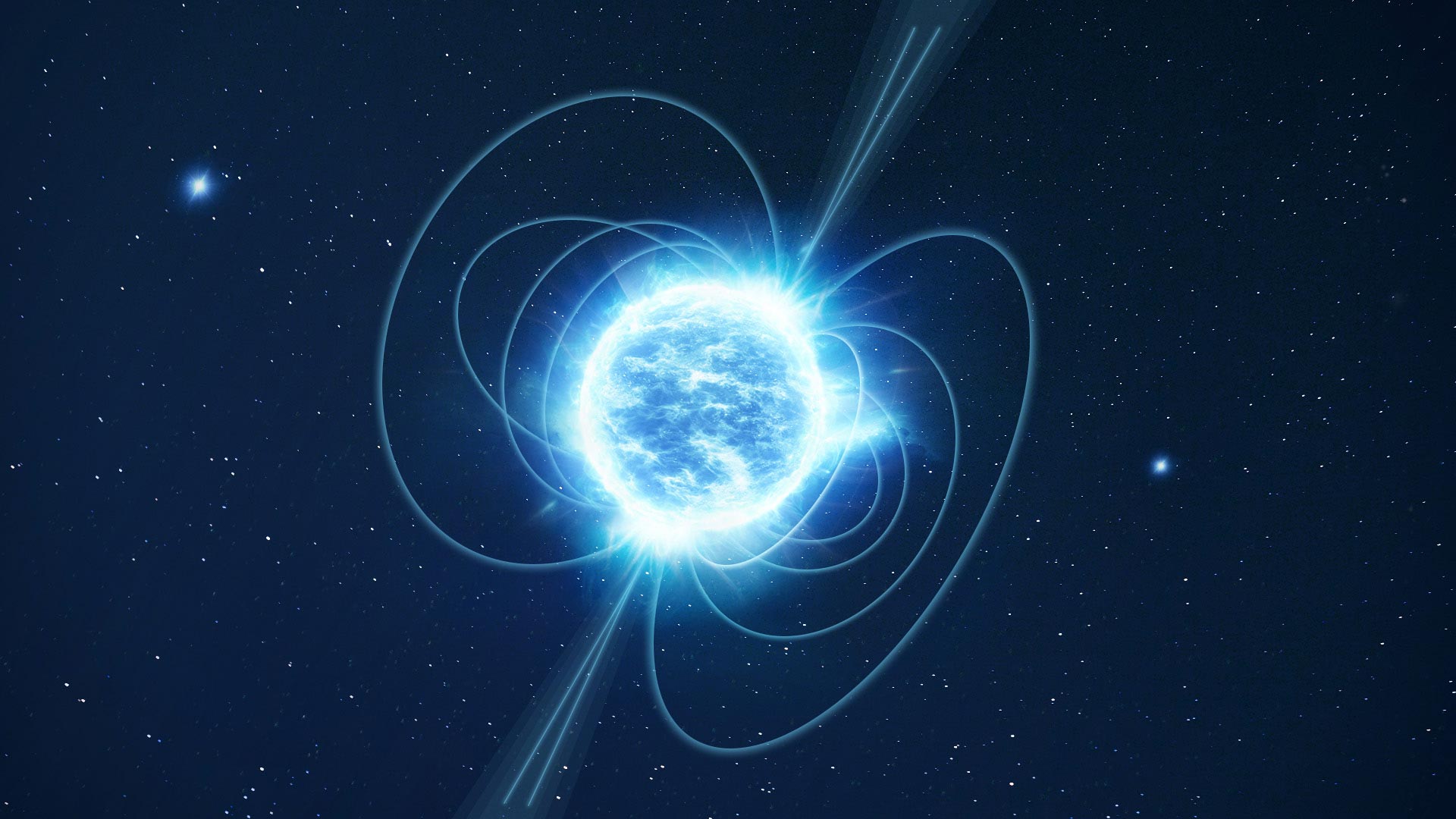
    Neutron stars are the dense remnants of massive stars that collapse during a supernova, forming objects with intense magnetic fields. These stars often manifest as pulsars due to rapid rotation and directional radio emissions and can also be part of X-ray binaries when in a binary system with a normal star. Credit: ESA

    What Is a Neutron Star?

    Besides black holes, neutron stars are among the most baffling objects in the Universe.

    A neutron star is formed in the last moments of the life of a very large star (with more than about eight times the mass as our Sun), when the nuclear fuel in its core eventually runs out. In a sudden and violent end, the outer layers of the star are ejected with monstrous energy in a supernova explosion, leaving behind spectacular clouds of interstellar material rich in dust and heavy metals. At the center of the cloud (nebula), the dense stellar core further contracts to form a neutron star. A black hole can also form when the remaining core’s mass is greater than about three solar masses.

    A neutron star is extraordinarily dense, packing more mass than the entire Sun (1.5 to 2.5 solar masses) in a globe with a diameter of 10-15 km (about the diameter of a city like Paris). Its density is so high that a sugar cube-sized object of neutron star material would weigh as much as all the people on Earth.

    Due to extreme pressure, the electrons and protons present in normal matter fuse together with the result that these exotic stars are composed almost entirely of neutrons. This ‘neutron compound’ generates enough force to support the inward pressure of gravity.

    Newly formed neutron stars have extremely strong magnetic fields; thousands to billions of times more intense than any magnetic field we can generate in our labs. Often neutron stars are also rotating extremely fast (completing up to hundreds of revolutions per second) and beam light at radio wavelength from their magnetic poles. This beam can be detected by radio telescopes only when it is pointing toward Earth, similar to the way a lighthouse can be seen only when the light is pointed in the direction of an observer. Because of this, the radio signal appears to be pulsating and these neutron stars are called pulsars.

    When a neutron star and a normal star are orbiting each other at a close distance, the neutron star can suck material away from its companion. This material falls with a high speed onto the collapsed object, becoming extremely hot and releasing energy in the form of X-rays. The star’s powerful magnetic field interact with the blazing gas and can form jets. Systems that consist of a neutron star ‘feeding’ on a normal star are known as X-ray binaries.

    Never miss a breakthrough: Join the SciTechDaily newsletter.
    Follow us on Google and Google News.

    Astronomy Astrophysics European Space Agency
    Share. Facebook Twitter Pinterest LinkedIn Email Reddit

    Related Articles

    Feared Apophis Impact Ruled Out – Asteroid Will Pass Close Enough to Earth to See With Naked Eye

    Tantalizing Evidence: Is the Nearest Star Cluster to the Sun Being Destroyed?

    Tantrums of a Baby Star: Herbig-Haro Objects

    Unexpected Discovery: Hubble Space Telescope Uncovers Concentration of Small Black Holes

    Unique Planetary System With Rhythmic Orbital Resonance Revealed by Exoplanet Watcher Cheops

    Cosmic Neon Lights: Strange New Type of Star Revealed in X-ray Light

    “Unprecedented” – Unusual Planetary Nebula Fades Mere Decades After It Arrived

    Hubble Captures Unprecedented Fading of Stingray Nebula – “This Is Very, Very Dramatic, and Very Weird”

    To the Milky Way’s Anticenter and Beyond: Gaia’s New Detailed Data From More Than 1.8 Billion Stars

    Leave A Reply Cancel Reply

    • Facebook
    • Twitter
    • Pinterest
    • YouTube

    Don't Miss a Discovery

    Subscribe for the Latest in Science & Tech!

    Trending News

    New Pill Lowers Stubborn Blood Pressure and Protects the Kidneys

    Humans May Have Hidden Regenerative Powers, New Study Suggests

    Scientists Just Solved the Mystery of Why Crabs Walk Sideways

    Doctors Are Surprised by What This Vaccine Is Doing to the Heart

    This Popular Supplement May Boost Your Brain, Not Just Your Muscles

    Scientists Say This Simple Supplement May Actually Reverse Heart Disease

    Warming Oceans Could Trigger a Dangerous Methane Surge

    This Simple Movement Could Be Secretly Cleaning Your Brain

    Follow SciTechDaily
    • Facebook
    • Twitter
    • YouTube
    • Pinterest
    • Newsletter
    • RSS
    SciTech News
    • Biology News
    • Chemistry News
    • Earth News
    • Health News
    • Physics News
    • Science News
    • Space News
    • Technology News
    Recent Posts
    • Researchers Discover Efficient New Way To Split Hydrogen From Water for Energy
    • This Korean Skincare Ingredient Could Help Fight Deadly Superbugs
    • Giant Squid Detected off Western Australia in Stunning Deep-Sea Discovery
    • Popular Sugar-Free Sweetener Linked to Liver Disease, Study Warns
    • Why Weight Loss Isn’t Enough for Everyone at Risk of Diabetes
    Copyright © 1998 - 2026 SciTechDaily. All Rights Reserved.
    • Science News
    • About
    • Contact
    • Editorial Board
    • Privacy Policy
    • Terms of Use

    Type above and press Enter to search. Press Esc to cancel.