

The development may have broad implications for efficient harvesting, storing, and control of energy flow for mechanical and optical applications.
- Their proof-of-concept experiment may have broad implications for efficient harvesting, storing, and control of energy flow for mechanical and optical applications
- The findings may facilitate improved technology for monitoring the structural integrity of bridges and other structural components
- The discovery may also lead to improved methods for energy harvesting and storage, wireless charging of electric vehicles, and may also have applications in quantum computing and ultralow-energy photonics
Light and sound waves are at the basis of energy and signal transport and fundamental to some of our most basic technologies — from cell phones to engines. Scientists, however, have yet to devise a method that allows them to store a wave intact for an indefinite period of time and then direct it toward a desired location on demand. Such a development would greatly facilitate the ability to manipulate waves for a variety of desired uses, including energy harvesting, quantum computing, structural-integrity monitoring, information storage, and more.
In a newly published paper in Science Advances, a group of researchers led by Andrea Alù, founding director of the Photonics Initiative at the Advanced Science Research Center (ASRC) at The Graduate Center, CUNY, and by Massimo Ruzzene, professor of Aeronautics Engineering at Georgia Tech, have experimentally shown that it is possible to efficiently capture and store a wave intact then guide it towards a specific location.
“Our experiment proves that unconventional forms of excitation open new opportunities to gain control over wave propagation and scattering,” said Alù. “By carefully tailoring the time dependence of the excitation, it is possible to trick the wave to be efficiently stored in a cavity, and then release it on demand towards the desired direction.”
“Typically storing energy in resonant cavities is inefficient, but with our proposed method all the energy can be efficiently stored in these cavities,” said Younes Ra’di, an ASRC Photonics research professor involved in the research.
Methodology
To achieve their goal, the scientists had to devise a way for changing the basic interaction between waves and materials. When a light or sound wave hits an obstacle, it is either partially absorbed or reflected and scattered. The absorption process entails immediately converting the wave into heat or other forms of energy. Materials that can’t absorb waves only reflect and scatter them. The researchers’ goal was to find a way to mimic the absorption process without converting the wave into other forms of energy and instead storing it in the material. This concept, introduced theoretically two years ago by the ASRC group, is known as coherent virtual absorption.
To prove their theory, the researchers reasoned that they needed to tailor the waves’ time evolution so that when they came in contact with non-absorbing materials, they wouldn’t be reflected, scattered, or transmitted. This would prevent the wave impinging on the structure from escaping, and it would be efficiently trapped inside as if it were being absorbed. The stored wave could then be released on demand.
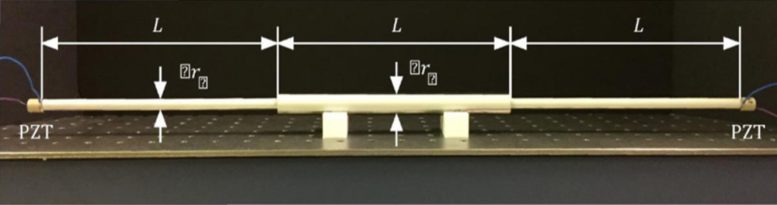
During their experiment, researchers propagated two mechanical waves traveling in opposite directions along a carbon steel waveguide bar that contained a cavity. The time variations of each wave were carefully controlled to ensure that the cavity would retain all of the impinging energy. Then, by stopping the excitation or detuning one of the waves, they were able to control the release of the stored energy and send it toward a desired direction on demand.
“While we ran our proof-of-concept experiment using elastic waves traveling in a solid material, our findings are also applicable to radiowaves and light, offering exciting prospects for efficient energy harvesting, wireless power transfer, low-energy photonics, and generally enhanced control over wave propagation,” said Ruzzene.
Research Funding
This study was funded by the Air Force Office of Scientific Research, the National Science Foundation, and the Simons Foundation.
Air Force Office of Scientific Research, the National Science Foundation, and the Simons Foundation
Reference: “Coherent virtual absorption of elastodynamic waves” by G. Trainiti, Y. Ra’di, M. Ruzzene and A. Alù, 30 August 2019, Science Advances.
DOI: 10.1126/sciadv.aaw3255
Abstract
Absorbers suppress reflection and scattering of an incident wave by dissipating its energy into heat. As material absorption goes to zero, the energy impinging on an object is necessarily transmitted or scattered away. Specific forms of temporal modulation of the impinging signal can suppress wave scattering and transmission in the transient regime, mimicking the response of a perfect absorber without relying on material loss. This virtual absorption can store energy with large efficiency in a lossless material and then release it on demand. Here, we extend this concept to elastodynamics and experimentally show that longitudinal motion can be perfectly absorbed using a lossless elastic cavity. This energy is then released symmetrically or asymmetrically by controlling the relative phase of the impinging signals. Our work opens previously unexplored pathways for elastodynamic wave control and energy storage, which may be translated to other phononic and photonic systems of technological relevance.
Never miss a breakthrough: Join the SciTechDaily newsletter.
Follow us on Google and Google News.
1 Comment
not possible 1st and 2nd law of thermodynamics says no