
A new method for simulating quantum entanglement between interacting particles has been developed by physicists.
Physicists are (temporarily) augmenting reality in order to crack the code of quantum systems.
Calculating the collective behavior of a molecule’s electrons is necessary to predict a material’s properties. Such predictions could one day help scientists create novel drugs or create materials with desirable qualities like superconductivity. The issue is that electrons may become ‘quantum mechanically’ entangled with one another, which means they can no longer be treated individually. For any system with more than a few particles, the entangled network of connections becomes outrageously difficult for even the most powerful computers to unravel directly.
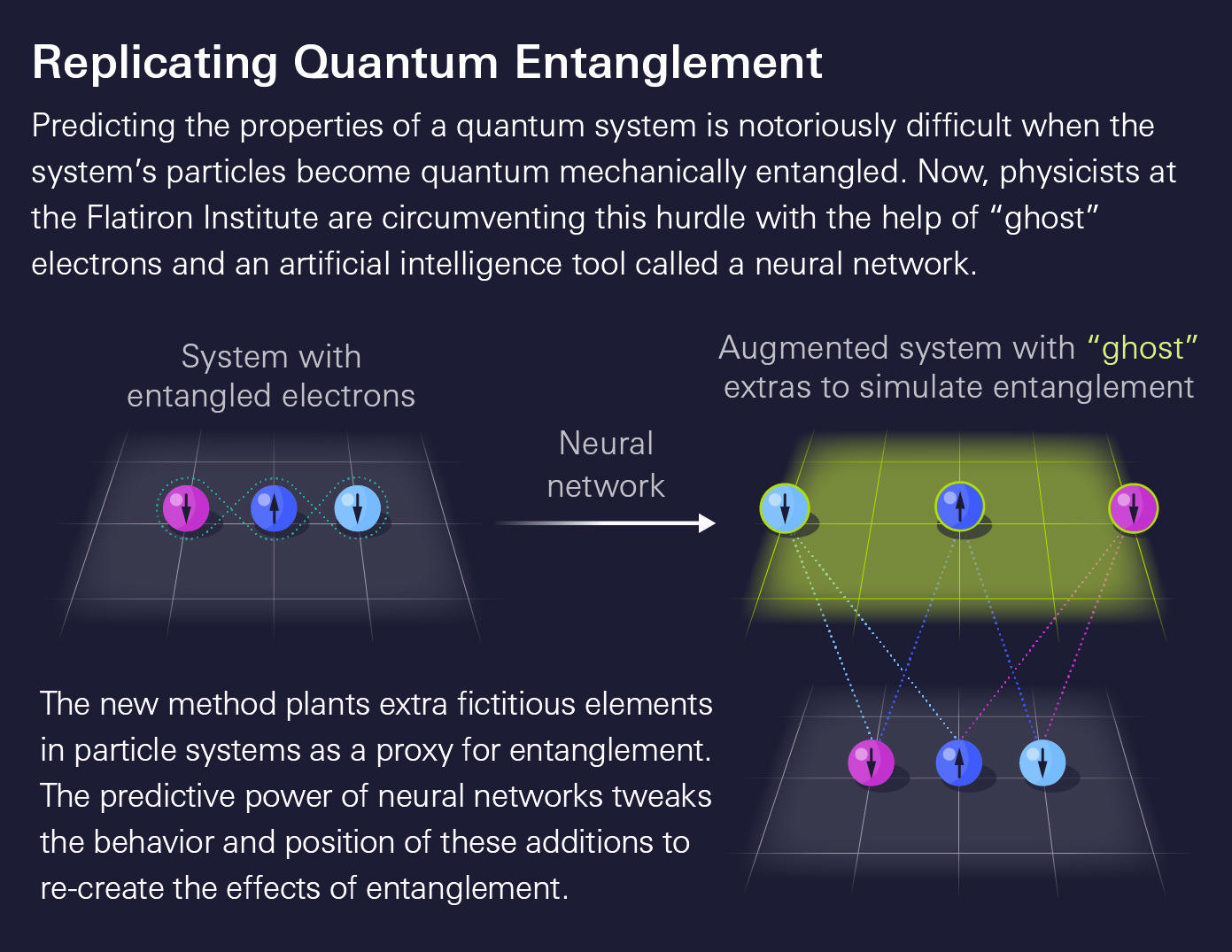
Now, quantum physicists from the École Polytechnique Fédérale de Lausanne (EPFL) in Switzerland and the Flatiron Institute’s Center for Computational Quantum Physics (CCQ) in New York City have found a workaround. By adding extra “ghost” electrons in their computations that interact with the system’s actual electrons, they were able to simulate entanglement.
Neural Networks to Simulate Entanglement
In the new approach, the behavior of the added electrons is controlled by an artificial intelligence technique called a neural network. The network makes tweaks until it finds an accurate solution that can be projected back into the real world, thereby re-creating the effects of entanglement without the accompanying computational hurdles.
The scientists recently published their work in the journal Proceedings of the National Academy of Sciences.
“You can treat the electrons as if they don’t talk to each other, as if they’re noninteracting,” says study lead author Javier Robledo Moreno, a graduate student at the CCQ and New York University. “The extra particles we’re adding are mediating the interactions between the actual ones that live in the actual physical system we’re trying to describe.”
In the new paper, the physicists demonstrate that their approach matches or outclasses competing methods in simple quantum systems.
Expanding Applications to Drug and Material Design
“We applied this to simple things as a test bed, but now we are taking this to the next step and trying this on molecules and other, more realistic problems,” says study co-author and CCQ director Antoine Georges. “This is a big deal because if you have a good way of getting the wave functions of complex molecules, you can do all sorts of things, like designing drugs and materials with specific properties.”
The long-term goal, Georges says, is to enable researchers to computationally predict the properties of a material or molecule without having to synthesize and test it in a lab. They might, for instance, be able to test a slew of different molecules for a desired pharmaceutical property with just a few clicks of a mouse. “Simulating big molecules is a big deal,” Georges says.
Robledo Moreno and Georges co-authored the paper with EPFL assistant professor of physics Giuseppe Carleo and CCQ research fellow James Stokes.
The new work is an evolution of a 2017 paper in Science by Carleo and Matthias Troyer, who is currently a technical fellow at Microsoft. That paper also combined neural networks with fictitious particles, but the added particles weren’t full-blown electrons. Instead, they just had one property known as spin.
“When I was [at the CCQ] in New York, I was obsessed with the idea of finding a version of neural network that would describe the way electrons behave, and I really wanted to find a generalization of the approach we introduced back in 2017,” Carleo says. “With this new work, we have eventually found an elegant way of having hidden particles that are not spins but electrons.”
Reference: “Fermionic wave functions from neural-network constrained hidden states” by Javier Robledo Moreno, Giuseppe Carleo, Antoine Georges and James Stokes, 3 August 2022, Proceedings of the National Academy of Sciences.
DOI: 10.1073/pnas.2122059119
Never miss a breakthrough: Join the SciTechDaily newsletter.
Follow us on Google and Google News.
6 Comments
When the electron doesn’t spin ,how can we consider it as a electron?
As I understand it, electrons have some property that’s like angular momentum, buy they don’t *actually* spin.
I imagine the best place to put extra ghost electrons could be a little like with the breadcrumbs in Hansel and Gretel, if both electrons come from the same collision.
Looks like the ghosts are charges that source no magnetic field, something like a tight cluster of smaller spins and fractional charges that merge to leave a unit charge.
Are these ghost electrons a bit like virtual particles, which are also merely an artifact of the math?
In my mostly unpublished model of the universe “artificial experiments tend to produce artificial results.” What I have posted several times before is that pulsing coils of outwardly radiating locally generated lines of gravity force is what causes particles (e.g. photons, electrons and/or small molecules) to behave as both particles and waves in the classic double-slit experiments. Add some basic gravitational flaws to the math and programming of the AIs and “Artificial Imaginations” is what you get.