
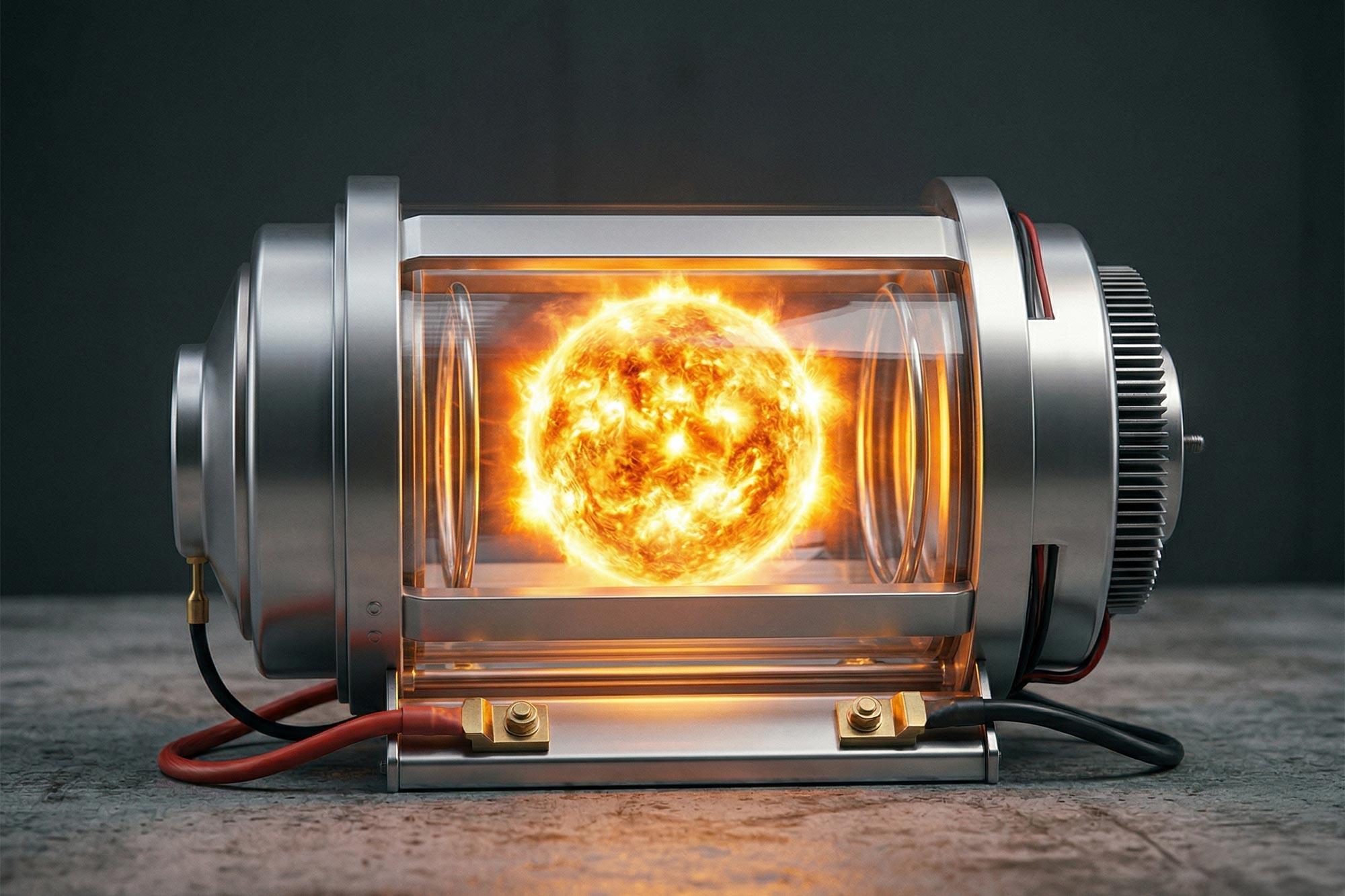
A newly engineered molecule acts like a “rechargeable” solar heat battery, storing sunlight and releasing it on demand.
Solar energy has one persistent weakness: it disappears at sunset. Finding a reliable way to store that energy for later use remains one of the biggest obstacles to expanding renewable power.
A research team at UC Santa Barbara may have found an unexpected workaround. Instead of relying on conventional batteries, they created a small organic molecule that captures sunlight, locks that energy into its structure, and releases it later as heat. The work, published in Science, introduces a new version of Molecular Solar Thermal (MOST) storage using a compound called pyrimidone.
“The concept is reusable and recyclable,” said lead author Han Nguyen, a doctoral student in the Han Group.
To understand the idea, Nguyen points to a familiar example. “Think of photochromic sunglasses. When you’re inside, they’re just clear lenses. You walk out into the sun, and they darken on their own. Come back inside, and the lenses become clear again,” Nguyen said. “That kind of reversible change is what we’re interested in. Only instead of changing color, we want to use the same idea to store energy, release it when we need it, and then reuse the material over and over.”
Bio-inspired design
To build this molecule, the researchers turned to DNA for inspiration. The pyrimidone structure resembles a DNA component that can reversibly change its form when exposed to UV light.
By creating a synthetic version, the team designed a molecule capable of repeatedly storing and releasing energy. They worked with Ken Houk, a distinguished research professor at UCLA, using computational modeling to understand how the molecule can hold energy while remaining stable for years.

“We prioritized a lightweight, compact molecule design,” Nguyen said. “For this project, we cut everything we didn’t need. Anything that was unnecessary, we removed to make the molecule as compact as possible.”
A ‘rechargeable battery’ for heat
Unlike solar panels that generate electricity, this system stores solar energy in chemical form. The molecule behaves like a coiled spring. When exposed to sunlight, it shifts into a strained, high energy configuration. It remains in that state until triggered by heat or a catalyst, which allows it to return to its original form and release the stored energy as heat.
“We typically describe it as a rechargeable solar battery,” Nguyen said. “It stores sunlight, and it can be recharged.”
The material shows strong performance, with an energy density exceeding 1.6 megajoules per kilogram (MJ/kg) (about 0.69 British thermal units per pound). This is roughly twice that of a typical lithium ion battery, which is around 0.9 MJ/kg, and higher than earlier optical switching materials.
From theory to boiling water
The critical breakthrough for Han’s group was translating high energy density into a tangible result. In the study, the researchers demonstrated that the heat released from the material was intense enough to boil water — a feat previously difficult to achieve in this field.
“Boiling water is an energy-intensive process,” Nguyen said. “The fact that we can boil water under ambient conditions is a big achievement.”
This capability opens the door for practical applications ranging from off-grid heating for camping to residential water heating. Because the material is soluble in water, it could potentially be pumped through roof-mounted solar collectors to charge during the day and stored in tanks to provide heat at night.
“With solar panels, you need an additional battery system to store the energy,” said co-author Benjamin Baker, a doctoral student in the Han Lab. “With molecular solar thermal energy storage, the material itself is able to store that energy from sunlight.”
Reference: “Molecular solar thermal energy storage in Dewar pyrimidone beyond 1.6 MJ/kg” by Han P. Q. Nguyen, Alexander J. Maertens, Benjamin A. Baker, Nathan M.-W. Wu, Zihao Ye, Qingyang Zhou, Qianfeng Qiu, Navneet Kaur, David B. Berkinsky, Katherine E. Shulenberger, K. N. Houk and Grace G. D. Han, 12 February 2026, Science.
DOI: 10.1126/science.aec6413
The research was supported by the Moore Inventor Fellowship, which Han received in 2025 to pursue the development of these “rechargeable sun batteries.”
Never miss a breakthrough: Join the SciTechDaily newsletter.
Follow us on Google and Google News.
2 Comments
What is needed is a molecule that releases electrical energy
It would have nice to include thew structure of this molecule !