

Agave plants, famous for tequila, are also water-retention experts, thriving in extreme drought conditions. Using terahertz spectroscopy, researchers uncovered how agaves store water in specialized leaf structures and use fructans as molecular sponges.
This breakthrough has exciting implications, from improving water-efficient crops to creating better food preservatives. The study’s non-invasive imaging method allows real-time plant hydration analysis, offering new possibilities for smart agriculture.
Unlocking Agave’s Water-Storing Secrets
Agave plants are widely known for their role in tequila production, but they are also highly efficient at storing water, allowing them to thrive in extremely dry environments. In a recent study, researchers used terahertz spectroscopy and imaging to better understand how these succulents manage water to survive in arid conditions.
“Understanding how plants adapt to dry conditions could lead to better farming practices and be used to develop crops that require less water,” said Monica Ortiz-Martinez from the Centro de Investigaciones en Optica (CIO) in Mexico. “This could lead to higher crop yields with lower water consumption, benefiting farmers, food production and global food security.”
Terahertz Waves: A New Lens on Hydration
The study focused on terahertz waves, which lie between microwaves and the mid-infrared region of the electromagnetic spectrum. Since water strongly absorbs terahertz radiation, researchers used terahertz spectroscopy and imaging to measure hydration levels in plant tissues, map water distribution inside the plant, and examine how fructan sugars retain moisture at a molecular level.
In the Optica Publishing Group journal Applied Optics, the researchers show that terahertz spectroscopy is a powerful tool for studying plants without causing any damage. Using this approach, they found that agave plants survive in dry environments by storing water in a specialized leaf structure and that its fructans act like molecular sponges to retain moisture.
“In the food industry, our findings on agave fructans and their exceptional water-binding properties could be used to develop new food ingredients that improve moisture retention, texture and shelf life, especially in dried or processed foods,” said the paper’s first author Enrique Castro-Camus from CIO. “This could lead to healthier, longer-lasting food products with fewer artificial preservatives.”
Combining Biology and Food Science
The agave research began as a collaboration between the Applied Terahertz Science group at CIO with June Simpson at Centro de Investigaciones Avanzadas (CINVESTAV) to explore water distribution in agave leaves and its connection to fructans from a biological perspective. Around the same time, the CIO group began a partnership with Socorro Villanueva from Centro de Investigación y Asistencia en Tecnología y Diseño del Estado de Jalisco (CIATEJ) that took a more food science approach to studying how fructans, which are used as food additives, form microscopic water layers that protect frozen products from freeze-related damage. Eventually, these two investigations came together to form a complete story of how agaves withstand extreme drought.
For terahertz imaging, the researchers used a time-domain terahertz spectrometer with a femtosecond fiber laser and sub-mm pixel resolution. They placed thin leaf slices between a terahertz emitter and detector and then used the water absorption measurements to map hydration levels. They reconfigured the same time-domain terahertz spectrometer to an attenuated total reflection geometry to analyze solutions containing fructan.
Revolutionizing Plant Hydration Studies
“Our research introduces several key innovations in the study of plant hydration using terahertz technology,” said Monica Ortiz-Martinez. “One of the most significant advancements is non-invasive water detection — unlike traditional methods that require cutting, drying and weighing plant samples, terahertz imaging enables real-time hydration analysis without damaging the plant.”
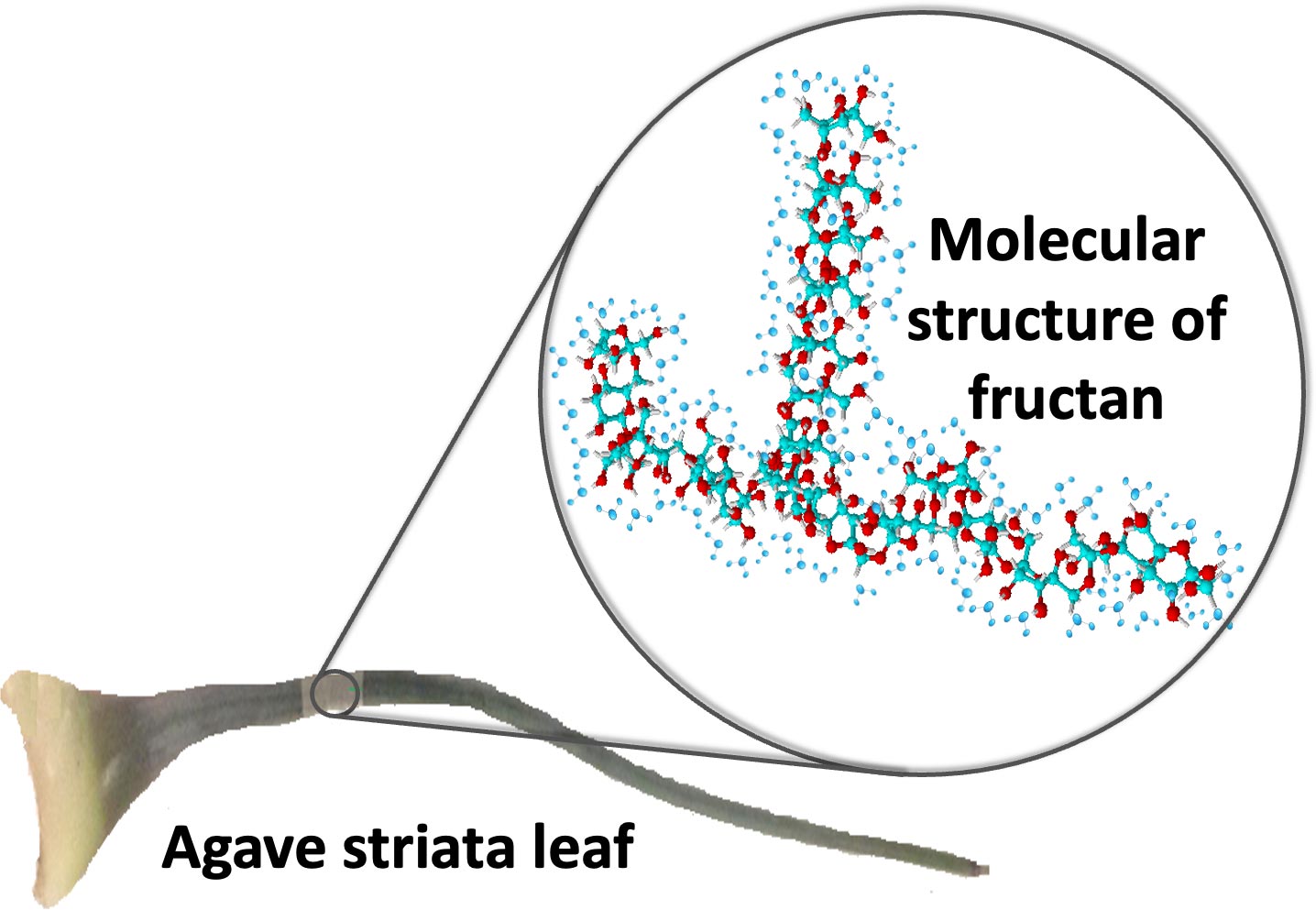
The analysis revealed that agave leaves have a specialized water storage system, where the leaf’s inner core remains highly hydrated while the outer layer acts as a protective barrier to reduce water loss. The researchers also found that fructans have an exceptional ability to attract and hold on to water molecules around them, far stronger than other sugars. This is because the branched chemical structure of fructans forms a kind of porous sponge on which water can be retained to keep the plant hydrated despite high temperatures.
The combination of tissue-level water storage and molecular-level water retention make agaves highly drought-resistant, enabling them to thrive in arid environments where water is scarce.
Expanding the Technology
Next, the researchers plan to expand the use of terahertz spectroscopy and imaging to study drought resistance in a wider range of plant species. They want to investigate how different plants manage water at both the tissue and molecular levels, particularly crops that are essential for global food security.
The researchers say that with further development, the setup, which is currently optimized for laboratory use, could be made into a portable and cost-effective terahertz system that could be used in fields or greenhouses for monitoring. Combining this with advanced machine learning algorithms to analyze terahertz images more efficiently could enable real-time detection of hydration patterns and drought stress indicators.
The researchers emphasize that achieving results with meaningful social and economic impact requires strong interdisciplinary collaboration, with close cooperation between experts in optics, plant physiology and food science being key in this study.
“By advancing non-invasive plant monitoring methods, our research lays the foundation for smarter, more sustainable agricultural practices, ultimately benefiting both farmers and consumers while helping to conserve natural resources for future generations,” said Castro-Camus.
Reference: “Terahertz spectroscopy and imaging as a tool to unlock physiological and molecular mechanisms for drought resistance of agaves” by Arely V. Perez-Lopez, June Simpson, Monica Ortiz-Martinez, Jose Antonio Morales-Hernandez, Socorro J. Villanueva-Rodriguez, Enrique Castro-Camus and Abhishek K. Singh, 5 March 2025, Applied Optics.
DOI: 10.1364/AO.547952
Never miss a breakthrough: Join the SciTechDaily newsletter.
Follow us on Google and Google News.