
The discovery opens a path to the sustainable synthesis of anti-inflammatory and anti-tumor agents.
Scientists at UBC Okanagan have revealed how plants create mitraphylline, a rare natural substance that shows potential for fighting cancer.
Mitraphylline is part of a small family of plant molecules known as spirooxindole alkaloids. These compounds are distinguished by their complex “twisted” ring structures and are recognized for powerful biological effects, including anti-tumor and anti-inflammatory activity.
Until recently, researchers did not know the precise molecular process plants use to form spirooxindoles. That mystery began to unravel in 2023 when Dr. Thu-Thuy Dang’s team in the Irving K. Barber Faculty of Science identified the first plant enzyme capable of twisting a molecule into the distinctive spiro shape.
Building on this discovery, doctoral student Tuan-Anh Nguyen led new research that pinpointed two enzymes: one that determines the molecule’s three-dimensional form and another that completes the final twist to produce mitraphylline.
“This is similar to finding the missing links in an assembly line,” says Dr. Dang, UBC Okanagan Principal’s Research Chair in Natural Products Biotechnology. “It answers a long-standing question about how nature builds these complex molecules and gives us a new way to replicate that process.”
A Roadmap for Sustainable Production
Natural compounds are often found in very small amounts in plants, making them difficult or costly to reproduce in the lab. Mitraphylline is one such example: it occurs only in trace amounts in tropical trees like Mitragyna (kratom) and Uncaria (cat’s claw), members of the coffee family.
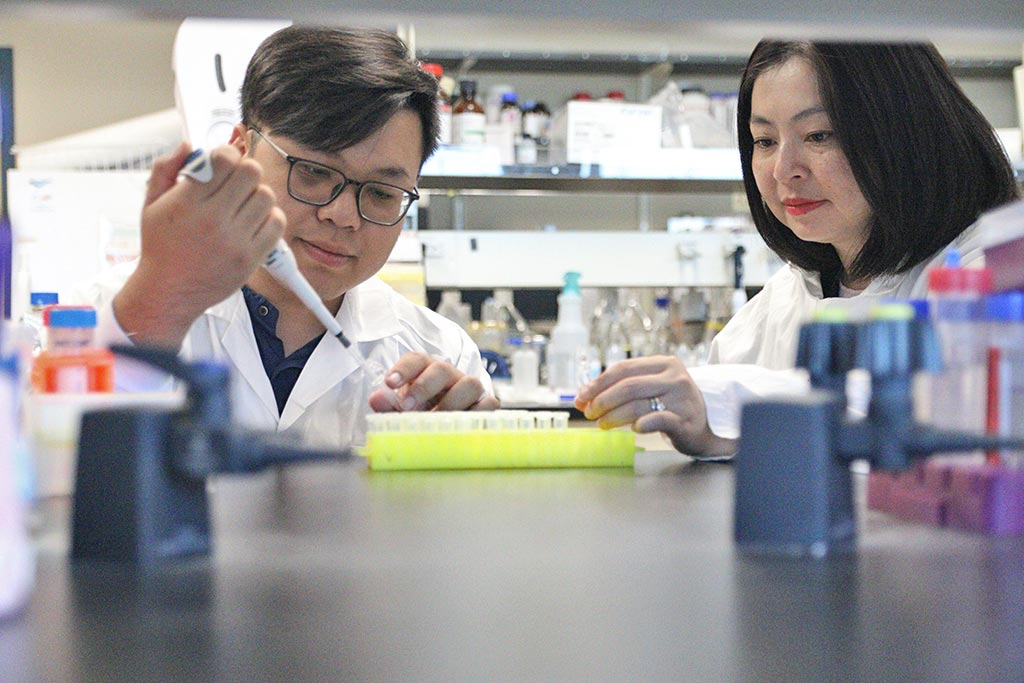
By identifying enzymes that build and shape mitraphylline, researchers now have a roadmap for producing it and related compounds in sustainable ways.
“With this discovery, we have a green chemistry approach to accessing compounds with enormous pharmaceutical value,” says Nguyen. “This is a result of UBC Okanagan’s research environment, where students and faculty work closely to solve problems with global reach.”
Collaboration and Future Directions
“Being part of the team that uncovered the enzymes behind spirooxindole compounds has been amazing,” Nguyen adds. “UBC Okanagan’s mentorship and support made this possible, and I’m excited to keep growing as a researcher here in Canada.”
The project is the result of collaboration between Dr. Dang’s lab at UBC Okanagan and Dr. Satya Nadakuduti’s team at the University of Florida.
“We are proud of this discovery coming from UBC Okanagan. Plants are fantastic natural chemists,” she says. “Our next steps will focus on adapting their molecular tools to create a wider range of therapeutic compounds.”
Reference: “A chromosome-level Mitragyna parvifolia genome unveils spirooxindole alkaloid diversification and mitraphylline biosynthesis” by Larissa C Laforest, Tuan-Anh M Nguyen, Gabriel Oliveira Matsumoto, Pavithra Ramachandria, Andre Chanderbali, Siva Rama Raju Kanumuri, Abhisheak Sharma, Christopher R McCurdy, Thu-Thuy T Dang and Satya Swathi Nadakuduti, 18 August 2025, The Plant Cell.
DOI: 10.1093/plcell/koaf207
The work was supported by Canada’s Natural Sciences and Engineering Research Council’s Alliance International Collaboration program, the Canada Foundation for Innovation, and the Michael Smith Health Research BC Scholar Program. Support also came from the United States Department of Agriculture’s National Institute of Food and Agriculture.
Never miss a breakthrough: Join the SciTechDaily newsletter.
Follow us on Google and Google News.
3 Comments
Say
Red Blood Cell Micromegaly
Various unexplored cancer treatments might include 1-Immune System Triggers. That is TINY exposures to poisonous substances, might train your immune system to eliminate your cancer. Many years ago, I saw a TV crime documentary, about a con artist who rubbed a Termenix glue/pesticide between his thumb and forefinger, and his brain tumor disappeared. There’s likely hundreds of such ISTs in nature and chemistry, that could stimulate an anti-cancer response, in TINY exposures, but they would be toxic in larger amounts. 2-cancer tumors blood vessels grow chaotically, so ‘cooking’ a cancer patients body in a bathtub of hot wax was once a method used to shrink big cancer tumors, or eliminate small ones, because the tumors irregular blood vessels couldn’t carry heat away. An alternative heat treatment, could be to give the patient a drug derived from loco weed, to raise their entire body’s temperature to dangerous levels, while packing ice packs around their heads. 3-a HONEY cure for cancer, might be to remove a cancer tumor from a cancer patient, freeze-dry into dust, mix the dust with honey, put it in a Contact capsule and have him eat it. That could tell his entire biosystems that the cancer cells in his body are good to eat! 4~an ELECTRIC cure for cancer tumors, might be to insert a long needle, that has most of its length coated with an electrically insulated material, into the core of the tumor, and Hotwire-ground it, and apply strong electric shocks all around the body area of the cancer tumor, which will all be grounded directionally into he tumor’s core and kill it. EOJ
Awesome news. Very i terested in both however anti inflammatory is key for a majority of us suffering from chronic inflammation due to disease in lymes etc