
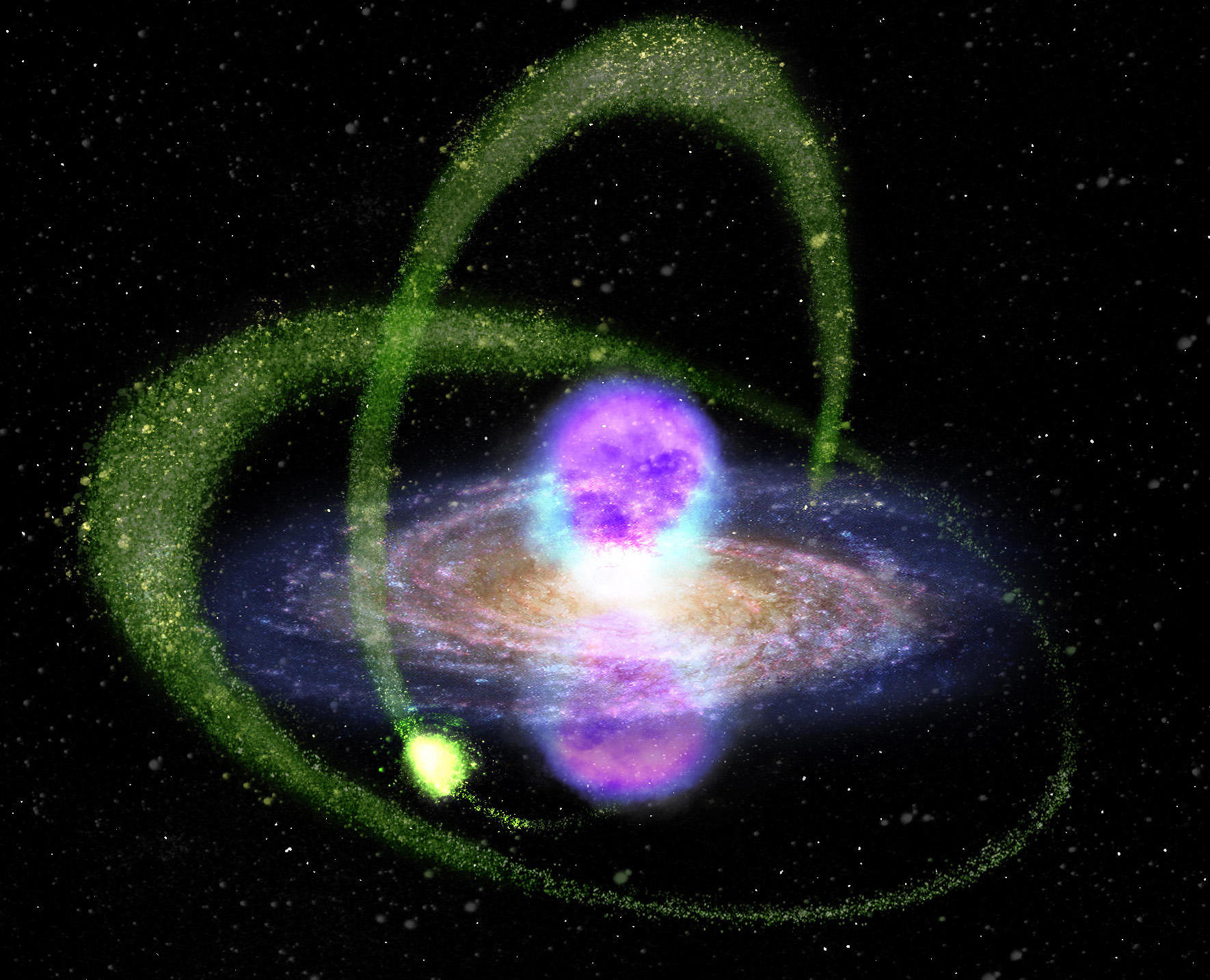
Researchers have used gamma rays to detect a small neighboring galaxy.
According to a new study recently published in the journal Nature Astronomy, an international team of researchers has discovered a small satellite galaxy of the Milky Way filled with dark matter, but its emissions are more likely the consequence of millisecond pulsars shooting out cosmic particles.
The center of our galaxy is blowing a pair of enormous gamma radiation bubbles spanning 50,000 light-years (magenta structures in the image above). This hourglass-shaped phenomenon was seen using the Fermi Gamma-ray Space Telescope roughly ten years ago, but its origin has remained a mystery.
These radiation lobes are known as Fermi bubbles, and they are patched with a few mysterious substructures of very bright gamma-ray emission. The Fermi cocoon, one of the brightest regions in the southern lobe (magnified inset in the image below), was once believed to be the result of previous outbursts from the galaxy’s supermassive black hole.
Origins of the Fermi Cocoon in the Sagittarius Dwarf Galaxy
An international team of researchers co-led by former Kavli Institute for the Physics and Mathematics of the Universe (Kavli IPMU) Project Researcher Oscar Macias (currently GRAPPA Fellow at the University of Amsterdam) and Australian National University Associate Professor Roland Crocker, and including Kavli IPMU Visiting Scientists Shunsaku Horiuchi and Shin’ichiro Ando, analyzed data from GAIA and Fermi space telescopes to reveal that the Fermi cocoon is actually due to emission from the Sagittarius dwarf galaxy.
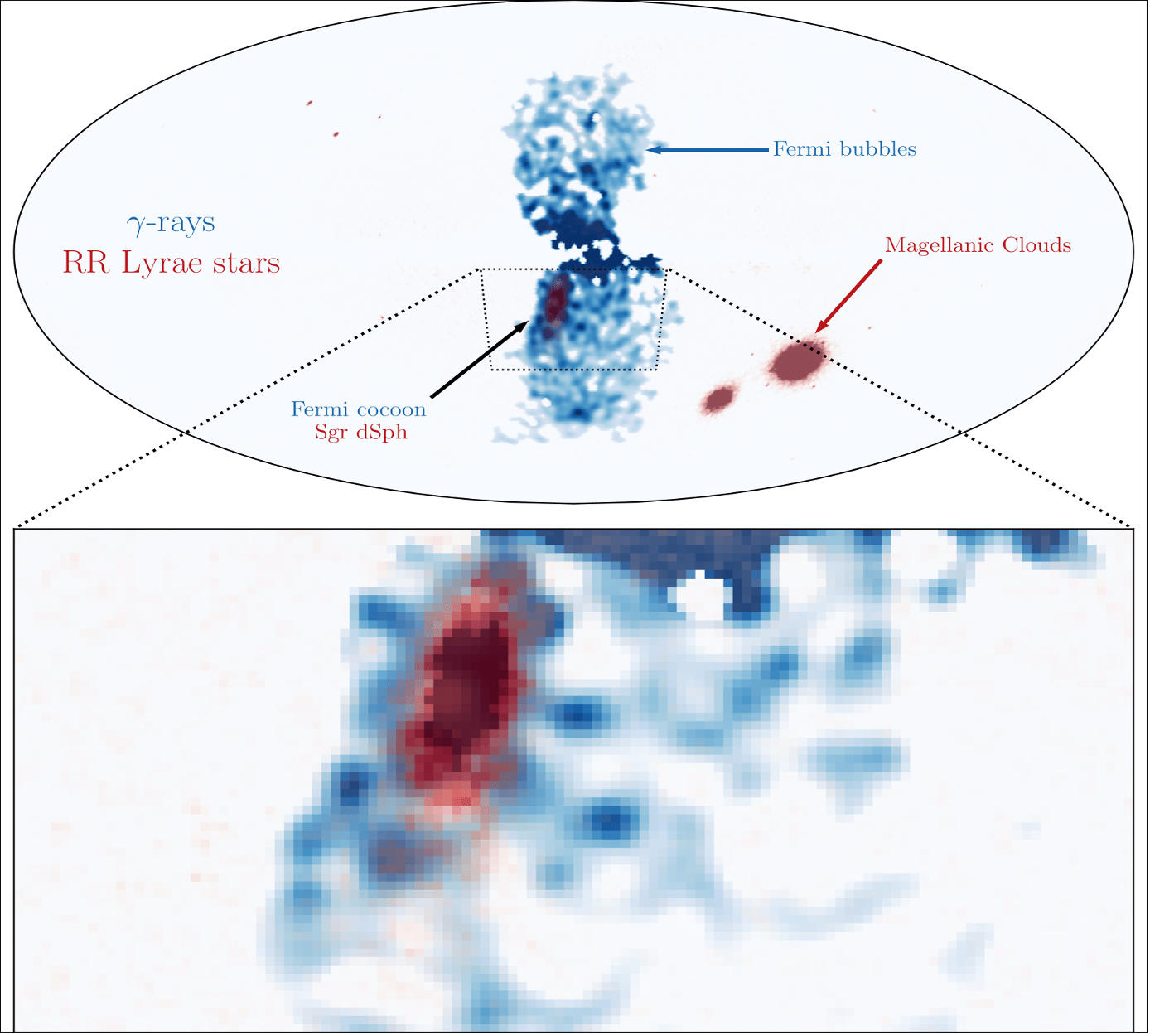
This satellite galaxy of the Milky Way is seen through the Fermi Bubbles from our position on Earth (image 1). Due to its tight orbit around our Galaxy and previous passages through the galactic disk, it has lost most of its interstellar gas and many of its stars have been ripped from its core into elongated streams.
Millisecond Pulsars Versus Dark Matter Annihilations
Given that Sagittarius was quiescent — with no gas and no stellar nurseries — there were only a few possibilities for its gamma-ray emission, including: i) a population of unknown millisecond pulsars or ii) dark matter annihilations.
Millisecond pulsars are remnants of certain types of stars, significantly more massive than the Sun, that are in close binary systems, but now blast out cosmic particles as a result of their extreme rotational energies. The electrons fired by millisecond pulsars collide with low-energy photons of the Cosmic Microwave Background propelling them to high-energy gamma radiation.
The researchers demonstrated that the gamma-ray cocoon could be explained by millisecond pulsars in the Sagittarius dwarf, therefore disfavoring the dark matter explanation.
Their discovery sheds light on millisecond pulsars as efficient accelerators of highly energetic electrons and positrons, and also suggests that similar physical processes could be ongoing in other dwarf satellite galaxies of the Milky Way.
“This is significant because dark matter researchers have long believed that an observation of gamma rays from a dwarf satellite would be a smoking gun signature for dark matter annihilation.”
“Our study compels a reassessment of the high energy emission capabilities of quiescent stellar objects, such as dwarf spheroidal galaxies, and their role as prime targets for dark matter annihilation searches,” said Macias.
Reference: “Gamma-ray emission from the Sagittarius dwarf spheroidal galaxy due to millisecond pulsars” by Roland M. Crocker, Oscar Macias, Dougal Mackey, Mark R. Krumholz, Shin’ichiro Ando, Shunsaku Horiuchi, Matthew G. Baring, Chris Gordon, Thomas Venville, Alan R. Duffy, Rui-Zhi Yang, Felix Aharonian, J. A. Hinton, Deheng Song, Ashley J. Ruiter and Miroslav D. Filipović, 5 September 2022, Nature Astronomy.
DOI: 10.1038/s41550-022-01777-x
Never miss a breakthrough: Join the SciTechDaily newsletter.
Follow us on Google and Google News.
5 Comments
I’m impressed with the new data we receiving from our new telescope !!!!! I am also impressed with the testing of ion powered space vehicle!!!! I’m am always excited to see all of your articles!!!!
… The title is misleading?.. (he asked). From what I read, it’s suspected the Sagittarius satellite galaxy *was* loaded with dark matter at one time, but its passage(s) through the plane of the Milky Way stripped this dark matter out which then allowed tidal disruption of the stars/”light” matter, elongating it…. From the articles and citations I’m finding? Please mark me if I’m wrong 🙂
Why would the headline say it was dark matter, when the story below states the dark matter hypothesis is now considered untrue? Did the headline writer not read the article, which was short, not likely to keep him/her awake for more than a few minutes? Or is dark matter a more sensationalistic and attention-grabbing description? Either way, this is poor science journalism.
The galaxy is still filled with dark matter. The study found that dark matter is not likely to be the cause of the emissions that the researchers detected, not that the dark matter isn’t there. “Sagittarius is stuffed with dark matter, this is unlikely to be the cause of the observed emission. ”
Topological vortex field is a gravitational field. When they are in the ground state, they do not interact with any other vortex, which means they do not absorb, reflect or emit electromagnetic radiation, and is therefore difficult to detect. The ground state topological vortex field has the characteristics of the dark matter gravitational effects.
Please see https://zhuanlan.zhihu.com/p/463666584.