
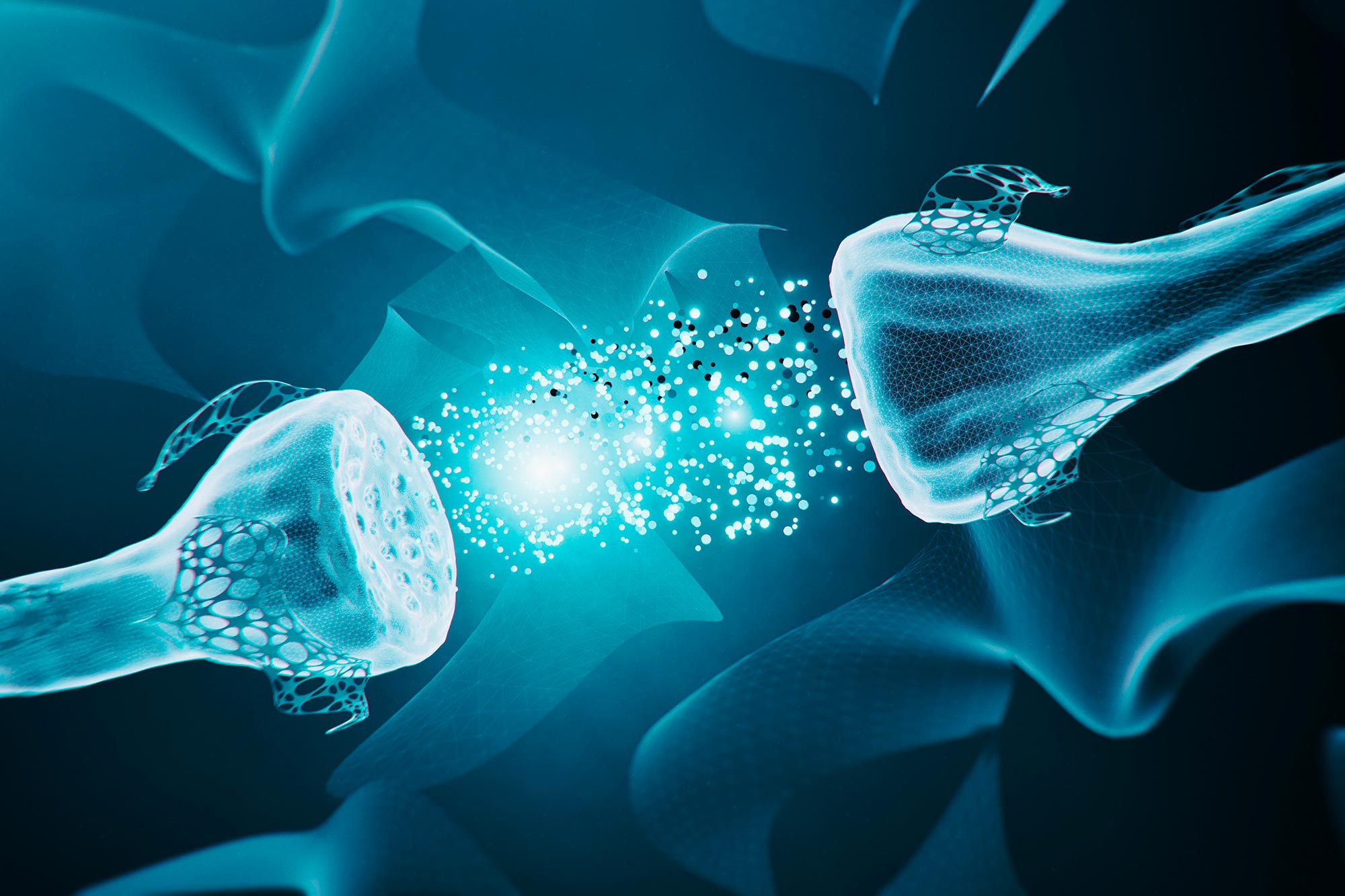
Advancements could enhance perceptual capabilities in robotics.
Artificially engineered biological processes, such as perception systems, remain a challenging target for organic electronics experts due to the dependence of human senses on an adaptive network of sensory neurons that communicate by firing in response to environmental stimuli.
A new collaboration between Northwestern University and Georgia Tech has advanced the field by developing a high-performance organic electrochemical neuron that operates within the frequency range of human neurons. They also created a complete perception system by designing additional organic materials and integrating their engineered neurons with artificial touch receptors and synapses, enabling real-time tactile signal sensing and processing.
The research, described in a paper recently published in the journal Proceedings of the National Academy of Sciences (PNAS), could move the needle on intelligent robots and other systems currently stymied by sensing systems that are less powerful than those of a human.
Advancements in Organic Electronics
“The study highlights significant progress in organic electronics and their application in bridging the gap between biology and technology,” said first author Yao Yao, a Northwestern engineering professor. “We created an efficient artificial neuron with a reduced footprint and outstanding neuronal characteristics. Leveraging this capability, we developed a complete tactile neuromorphic perception system to mimic real biological processes.”
According to corresponding author Tobin J. Marks, Northwestern’s Charles E. and Emma H. Morrison Professor of Chemistry in the Weinberg College of Arts and Sciences, existing artificial neural circuits tend to fire within a narrow frequency range.
“The synthetic neuron in this study achieves unprecedented performance in firing frequency modulation, offering a range 50 times broader than existing organic electrochemical neural circuits,” Marks said. “In contrast, our device’s outstanding neuronal characteristics establish it as an advanced achievement in organic electrochemical neurons.”
Key Contributors to the Research
Marks is a world leader in the fields of organometallic chemistry, chemical catalysis, materials science, organic electronics, photovoltaics, and nanotechnology. He is also a professor of Materials Science and Engineering and Professor of Chemical and Biological Engineering in Northwestern’s McCormick School of Engineering and as Professor of Applied Physics. His co-corresponding author Antonio Facchetti, a professor at Georgia Tech’s School of Materials Science and Engineering, also serves as an adjunct professor of chemistry at Northwestern.
“This study presents the first complete neuromorphic tactile perception system based on artificial neurons, which integrates artificial tactile receptors and artificial synapses,” said Facchetti. “It demonstrates the ability to encode tactile stimuli into spiking neuronal signals in real-time and further translate them into post-synaptic responses.”
The team spanned departments and schools, with researchers who specialized in organic synthesis creating advanced materials that electronic device researchers then incorporated into circuit design and fabrication, and system integration.
With the human brain’s immense network of 86 billion neurons poised to fire, sensing systems remain difficult to recreate. Scientists are limited by both the footprint of the design and by the amount they can create. In future models, the team hopes to further reduce the device’s size, taking the project a step closer to fully mimicking human sensing systems.
Reference: “An organic electrochemical neuron for a neuromorphic perception system” by Yao Yao, Robert M. Pankow, Wei Huang, Cui Wu, Lin Gao, Yongjoon Cho, Jianhua Chen, Dayong Zhang, Sakshi Sharma, Xiaoxue Liu, Yuyang Wang, Bo Peng, Sein Chung, Kilwon Cho, Simone Fabiano, Zunzhong Ye, Jianfeng Ping, Tobin J. Marks and Antonio Facchetti, 8 January 2025, Proceedings of the National Academy of Sciences.
DOI: 10.1073/pnas.2414879122
This work was supported by the Air Force Office of Scientific Research (FA9550-22-1-0423), the Northwestern University Materials Research Science and Engineering Center (MRSEC; award from National Science Foundation DMR-230869), Flexterra Corporation, the National Science Fund for Distinguished Young Scholars of China (No. 32425040) and the National Natural Science Foundation of China (Grant No. 32201648).
Never miss a breakthrough: Join the SciTechDaily newsletter.
Follow us on Google and Google News.
1 Comment
Another piece of science on the step to a world dysfunctional to humans. We aren’t H sap for nothing; it took 6 million years to evolve into stupidity.